
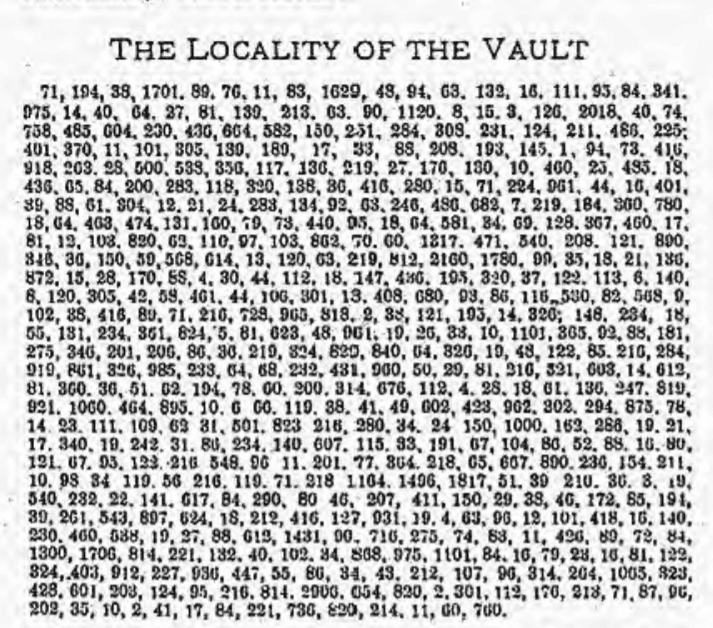
The Beale Ciphers represent one of America’s most tantalizing unsolved mysteries. These three encrypted messages allegedly reveal the location of a massive treasure worth over $60 million in today’s currency. Hidden somewhere in Bedford County, Virginia, this cache of gold, silver, and jewels has driven countless treasure hunters to obsession and ruin. Only one cipher has been decoded in nearly 140 years. The other two guard their secrets with supernatural stubbornness.
The story begins in 1885 with a mysterious pamphlet called “The Beale Papers.” According to this document, a gentleman adventurer named Thomas J. Beale discovered a rich mine in the early 1800s. He and thirty companions spent eighteen months extracting thousands of pounds of precious metals from the earth. Beale then transported this fortune to Virginia and buried it in a secret location. Before vanishing forever, he created three ciphers describing the treasure’s location, contents, and rightful owners.
The Beale Ciphers and Their Cryptic Origins
Thomas Beale entrusted his encrypted secrets to Robert Morriss, a Lynchburg innkeeper, in 1822. Beale instructed Morriss to open the iron box only if he failed to return within ten years. A promised key to decode the messages never arrived. Morriss waited twenty-three years before breaking the seal. Inside, he found the three ciphers and two letters explaining their purpose.
The innkeeper spent decades trying to crack the codes. Eventually, he passed them to an unnamed friend who dedicated twenty years of his life to the puzzle. This mysterious cryptanalyst managed to solve only the second cipher. It revealed staggering details about the buried treasure: 2,921 pounds of gold, 5,100 pounds of silver, and jewels worth $13,000 in 1820s currency.
The decoded message painted a picture of unimaginable wealth. Yet it provided only general location information. The first cipher, containing precise burial coordinates, remained locked. The third cipher, listing the treasure’s rightful heirs, also defied all attempts at decryption. Frustrated and financially ruined by his obsession, the anonymous solver published all three ciphers in 1885, hoping others might succeed where he had failed.
Strange Patterns in the Beale Ciphers Revealed
Another fascinating historical case is: Lead Masks Case: Brazil’s Most Baffling Unsolved Death Mystery
Modern computer analysis has revealed disturbing anomalies within the unsolved ciphers. Dr. Carl Hammer of Sperry-Univac made a startling discovery in 1970. His UNIVAC 1108 computer compared the codes to random number patterns. The results were chilling: “Beale Cyphers 1 and 3 are ‘for real,'” Hammer concluded. “They contain intelligence and messages of some sort.”
The statistical evidence grows more unsettling under scrutiny. When researchers use the Declaration of Independence as a key for the first cipher, alphabetical sequences emerge: “abcdefghiijklmmnohpp” and others. The American Cryptogram Association calculated the odds of such patterns appearing by chance. The probability? Less than one in a hundred million million.
Even stranger, the frequency of last digits in cipher numbers shows non-random distribution. This mathematical signature suggests an intelligent design behind the codes. Historical newspaper accounts from the 1970s document how these discoveries sent shockwaves through the cryptographic community. Professional codebreakers who had dismissed the ciphers as hoaxes suddenly took notice.
Obsession and Ruin: The Beale Ciphers’ Dark Legacy
The unsolved Beale Ciphers have claimed more victims than any pirate’s curse. Families have crumbled under the weight of treasure fever. Bank accounts have evaporated. Lives have been consumed by an impossible dream. Peter Viemeister, author of “The Beale Treasure: A History of a Mystery,” warned: “Once you get the Beale treasure in your system, it’s hard to get it out. You could get possessed by it.”
Stan Czanowski spent $70,000 over seven years on dynamite and bulldozers. Another hunter bankrupted himself blasting rocks for six months in the early 1980s. The anonymous 19th-century solver who first cracked cipher two described his compulsion to “neglect family, friends, and all legitimate pursuits for what has proved, so far, the veriest illusion.”
Local residents in Bedford County have suffered too. By 1972, landowners were firing warning shots at night trespassers. “People would sneak onto their land and blow big holes out of the ground and leave them that way,” one resident complained. “Cows would step in and break their legs.” The treasure’s phantom presence has scarred the landscape with countless abandoned excavations.
Modern Theories and Continuing Mystery
Skeptics argue the entire story represents an elaborate hoax. Cryptographer Jim Gillogly published “A Dissenting Opinion” in 1980, challenging the ciphers’ authenticity. Scholar Joe Nickell’s 1982 analysis found historical anachronisms in the original pamphlet. Words like “stampeding” didn’t exist in Beale’s supposed era. Nickell concluded that James B. Ward, the pamphlet’s publisher, likely created the entire mystery as Masonic allegory.
Recent investigators have proposed even stranger theories. Some claim the ciphers contain messages from the Knights of the Golden Circle, a Civil War-era secret society. Others suggest connections to famous land fraudster James Reavis and financier J.P. Morgan. These theories paint the Beale treasure as part of vast 19th-century conspiracies involving mining rights and financial manipulation.
Despite decades of computer analysis and professional cryptographic attention, the two remaining ciphers guard their secrets. Modern treasure hunters continue claiming breakthroughs, but none have produced verifiable results. The codes seem to mock human intelligence with their stubborn silence.
The Beale Ciphers endure as America’s greatest cryptographic mystery. Whether genuine treasure map or elaborate fiction, they’ve captured imaginations for nearly 140 years. The promise of $60 million in buried gold continues drawing new victims into their web. Perhaps that’s the real treasure – not gold and silver, but the eternal human hunger for mystery and the impossible dream of easy riches. The ciphers remain unsolved, their secrets intact, waiting for someone clever or lucky enough to break their ancient spell.
Related Posts
 Uvb-76: The Mysterious Russian Radio Station That Never Stops Broadcasting
 Biblical Conspiracy Theory: The Hidden Truth About Sacred Texts and Secret Societies
 Mysterious Drone Incursions at Belgian Military Bases and Nuclear Facilities: Silent Watchers in the Night
 Why Are Warm-water Ports Important to Russia: The Cursed Quest That Haunts Moscow’s Naval Dreams