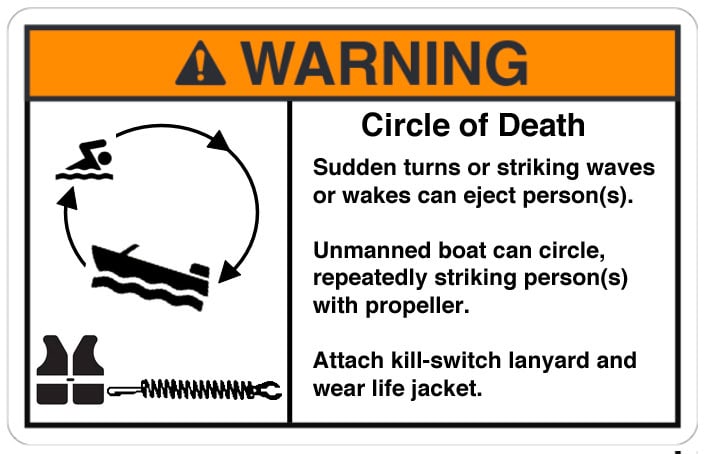
The Circle of Death (boating) represents one of the most horrifying maritime phenomena that can transform a peaceful day on the water into a nightmare of mechanical terror. This deadly occurrence happens when a motorboat becomes an unmanned predator, spinning endlessly in tight circles while its razor-sharp propeller seeks human prey. Unlike other boating accidents that strike once and end, this phenomenon creates a prolonged horror where victims find themselves trapped in the water, watching helplessly as tons of spinning metal hunt them in relentless circles.
The physics behind this maritime terror are as simple as they are deadly. When a boat operator loses control or is thrown overboard while the engine remains running, the vessel doesn’t simply drift away to safety. Instead, the rotating propeller creates what engineers call “steering torque” – a force that causes the outboard motor to twist sharply in its mounting. This mechanical betrayal transforms the boat from a tool of recreation into an instrument of potential death, cutting sharp turns that can eject anyone still aboard into the very waters the boat now patrols.
The Mechanical Beast: How the Circle of Death Claims Its Victims
The transformation from peaceful vessel to deadly hunter happens in seconds. As the propeller spins beneath the surface, its angled blades don’t just push water backward – they create a twisting force that acts like an invisible hand, wrenching the motor to one side. The boat responds by cutting sharply in the opposite direction, often at full throttle. Anyone standing or sitting unprepared gets hurled into the water with violent force.
What happens next defies the natural order of rescue scenarios. Instead of the boat speeding away from its victims, it begins its deadly dance. The Circle of Death (boating) locks the vessel into a tight spiral, typically 30 to 50 feet in diameter. The boat maintains its speed, sometimes reaching 25 mph or more, creating a whirlpool of mechanical death. Victims in the water watch in horror as their former sanctuary becomes a circling shark, its propeller cutting through the water mere feet from their heads.
The psychological terror compounds the physical danger. Survivors describe the helpless feeling of treading water while calculating the boat’s next pass. Some attempt to swim toward the center of the circle, hoping the boat’s turning radius will keep them safe. Others try to escape the perimeter entirely, racing against time and their own exhaustion. The propeller strike injuries that result from these encounters often prove fatal or permanently disabling.
True Tales of Circle of Death Survival and Tragedy
For more strange history, see: Piltdown Man: The 41-Year Hoax That Fooled the Scientific World
Court records and accident reports reveal chilling accounts of Circle of Death encounters. In one documented case, a family fishing trip turned into a nightmare when the boat operator stood to net a fish and lost his balance. The sudden shift in weight caused him to fall backward, releasing the steering wheel as he tumbled overboard. His wife and two children watched from the water as their 18-foot bass boat began its deadly spiral around them.
The children, ages 8 and 12, had been taught basic water safety but nothing had prepared them for this scenario. The mother later testified that the sound of the engine grew louder and softer in a rhythmic pattern as the boat completed each circle. She described the terror of calculating whether they could dive deep enough to avoid the propeller, knowing that children might not have the lung capacity for such desperate measures.
Another incident involved a solo fisherman whose boat entered the Circle of Death after he reached over the side to retrieve a lure. The boat circled for over twenty minutes before running out of fuel. Coast Guard rescuers found the exhausted man floating in the center of the circle, suffering from hypothermia and severe psychological trauma. He reported that he had counted 47 complete rotations, each one bringing the propeller within arm’s reach of his body.
The Deadly Physics Behind Boating’s Most Feared Phenomenon
Marine engineers have studied the Circle of Death (boating) extensively, seeking to understand why some boats enter tighter, more dangerous spirals than others. The phenomenon depends on several factors: the boat’s design, the propeller’s rotation direction, and the engine’s mounting system. Outboard motors, which can swivel freely on their mounts, are particularly susceptible to this behavior.
The propeller itself acts like a massive gyroscope, creating forces that seem to give the boat a mind of its own. As the blades slice through water at hundreds of revolutions per minute, they generate not just forward thrust but also a sideways component that tries to “walk” the motor in one direction. When no human hand restrains the steering, this mechanical force takes complete control.
Different boat designs create different circle patterns. Flat-bottomed boats tend to create wider, faster circles. Deep-V hulls often produce tighter spirals that move more slowly but prove equally deadly. The water conditions also play a role – choppy seas can sometimes break the circle pattern, while calm water allows for perfect, uninterrupted rotations that can continue until the fuel runs out.
Modern Prevention and the Fight Against Maritime Terror
The boating industry has responded to Circle of Death incidents with increasingly sophisticated safety systems. Kill switches, also called engine cut-off switches, represent the primary defense against this phenomenon. These devices attach to the operator with a lanyard, automatically shutting down the engine if the person moves too far from the controls or falls overboard.
However, kill switches only work when properly used. Many boaters find the lanyards inconvenient or forget to attach them during the excitement of fishing or water sports. Some experienced operators develop a false sense of security, believing their skill will prevent accidents. This overconfidence has contributed to numerous Circle of Death incidents, even on boats equipped with the latest safety technology.
The Minnesota Department of Natural Resources has documented the Circle of Death as one of the most preventable yet persistent causes of boating fatalities. Their research shows that proper kill switch usage could eliminate virtually all such incidents, yet compliance remains frustratingly low among recreational boaters.
Training programs now include Circle of Death scenarios, teaching boaters to recognize the early signs and take immediate action. The key lies in understanding that once the circle begins, human intervention becomes nearly impossible. Prevention remains the only reliable protection against this mechanical predator that can transform any peaceful day on the water into a fight for survival against an unmanned vessel that seems determined to claim its victims.
The Circle of Death (boating) continues to claim lives and traumatize survivors, serving as a stark reminder that even our most familiar tools can become instruments of terror when the delicate balance between human control and mechanical power shifts in favor of the machine. Each incident reinforces the critical importance of maintaining constant vigilance on the water, where a moment’s inattention can unleash forces that transform boats from vessels of pleasure into circling instruments of death.