
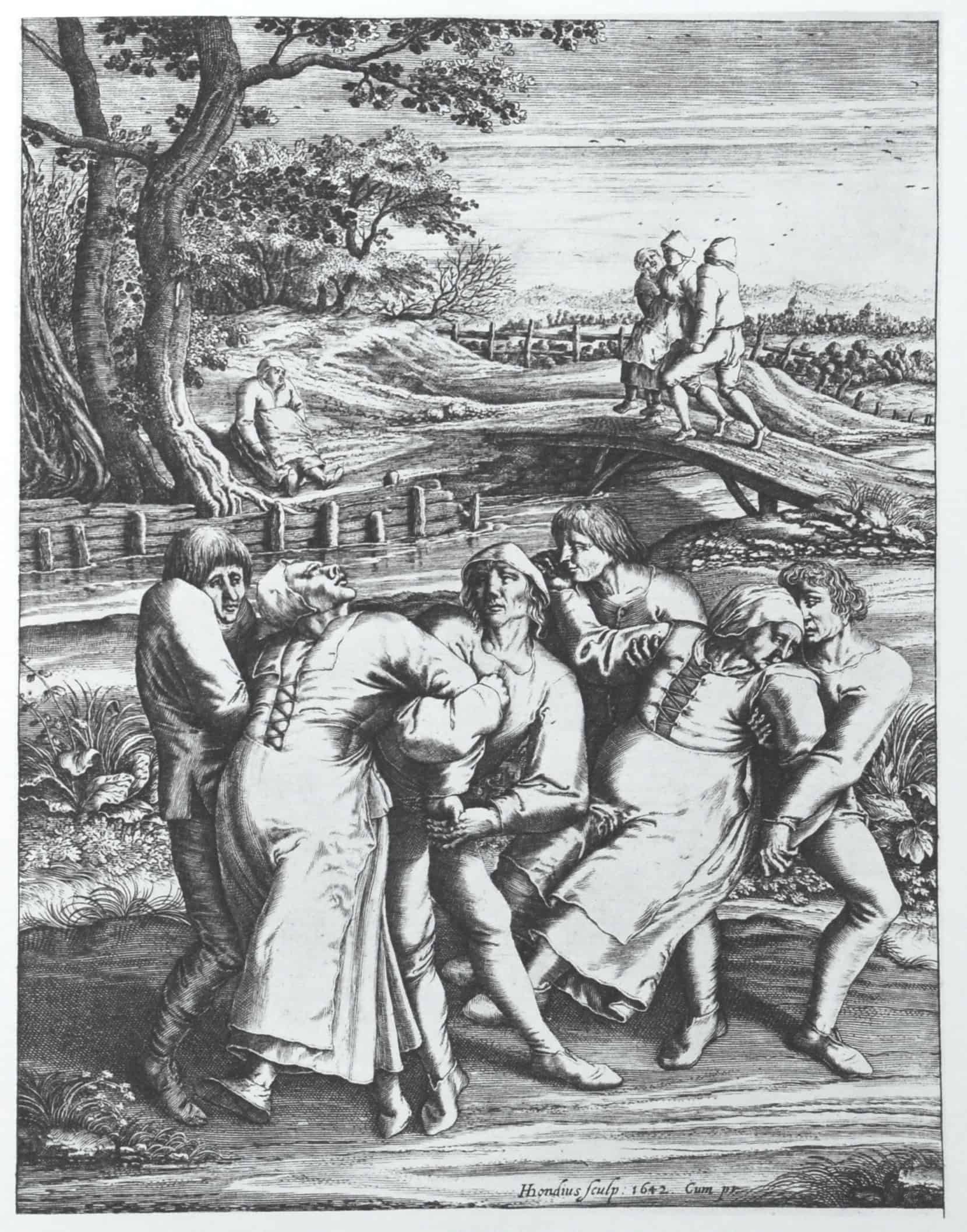
The Dancing Plague of 1518 remains one of history’s most bizarre and terrifying mass hysteria events. In the summer of 1518, the streets of Strasbourg became a stage for an inexplicable nightmare. Hundreds of people began dancing frantically and couldn’t stop. They danced until their feet bled. They danced until they collapsed from exhaustion. Some even danced themselves to death.
What started as one woman’s strange behavior on a cobblestone street would spread like wildfire through the medieval city. The afflicted moved with wild, spasmatic motions. Their eyes became vacant and glassy. Blood pooled in their swollen feet and seeped into their shoes. The dancing continued for weeks, defying all attempts to understand or stop it.
The Dancing Plague of 1518 Begins with Frau Troffea’s Mysterious Compulsion
On July 14, 1518, a woman known as Frau Troffea stepped onto a narrow cobblestone street outside her half-timbered home. Without warning or music, she began to dance. Her movements were frenzied and uncontrollable. She couldn’t stop, even when exhaustion set in.
Troffea’s daughter, Fräulein Emma Götz, soon joined her mother in the bizarre dance. The two women continued their relentless movement for an entire week. Witnesses gathered to stare at the spectacle. Some began to mimic the dancers’ movements.
Within days, more than thirty people had joined the dancing mania. Their bodies convulsed spasmodically. Their arms thrashed violently through the air. Sweat drenched their ragged clothes as they moved without rest. The dancing mania spread like a contagion through Strasbourg’s population.
The dancers’ physical condition deteriorated rapidly. Blood began seeping from their swollen feet into leather boots and wooden clogs. Their faces became pinched and gaunt. Yet they couldn’t stop dancing, as if possessed by an invisible force.
Authorities Struggle to Contain the Dancing Plague of 1518 Outbreak
Related article: Street fighting Throughout History: From Ancient Combat to Modern Urban Violence
By August 1518, the dancing epidemic had claimed 400 victims. The Strasbourg city council watched in horror as more citizens joined the frenzied dance. They had never witnessed anything like this supernatural phenomenon.
Initially, physicians advised the afflicted to “dance themselves free of it.” The council opened guild halls to accommodate the dancers. They hired musicians to provide accompaniment. Strong men were employed to help keep the exhausted dancers upright.
This approach backfired spectacularly. The music and encouragement only attracted more participants. Citizens began dancing in fear that the plague was divine punishment from Saint Vitus. They believed joining the dance would free them from sin.
The council quickly reversed course and banned public dancing entirely. They also prohibited music throughout the city. The authorities recognized that their well-intentioned efforts had only fueled the mysterious contagion.
Desperation led officials to seek spiritual intervention. They ordered the dancers to visit Saint Vitus’s shrine. The afflicted wore special red shoes sprinkled with holy water. Painted crosses adorned the tops and soles of their footwear.
Death Stalks the Streets During the Dancing Plague Peak
As the dancing plague reached its horrifying climax, deaths began mounting. Witnesses reported up to fifteen fatalities per day during the outbreak’s peak. The dancers succumbed to heart attacks, strokes, and complete exhaustion.
Those who didn’t die from cardiac events collapsed from hunger and thirst. Their bodies simply couldn’t sustain the relentless movement any longer. Cries for help echoed through Strasbourg’s streets as victims begged for relief from their compulsion.
The physical toll was gruesome to witness. Dancers’ eyes became completely vacant and expressionless. Their movements grew increasingly erratic and violent. Blood stained the cobblestones where their wounded feet had touched the ground.
Contemporary chronicles documented the horror in vivid detail. Physician notes, cathedral sermons, and city council records all confirmed the dancing continued without pause. The historical accounts paint a picture of medieval Strasbourg gripped by supernatural terror.
Modern controversy surrounds the actual death toll. Some historians question whether people truly danced themselves to death. Contemporary Strasbourg records don’t explicitly mention fatalities. However, later accounts consistently reference deaths during the outbreak’s peak.
Theories and Explanations for the Mysterious Epidemic
The Dancing Plague of 1518 has puzzled historians and scientists for centuries. Multiple theories attempt to explain this bizarre mass hysteria event. None provide a completely satisfactory answer to the mystery.
Mass psychogenic illness represents the most widely accepted explanation today. Historian John Waller argues that extreme stress created perfect conditions for the outbreak. Strasbourg was experiencing crop failures, famine, and disease epidemics in 1518.
The population was physically weakened and emotionally strained. These conditions made citizens highly suggestible to psychological contagion. When Frau Troffea began dancing, others unconsciously mimicked her behavior.
Ergot poisoning once seemed like a plausible cause. This fungus grows on rye and can cause hallucinations and convulsions. However, ergot restricts blood flow to extremities. This would make coordinated dancing for days physically impossible.
Religious beliefs may have amplified the psychological effects. Medieval citizens accepted that divine curses or demonic possession could compel dancing. This cultural framework made the dancing plague seem believable and terrifying.
The outbreak finally ended in September 1518. Remaining dancers were taken to a mountaintop shrine to pray for absolution. Word spread that Saint Vitus had forgiven the sinners. The psychological spell was broken at last.
The Dancing Plague of 1518 continues to fascinate modern audiences. Recent cultural works have drawn inspiration from this medieval mystery. The event serves as a chilling reminder of how psychological contagion can spread through stressed communities. Even today, we struggle to fully understand what drove hundreds of people to dance themselves toward death in the streets of Strasbourg.