
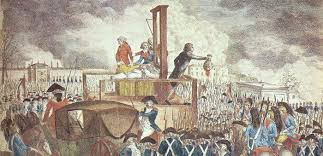
The French Guillotine Blinking Experiment represents one of history’s most disturbing scientific inquiries. During the French Revolution’s bloodiest years, doctors and scientists became obsessed with a terrifying question: did consciousness survive the blade’s swift cut? As heads rolled into baskets beneath the guillotine, witnesses claimed to see eyes blinking, mouths moving, and faces contorting with apparent awareness. These macabre observations sparked a series of ghoulish experiments that would haunt medical history for centuries.
The guillotine’s invention promised a humane death. Dr. Joseph-Ignace Guillotin believed his machine would deliver instant, painless execution. But disturbing reports soon emerged from execution grounds across France. Spectators swore they saw severed heads responding to their names. Some claimed to witness expressions of rage or recognition flickering across lifeless faces. These eerie accounts prompted scientists to investigate whether death truly came as swiftly as promised.
The Charlotte Corday French Guillotine Blinking Experiment Incident
Charlotte Corday’s execution on July 17, 1793, produced the most famous early account of post-decapitation consciousness. After the blade fell, a carpenter named Legros grabbed Corday’s severed head and slapped it across the face. Witnesses gasped as the head allegedly blushed deep red and showed “unequivocal marks of indignation.” The crowd watched in horror as Corday’s eyes seemed to focus on her attacker with unmistakable fury.
Executioner Charles-Henri Sanson later wrote in his diary that Legros had been hired to repair the guillotine. The carpenter’s shocking act wasn’t planned as an experiment. Yet the apparent response sent shockwaves through Revolutionary France. How could a severed head blush without blood circulation? Medical experts struggled to explain the phenomenon. Some dismissed it as muscle spasms or crowd hysteria. Others insisted they’d witnessed proof of surviving consciousness.
The incident sparked fierce debate among physicians and philosophers. Charlotte Corday’s execution became a touchstone for those investigating the mysteries of death and consciousness.
Dr. Beaurieux’s Controversial French Guillotine Blinking Experiment
For more strange history, see: January 2026 Solar Storm: The Celestial Event That Defied Scientific Predictions
The most systematic French Guillotine Blinking Experiment occurred on June 28, 1905. Dr. Gabriel Beaurieux obtained special permission to attend the execution of Henri Languille, a convicted murderer. At 5:30 a.m., as dawn broke over the prison courtyard, Beaurieux positioned himself near the guillotine with stopwatch in hand. He planned to test whether severed heads retained consciousness.
When the blade fell, Beaurieux immediately called Languille’s name. According to his published account, the severed head’s eyelids lifted and eyes focused directly on him. The doctor called again. Once more, the eyes opened and appeared to track his movement. Beaurieux claimed this response occurred twice, with each instance lasting several seconds. He documented the head’s apparent awareness for nearly thirty seconds after decapitation.
Modern researchers question whether this experiment actually happened as described. Contemporary newspaper coverage makes no mention of Beaurieux’s presence. A widely circulated photograph supposedly showing the condemned man appears to be a crude fake. Yet Beaurieux’s account became legendary among those studying consciousness and death.
The Lavoisier French Guillotine Blinking Experiment Legend
Perhaps the most famous story involves Antoine Lavoisier, the brilliant chemist executed during the Terror. Legend claims Lavoisier arranged with mathematician Joseph-Louis Lagrange to blink as long as possible after his beheading. According to the tale, Lavoisier’s severed head blinked fifteen to twenty times at one-second intervals. This would suggest consciousness persisted for nearly half a minute.
Recent academic research has thoroughly debunked this story. The Journal of Chemical Education confirms that no reputable Lavoisier biography mentions any postmortem experiment. On May 8, 1794, Lavoisier was hastily executed alongside other tax collectors. Their heads fell into a common sack, and bodies were dumped in an unmarked mass grave. No opportunity existed for careful observation or scientific experimentation.
The Lavoisier legend likely emerged decades later as scientists grappled with questions about consciousness and death. Historical newspaper accounts from the period make no mention of blinking experiments. The story became popular precisely because it seemed to validate scientific curiosity about life’s final moments.
Modern Science and the Persistence of Mystery
Contemporary neuroscience offers clearer answers about consciousness after decapitation. Brain activity ceases within ten to thirty seconds when oxygenated blood flow stops. Any apparent responses likely result from muscle spasms rather than conscious awareness. The human brain requires constant oxygen to maintain consciousness. Without circulation, awareness fades rapidly.
Yet mysteries remain. A 2008 study found decapitated eels showed signs of life for up to eight hours. Animal research suggests some species tolerate oxygen deprivation better than others. These findings complicate simple explanations about immediate death. Modern consciousness science continues exploring the boundaries between life and death.
The French Academy of Medicine reported in 1956 that guillotine death “is not immediate.” This contradicted earlier medical opinions about instantaneous death. For every account of consciousness in severed heads, conflicting reports describe no retained awareness. Current evidence remains limited and often contradictory.
The French Guillotine Blinking Experiment legacy persists in modern debates about consciousness, death, and human awareness. While science has largely debunked claims of prolonged consciousness after decapitation, these historical accounts continue to fascinate researchers studying the final moments of life. The macabre experiments of Revolutionary France remind us that humanity’s darkest chapters often produce our most profound questions about existence itself.
Related Posts
 The Adventure of the German Student: Washington Irving’s Chilling Tale of Revolutionary Terror and Supernatural Horror
 French Destroyer Framée: The Doomed Warship That Vanished in Minutes
 The Voracious Appetite of Tarrare: A 18th-Century French Enigma
 Piltdown Man: The 41-Year Hoax That Fooled the Scientific World