
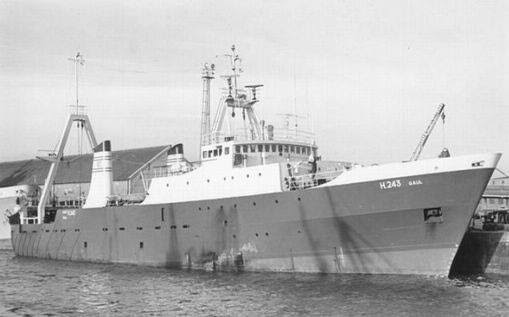
The Fv Gaul vanished into the icy darkness of the Barents Sea on February 8, 1974, taking all 36 crew members with her. This modern factory ship simply disappeared without sending a single distress signal. One moment she was reporting her position to company headquarters. The next, she was gone.
The loss shocked Britain’s fishing industry. Here was their most advanced trawler, barely 18 months old, equipped with the latest safety gear. She shouldn’t have vanished so completely. Yet the Arctic waters had swallowed her whole, leaving behind only questions and grief.
What happened during those final hours remains one of the sea’s darkest mysteries. The official explanation never satisfied the families left behind. They knew something wasn’t right about this tragedy.
The Fv Gaul’s Final Voyage Into Arctic Darkness
The Fv Gaul departed Hull on January 22, 1974, bound for the rich fishing grounds off Norway’s coast. Captain Gerald Wood commanded a crew of experienced fishermen. They expected to return home with full holds after several weeks at sea.
Everything seemed routine at first. The ship made scheduled radio contacts with British United Trawlers headquarters. She reported her catches and weather conditions like clockwork. But the Arctic had other plans.
On February 8, violent storms lashed the Barents Sea. Waves towered 30 feet high. Winds screamed at gale force. The Gaul’s final radio message came at 10:30 AM, reporting she was “laid and dodging” off North Cape Bank – fishing terminology meaning she was riding out the storm.
That transmission would be her last. When the scheduled 4:30 PM report never came, concern began to grow. By February 10, British United Trawlers knew something was terribly wrong.
The Mysterious Disappearance of Fv Gaul
This event shares similarities with: USS Craven (TB-10): The Cursed Torpedo Boat That Met a Fiery End
The search for the missing trawler became one of the largest maritime rescue operations in Arctic waters. HMS Hermes, a British aircraft carrier, coordinated the effort. Four British ships, three Norwegian vessels, and 19 fishing trawlers scoured the storm-tossed seas.
They found nothing. No wreckage. No oil slicks. No bodies. The Fv Gaul had vanished as completely as if she’d never existed. Only a single life ring, discovered three months later, offered any trace of the doomed vessel.
The families couldn’t accept such a complete disappearance. Modern ships don’t just vanish, they argued. Something more sinister must have happened. Whispers began spreading through Hull’s fishing community about Cold War secrets and Soviet submarines.
The official investigation concluded that massive waves had overwhelmed the trawler. But this explanation felt hollow to those who knew the sea. Experienced fishermen questioned how such a modern vessel could sink so quickly without any distress signal.
Cold War Conspiracy Theories Surrounding the Fv Gaul
Strange theories emerged in the years following the disaster. Some claimed the Fv Gaul had been captured by Soviet forces while conducting espionage missions. Others suggested a Russian submarine had deliberately sunk her to protect military secrets.
These weren’t entirely far-fetched ideas. British fishing vessels did gather intelligence during the Cold War. Hull skippers later admitted they photographed Soviet ships and listened to radio transmissions. The waters where the Gaul vanished crawled with military activity from both sides.
One particularly chilling theory involved underwater cables. The SOSUS system – a network of submarine detection equipment – crisscrossed the Arctic seabed. Perhaps the Gaul’s nets had snagged these secret installations, dragging her to the bottom.
Contemporary newspaper reports fueled these conspiracy theories with speculation about missing trawlers and government cover-ups. The families found more comfort in these dramatic explanations than in simple mechanical failure.
The Wreck Discovery and Disturbing Evidence
Twenty-three years passed before the truth began emerging from the depths. In 1997, a television documentary team located the wreck exactly where Norwegian fishermen had reported snagging their nets years earlier. The British government had known this location but chose not to investigate.
Underwater cameras revealed a haunting scene. The Fv Gaul sat upright on the seabed, her hull intact but her secrets exposed. Critical safety hatches hung open. Watertight doors had failed. The ship’s design flaws had finally claimed their victims.
Human remains scattered across the wreck told the final chapter of this tragedy. DNA testing confirmed that four crew members had gone down with their ship. They hadn’t been captured or imprisoned. They had simply died in the cold Arctic waters, victims of corporate negligence and harsh seas.
The 2004 re-investigation concluded that flooding through open hatches had caused the rapid sinking. An emergency turn had shifted 100 tons of water to one side, capsizing the vessel in minutes. No conspiracy. No enemy action. Just a preventable accident that killed 36 men.
The Fv Gaul tragedy stands as a reminder that the sea keeps its secrets well. For over two decades, families lived with uncertainty and wild theories. The truth, when it finally surfaced, proved more mundane but no less heartbreaking than the conspiracy theories that had sustained their hope.
Related Posts
 Alyoshenka: The Kyshtym Dwarf That Vanished Without a Trace
 The Bélmez Faces: Spain’s Most Terrifying Paranormal Mystery That Haunts Scientists Today
 Disappearance of Owen Parfitt: The 1760s Mystery That Defied All Logic
 The Infamous Exploding Whale of 1970: A Cautionary Tale of Unintended Consequences