
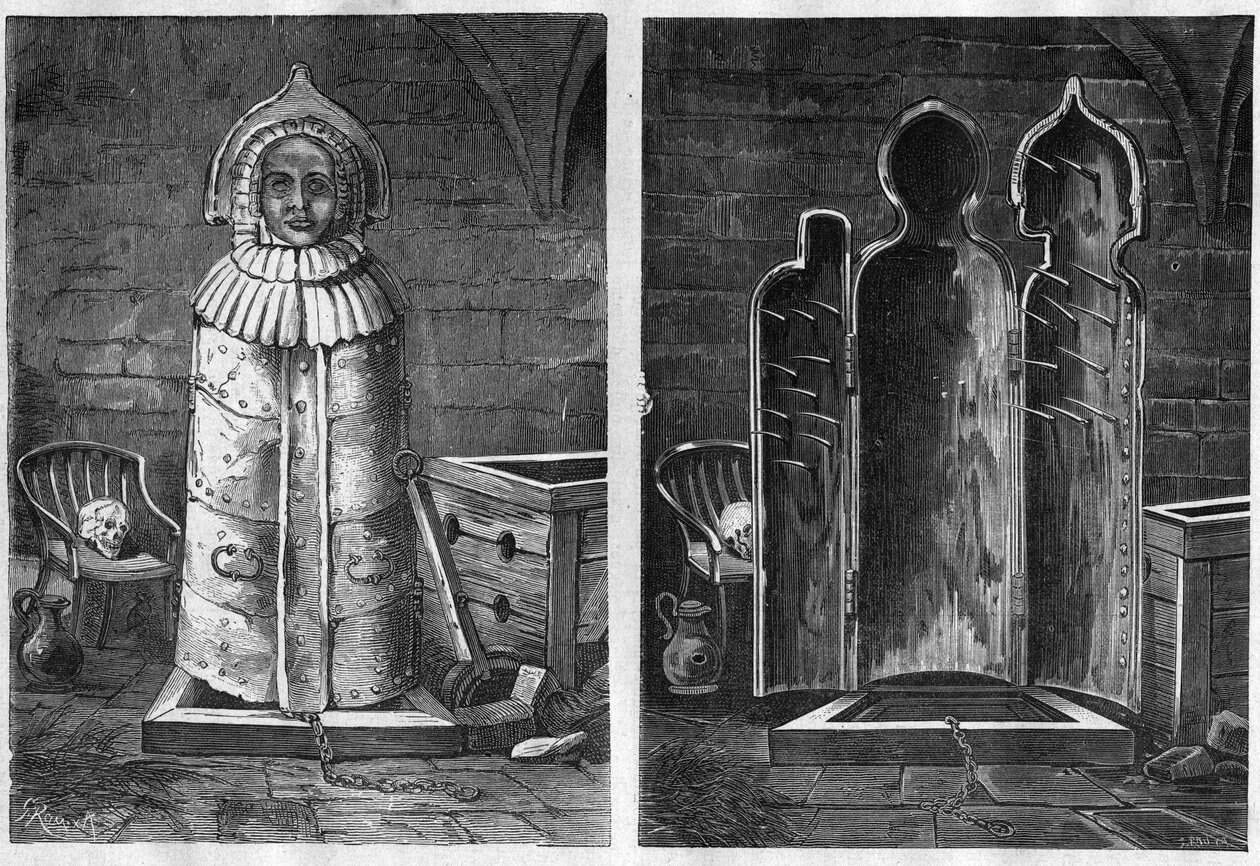
The Iron Maiden stands as one of history’s most terrifying torture devices that never actually existed. This spiked coffin, designed to slowly impale victims, has haunted our collective imagination for centuries. Yet historians have uncovered a chilling truth: the medieval Iron Maiden is nothing more than a 19th-century fabrication.
The device consists of a human-sized iron cabinet lined with deadly spikes. Victims would allegedly be locked inside, slowly pierced by dozens of metal points. The horror seems medieval in its cruelty. But archaeological evidence tells a different story entirely.
No authentic Iron Maiden has ever been found in medieval ruins. No historical documents from the Middle Ages mention such devices. The earliest known reference dates to the 1790s, when German historian Johann Philipp Siebenkees described a supposed execution in Nuremberg. Even this account appears to be fictional.
The Iron Maiden of Nuremberg’s Dark Origins
The most famous Iron Maiden emerged in Nuremberg around 1802. This terrifying exhibit drew crowds of horrified spectators. The device stood seven feet tall, with a hinged door revealing rows of razor-sharp spikes inside. Visitors gasped at the medieval barbarity on display.
But the truth was far more mundane. Museum curators had assembled the device from unrelated artifacts. They took a medieval shame mask called a “Schandmantel” and added French bayonets from Napoleon’s wars. The result was a profitable horror show that bore no resemblance to actual medieval punishment.
Wolfgang Schild, a criminal law professor at Bielefeld University, exposed this deception. His research revealed how 19th-century showmen created these devices for commercial exhibition. They preyed on public fascination with medieval cruelty.
The original Nuremberg Iron Maiden met its own violent end. Allied bombs destroyed it during World War II in 1945. Only copies remain, displayed in museums worldwide as examples of historical fraud.
Baghdad’s Modern Iron Maiden Horror
For more strange history, see: The Elusive Canterbury Panther: Unraveling New Zealand’s Enduring Urban Legend
The most disturbing chapter in the Iron Maiden story unfolded in 2003 Baghdad. American troops discovered a functioning device in Uday Hussein’s sports complex. Unlike the medieval myth, this one showed clear signs of recent use.
The Baghdad Iron Maiden stood in Uday’s office, covered by leaves. Time magazine reported that the device was “visibly worn from use, its spikes having lost their sharpness.” Athletes who failed to perform faced this nightmare.
Journalists found torture manuals printed from internet sources scattered throughout the facility. The pages detailed historical torture methods, suggesting Uday had researched medieval techniques. The irony was chilling: a mythical medieval device had become horrifyingly real in modern Iraq.
This discovery transformed the Iron Maiden from historical curiosity to contemporary nightmare. The device that never existed in the Middle Ages had found new life in Saddam Hussein’s regime.
Ancient Inspirations Behind the Iron Maiden Myth
While the medieval Iron Maiden never existed, similar devices appeared throughout history. Ancient Sparta’s tyrant Nabis used a deadly statue of his wife around 200 BCE. The bronze figure would embrace victims with hidden spikes, crushing them slowly.
The Carthaginians employed a similar method against Roman general Marcus Atilius Regulus. They forced him into a spiked wooden box where he couldn’t lean without being pierced. These accounts likely inspired later Iron Maiden creators.
Islamic historian Al-Tabari described another precursor. The Abbasid vizier Ibn al-Zayyat created a “wooden oven-like chest with iron spikes” in 847 CE. Ironically, he later died in his own creation during a political purge.
These historical accounts provided the blueprint for 19th-century showmen. They combined ancient torture methods with medieval aesthetics to create the perfect horror exhibit.
The Enduring Legacy of a Fictional Terror
The Iron Maiden myth reveals humanity’s fascination with medieval cruelty. We imagine the Middle Ages as a time of unparalleled barbarism. This device perfectly embodied those fears, regardless of historical accuracy.
Modern torture museums continue displaying Iron Maidens worldwide. The Medieval Crime Museum in Rothenburg houses a famous replica, clearly labeled as a 19th-century creation. Visitors still shudder at its spiked interior.
Popular culture has embraced the Iron Maiden as shorthand for medieval torture. Movies, books, and video games feature the device regularly. Even the famous heavy metal band took its name from this mythical contraption.
The device’s fictional nature doesn’t diminish its psychological impact. It represents our deepest fears about human cruelty and medieval justice. Sometimes myths reveal more about our anxieties than historical facts ever could.
The Iron Maiden stands as a testament to the power of fabricated history. This device that never existed continues terrorizing imaginations centuries after its creation. Its legacy proves that sometimes the most compelling historical artifacts are the ones that never actually existed at all.
Related Posts
 January 2026 Solar Storm: The Celestial Event That Defied Scientific Predictions
 Prillwitz Idols: The Bronze Forgeries That Fooled European Nobility for Decades
 Russian Sleep Experiment: The Terrifying Creepypasta That Fooled the World
 Hodag: Wisconsin’s Terrifying Hoax That Fooled Thousands and Sparked a Legend