
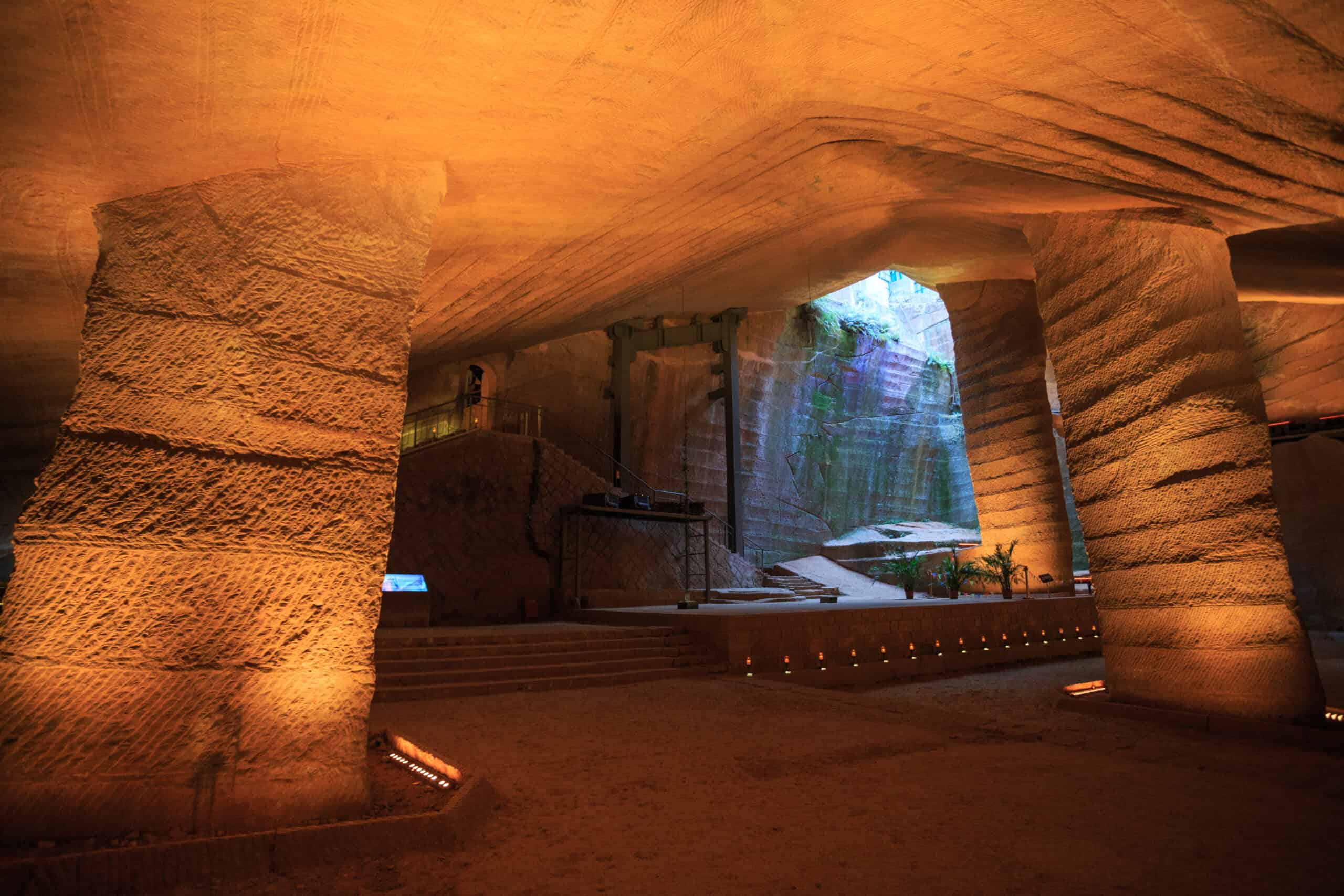
The Longyou Caves in China’s Zhejiang Province represent one of archaeology’s most baffling mysteries. These 24 massive underground chambers were carved from solid sandstone over 2,000 years ago. Yet no historical records mention their construction. No tools have been found. No evidence exists of where nearly one million cubic meters of excavated stone went.
What makes these caves even stranger? When farmers first drained them in 1992, they found no signs of life inside. Natural caves in the area teem with fish and wildlife. The Longyou Caves contained nothing living at all.
The discovery happened by accident. Wu Anai, a curious farmer, convinced his neighbors to pool money for a water pump. For 17 days in June 1992, they drained what locals called “Bottomless Pond.” What emerged defied belief – a perfectly preserved underground chamber with 30-foot-high ceilings.
The Mysterious Discovery of the Longyou Caves
The first glimpse into these ancient chambers revealed something extraordinary. Every surface – walls, ceilings, pillars – bore identical chisel marks. Parallel bands 60 centimeters wide covered every inch. The marks angled at precisely 60 degrees, spaced exactly one inch apart.
Wu Anai’s discovery led to finding 23 more caves nearby. Each chamber averaged over 11,000 square feet of floor space. The total excavated area exceeded 320,000 square feet. Yet despite their proximity, no connecting tunnels linked the caves.
Archaeological investigations revealed pottery shards dating to the Western Han Dynasty (206 BC to 23 AD). This suggests the caves predate even these ancient artifacts.
The precision of construction baffles experts. Yang Hongxun from the Chinese Academy of Social Sciences noted something impossible: “At the bottom of each cave, the ancient builders wouldn’t be able to see what others were doing in the next grotto. Nevertheless, each cave had to be parallel with the others, or the wall would be holed through.”
Strange Construction Methods of the Longyou Caves
Another fascinating historical case is: Havana Syndrome: The Mysterious Illness Targeting American Officials Worldwide
The engineering challenges seem insurmountable for ancient builders. Some walls between chambers measure just 50 centimeters thick. One miscalculation would have breached into neighboring caves. Yet every measurement proves perfect.
The acoustic properties add another layer of mystery. Sound carries perfectly throughout each chamber. Today, the caves host concerts because of these remarkable acoustic qualities. Did ancient builders understand sound engineering this advanced?
No construction camps have been found. No worker settlements. No evidence of the massive labor force required. Estimates suggest 1,000 people working continuously for six years couldn’t complete this project. Where did these workers live? What did they eat? How did they organize such precision without modern surveying tools?
The missing million cubic meters of stone presents another puzzle. Carving these chambers required removing enough rock to build several pyramids. Yet archaeologists have found no quarries, no stone piles, no evidence of where this material went.
Unexplained Features That Defy Logic in the Longyou Caves
Perhaps most unsettling is the complete absence of life when first discovered. Natural caves harbor ecosystems. Fish, insects, and microorganisms thrive in underground environments. The Longyou Caves contained nothing alive.
The preservation seems impossible. Despite China’s seismic activity, no structural damage appears anywhere. No fallen rocks. No cracks. No signs of geological stress. The caves look as if carved yesterday, not 2,000 years ago.
Seven caves align perfectly with the stars of Ursa Major. This astronomical alignment suggests sophisticated knowledge of celestial navigation. Why would underground chambers need star alignment? What purpose required such precise astronomical orientation?
Recent theories propose various explanations. Some suggest they were military hideouts. Others claim they stored grain or housed imperial treasures. Yang Hongxun theorized in 2014 that King Goujian built them in 494 BC to hide defeated soldiers.
Yet none of these theories explain the construction methods. None account for the missing evidence. None address why builders would create such elaborate, precisely decorated storage spaces.
Modern Investigations and Lingering Questions
Since opening to tourists in 1997, the caves attract 100,000 visitors annually. International experts have studied every detail. Advanced technology has mapped each chamber. Yet fundamental questions remain unanswered.
The chisel marks follow no known ancient Chinese construction technique. The precision exceeds capabilities of available tools from that era. The scale rivals modern engineering projects. How did ancient builders achieve such perfection?
Dr. Chu Liangcai from Zhejiang University proposed they were Emperor Xuan’s warehouses. But warehouses don’t require decorative chisel patterns covering every surface. Storage facilities don’t need acoustic perfection or astronomical alignment.
The mystery deepens with each investigation. Modern engineers struggle to explain the structural stability. Archaeologists can’t locate construction evidence. Historians find no written records despite the enormous undertaking required.
Flooding and tourism now threaten the site’s preservation. Yet no new excavations have expanded beyond the original 24 chambers. Perhaps more caves await discovery. Perhaps they hold clues to unlock this ancient puzzle.
The Longyou Caves continue challenging our understanding of ancient capabilities. They represent a lost chapter of human achievement. Until someone discovers definitive evidence of their purpose and construction methods, these underground chambers will remain one of archaeology’s most compelling unsolved mysteries.
Related Posts
 Folkton Drums: The Mysterious Neolithic Objects That May Have Measured Ancient Britain
 Phaistos Disc: The Mysterious Clay Artifact That Defies All Attempts at Translation
 Nightmarchers: Hawaii’s Terrifying Ghost Warriors That Still March Tonight
 Spook Hill: Florida’s Mysterious Gravity-Defying Road That Captivated America