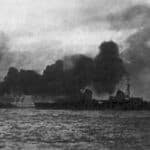
The Ms Totila disaster remains one of World War II’s most devastating maritime tragedies, yet few people have ever heard of it. On May 10, 1944, this German cargo ship sank in the Black Sea near Crimea, taking up to 5,000 German and Romanian soldiers to their deaths. The ship went down so quickly that rescue efforts proved nearly impossible. Bodies floated in the dark waters for days afterward. What makes this tragedy even more haunting is how it’s been forgotten by history, overshadowed by other wartime disasters.
The Ms Totila had been hastily converted from a Hungarian cargo vessel called Magyar Vitez. German forces confiscated the ship in spring 1944 as their military situation in Crimea became desperate. They armed it with anti-aircraft guns and pressed it into service for what would become one of the war’s most chaotic evacuations. The ship’s final voyage would last less than 24 hours.
The Desperate Evacuation and Ms Totila’s Final Mission
By April 1944, Hitler’s 17th Army found itself trapped on the Crimean Peninsula. Soviet forces had surrounded 235,000 German and Romanian troops with no escape route by land. Initially, Hitler refused to authorize a seaborne evacuation. He wanted his forces to fight to the death. But as the military situation deteriorated, he finally relented on April 11th.
The evacuation that followed was chaotic and deadly. Ships of all sizes were pressed into service, including the Ms Totila. On May 10th, the vessel arrived at Khersones alongside another ship called Teja. Both vessels immediately began loading desperate soldiers. Witnesses described scenes of panic as men fought to get aboard. The ships were packed far beyond their safe capacity.
The Ms Totila carried approximately 5,000 men – 3,000 Germans and 2,000 Romanians. Many soldiers had to stand on deck because there wasn’t enough room below. The ship’s original cargo holds were crammed with human beings instead of supplies. As they departed Khersones, everyone aboard knew they were sailing into danger.
The Attack That Doomed Ms Totila
This event shares similarities with: Dade Battle: The 1835 Massacre That Sparked the Second Seminole War
Soviet aircraft had been hunting the evacuation convoys relentlessly. The Ms Totila’s crew spotted the first formation of 20 Soviet planes around 9:00 AM. Anti-aircraft guns blazed from the ship’s deck as bombs fell around them. Miraculously, this first attack missed its mark. The ship continued sailing toward Romania, but their luck wouldn’t hold.
At 9:30 AM, a second wave of 21 Soviet aircraft appeared. This time, three bombs found their target. The explosions tore massive holes in the Ms Totila’s hull. Water rushed in with terrifying speed. The ship had been built as a cargo vessel, not a passenger liner. It lacked proper watertight compartments and safety equipment for the thousands of men aboard.
Survivors later described the horror that followed. Men trapped below deck had no chance of escape as water flooded the compartments. Those on deck were thrown into the freezing Black Sea waters. Many soldiers couldn’t swim. Others were weighed down by their equipment and uniforms. The ship sank in minutes, taking most of its human cargo with it.
The Forgotten Tragedy of Ms Totila and Her Sister Ship
The escort ships couldn’t stop to rescue survivors from the Ms Totila. Soviet aircraft were still attacking, and stopping would have made them sitting targets. Only about 400 men were eventually pulled from the water. The rest – nearly 5,000 souls – disappeared beneath the waves.
The tragedy didn’t end there. At 2:45 PM that same day, Soviet bombers found the Teja. This sister ship met the same fate as the Ms Totila, sinking with approximately 4,000 men aboard. In a single day, these two vessels claimed up to 9,000 lives. It ranks among the deadliest maritime disasters in human history.
Yet unlike the Titanic or Lusitania, few people know about the Ms Totila. The chaos of war and the classified nature of military operations kept the story hidden for decades. Even today, exact casualty figures remain uncertain. The naval records from this period are incomplete, and many witness accounts were never officially recorded.
The Wreck Discovery and Lingering Mysteries
In May 2003, nearly 60 years after the disaster, divers finally located the wreck of the Ms Totila near Sevastopol. The discovery brought renewed attention to this forgotten tragedy. But the wreck also raised new questions. The ship’s remains lie in deep, cold waters that have preserved much of the vessel.
What the divers found was both fascinating and disturbing. Personal belongings, weapons, and human remains were scattered across the seafloor. The wreck serves as an underwater tomb for thousands of men whose families never learned their fate. Many bodies were never recovered, leaving families to wonder for decades what happened to their loved ones.
The official records of the Ms Totila disaster remain sparse. Military archives from both German and Soviet sources provide only basic details. This has led some researchers to question whether the full story has ever been told. Were there survivors who never came forward? Did the ship carry more than just soldiers?
Some divers who have visited the wreck report strange experiences. They describe an eerie silence around the vessel, as if the sea itself remembers the tragedy. Others claim to have seen unexplained lights near the wreck site. Whether these are tricks of light and current or something more mysterious remains unknown.
The Ms Totila represents more than just a wartime disaster. It symbolizes the human cost of conflict and the stories that get lost in the chaos of history. Thousands of men died in minutes, their final moments witnessed only by the dark waters of the Black Sea. Today, the wreck serves as both a grave and a reminder of this forgotten chapter of World War II.