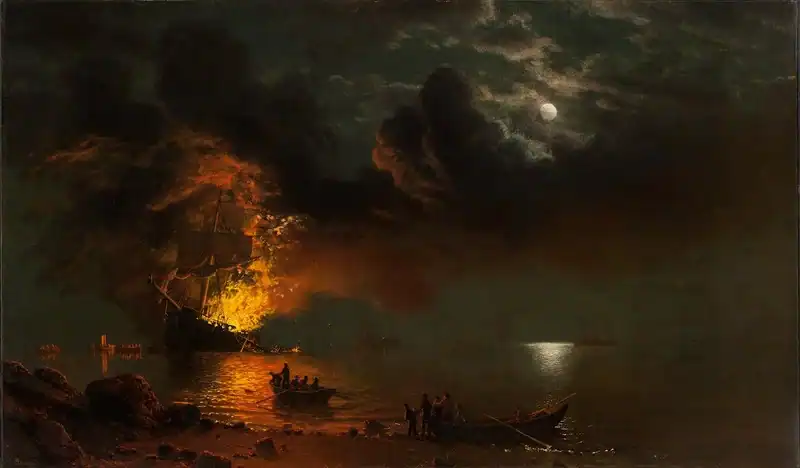
The Palatine Light remains one of New England’s most enduring maritime mysteries. For nearly three centuries, witnesses have reported seeing a burning ship sailing through the waters near Block Island, Rhode Island. This ghostly vessel appears most often during winter storms, glowing with an otherworldly fire that defies explanation. The phantom ship’s origins trace back to a real tragedy from 1738, but the supernatural sightings that followed have made this one of America’s most documented ghost ship phenomena.
Local fishermen and residents describe the apparition in chilling detail. The burning vessel appears suddenly on the horizon, usually during the week between Christmas and New Year’s Eve. Witnesses report seeing flames dancing across the ship’s rigging and sails, yet the fire never consumes the vessel completely. The ghostly craft drifts silently through the waves before vanishing without a trace, leaving observers questioning what they’ve witnessed.
The Tragic Wreck Behind the Palatine Light Legend
The supernatural sightings stem from the horrific fate of the Princess Augusta in 1738. This British vessel departed Rotterdam in August with 240 German immigrants bound for Philadelphia. Captain George Long commanded the 220-ton ship with a crew of fourteen, but their journey would become a nightmare of death and betrayal.
Contaminated water supplies triggered a deadly plague aboard the overcrowded vessel. The “fever and flux” killed 200 passengers and half the crew, including Captain Long himself. First mate Andrew Brook assumed command as violent storms pushed the dying ship far off course. For three brutal months, survivors endured freezing temperatures and dwindling food supplies while Brook allegedly forced passengers to pay for remaining rations.
The doomed vessel finally wrecked at Sandy Point on Block Island’s northern tip during a December 27 snowstorm. Brook and his remaining crew rowed to safety, abandoning the surviving passengers aboard the sinking ship. Block Island Historical Society records indicate that locals rescued the passengers the following day and buried approximately twenty who died after the wreck.
Mysterious Palatine Light Sightings Through the Centuries
For more strange history, see: Angikuni Lake
The first reported Palatine Light sightings began appearing within decades of the original wreck. Witnesses described seeing a burning ship sailing past Block Island during winter storms, always appearing and disappearing without explanation. These accounts became so common that locals began expecting the ghostly vessel’s annual return.
The phenomenon gained widespread attention through poet John Greenleaf Whittier’s 1867 work “The Palatine.” Whittier learned the tale from Newport resident Joseph P. Hazard, whose family preserved the oral traditions surrounding the supernatural sightings. The poem appeared in Atlantic Monthly and later became one of Whittier’s most celebrated works, cementing the ghost ship’s place in American folklore.
Eyewitness accounts share remarkably consistent details across different time periods. The phantom vessel appears as a full-rigged ship engulfed in flames, yet the fire never destroys the craft. Witnesses report seeing the burning ship sail steadily through rough seas before fading into darkness. Some observers claim to hear screams and cries carried on the wind, suggesting the tormented souls of those who perished still haunt the ghostly vessel.
The Palatine Light’s Enduring Supernatural Mystery
Modern investigators have struggled to explain the Palatine Light phenomenon through conventional means. Skeptics suggest the sightings result from optical illusions, distant fires reflected on low clouds, or phosphorescent algae creating unusual light effects on the water. However, these explanations fail to account for the detailed ship-like appearance witnesses consistently describe.
The timing of sightings adds another layer of mystery to the phenomenon. Reports cluster around the anniversary of the original wreck, particularly during the week between Christmas and New Year’s Eve. This pattern suggests something more than random natural phenomena or misidentified objects.
Historical documentation reveals that two versions of the wreck story began circulating almost immediately after the tragedy. Some accounts claim a woman named Mary Van Der Line was forgotten aboard the ship and burned alive when locals set the vessel adrift. This tragic detail may explain why the ghost ship appears wreathed in flames, representing the suffering of those who died in the disaster.
Block Island’s Dark Maritime Reputation
Block Island’s geography made it a natural hazard for colonial-era shipping. The island’s position in busy shipping lanes, combined with treacherous currents and sudden storms, created perfect conditions for maritime disasters. Local folklore suggests some residents may have deliberately caused wrecks by displaying false beacon lights to lure ships onto the rocks.
These “wrecker” legends paint a sinister picture of islanders who profited from maritime tragedies. While historians debate the accuracy of such claims, the stories contributed to Block Island’s reputation as a place where the dead don’t rest peacefully. The combination of multiple shipwrecks and suspicious circumstances created ideal conditions for ghost stories to flourish.
Contemporary accounts from the Princess Augusta’s crew depositions, discovered in 1925, provide disturbing details about the disaster. The surviving crew members painted First Mate Brook as a cruel opportunist who exploited desperate passengers for personal gain. These historical documents lend credibility to the darker aspects of the legend and may explain why supernatural activity continues around the wreck site.
The Palatine Light continues appearing to modern witnesses, proving that some mysteries transcend rational explanation. Whether the phenomenon represents genuine supernatural activity or unusual natural occurrences, the burning ghost ship remains an integral part of Block Island’s haunted maritime heritage. For nearly three centuries, this spectral vessel has reminded observers that some tragedies leave permanent scars on the places where they occurred, creating lasting connections between the living and the dead.