
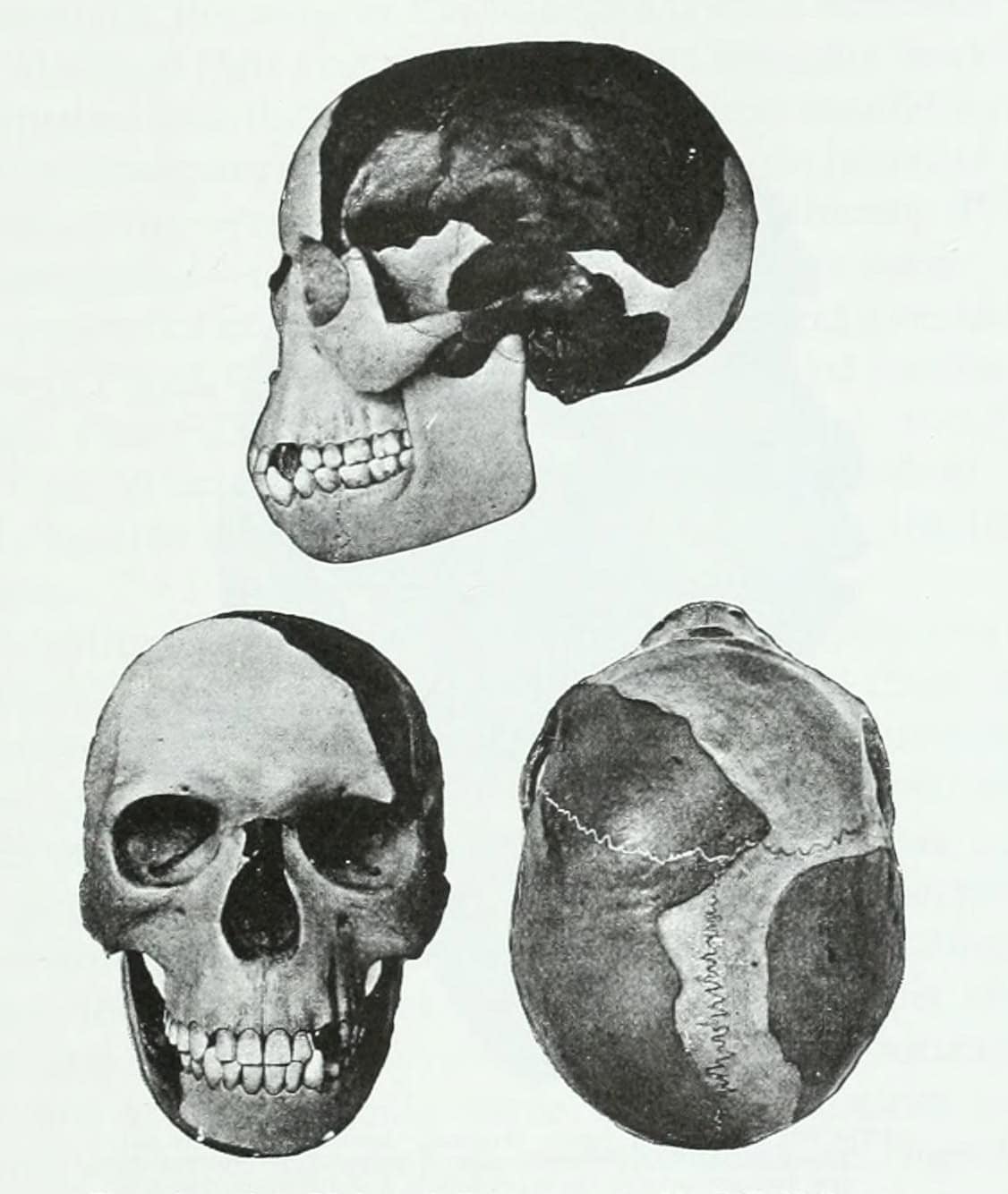
The Piltdown Man stands as one of the most audacious scientific hoaxes in history. For over four decades, this elaborate fraud fooled some of Britain’s most respected scientists. What began as Charles Dawson’s quest for recognition became a cautionary tale about the dangers of confirmation bias in science.
In 1912, amateur archaeologist Charles Dawson claimed he’d found humanity’s “missing link.” The discovery seemed too good to be true. It perfectly matched what British scientists wanted to believe about human evolution. The skull fragments suggested that early humans had developed large brains first, before other evolutionary changes. This theory dominated anthropology for decades.
But something sinister lurked beneath the surface of this groundbreaking find. The evidence was carefully crafted to deceive. Dawson had combined an orangutan’s jawbone with a modern human skull. He’d stained the bones to make them appear ancient. The primitive tools were planted at the site. Every detail was designed to support a Eurocentric view of human evolution.
The Piltdown Man Discovery That Shocked Science
Charles Dawson contacted Arthur Smith Woodward in February 1912 with extraordinary news. He claimed workmen at a gravel pit near Piltdown, East Sussex, had given him fragments of an ancient skull. The workers had allegedly discovered the skull earlier but broke it up, thinking it was a fossilized coconut.
Dawson’s reputation gave weight to his claims. He was known for previous archaeological “discoveries” in the area. What the scientific community didn’t know was that these earlier finds were also fraudulent. Dawson had been practicing his deception for years.
That summer, Dawson and Woodward returned to the site. They “discovered” more bone fragments, teeth, and primitive stone tools. The cranium appeared human-like, with a large brain capacity. The jawbone resembled that of an ape. This combination seemed to prove that early humans had developed intelligence before other evolutionary traits.
The Natural History Museum embraced the discovery enthusiastically. Woodward reconstructed the skull and estimated its age at 500,000 years. The scientific community was hungry for evidence of human evolution. Piltdown appeared to fill a crucial gap in the fossil record.
Why the Piltdown Man Hoax Succeeded
For more strange history, see: Rasputin
The timing of Dawson’s deception was perfect. Evolutionary theory was gaining acceptance, but fossil evidence remained scarce. Scientists desperately wanted proof of human evolution. The Piltdown fragments seemed to provide exactly what they needed.
Cultural bias played a major role in the hoax’s success. British scientists were eager to believe that human evolution had begun in England, not Africa. This Eurocentric view reflected colonial attitudes of the time. European ancestry was considered superior to other races. The Piltdown discovery supported these prejudiced beliefs.
The scientific community also suffered from confirmation bias. The evidence matched prevailing theories about brain development. Scientists saw what they wanted to see. They ignored inconsistencies and troubling details. The jawbone and skull didn’t quite fit together properly. The teeth showed unusual wear patterns. These red flags were dismissed or explained away.
Dawson’s reputation provided crucial credibility. He was respected in archaeological circles. His previous “discoveries” had been accepted without question. No one suspected that he was capable of such elaborate deception. Trust in his character allowed the hoax to flourish.
Unraveling the Piltdown Man Deception
Doubts about the authenticity began almost immediately. Some scientists questioned whether the skull and jawbone belonged to the same individual. The pieces seemed to come from different species entirely. But these concerns were overshadowed by enthusiasm for the discovery.
New fossil finds in the 1920s and 1930s began to contradict the Piltdown evidence. Discoveries in Africa suggested that human evolution had occurred there, not in Europe. The large-brained Piltdown specimen didn’t fit with these new findings. Scientists started to question the British discovery.
Advanced dating techniques in the 1940s revealed troubling inconsistencies. The bones appeared to be of different ages. Chemical analysis showed that they had been artificially stained. The primitive tools were clearly modern forgeries. The evidence was mounting against Piltdown’s authenticity.
In 1953, a team of scientists finally exposed the truth. Detailed analysis revealed that the skull belonged to a modern human. The jawbone came from an orangutan. The teeth had been filed down to create artificial wear patterns. The entire assemblage was a carefully constructed fake.
The Legacy of Scientific Deception
The exposure of the hoax sent shockwaves through the scientific community. Forty-one years of research had been based on fraudulent evidence. Textbooks needed to be rewritten. Museum displays had to be changed. The credibility of paleoanthropology suffered a severe blow.
Charles Dawson died in 1916, taking his secrets to the grave. For decades, his role in the deception remained unclear. Some suspected he had been an unwitting victim of someone else’s fraud. Others believed he was the mastermind behind the hoax.
A comprehensive 2016 investigation finally settled the question. Researchers examined all of Dawson’s archaeological finds using modern techniques. They discovered that at least 38 of his discoveries were forgeries. Dawson had been conducting fraudulent archaeology for most of his career. His motivation was simple: he craved recognition and status in the scientific community.
The Piltdown scandal changed how scientists approach new discoveries. Peer review became more rigorous. Independent verification became standard practice. The hoax served as a powerful reminder that even respected experts can be deceived by their own biases and assumptions.
The story of the Piltdown Man reveals the human side of scientific discovery. Ambition, prejudice, and wishful thinking can corrupt even the most rigorous research. The hoax succeeded because it told scientists what they wanted to hear. It took decades of contradictory evidence and technological advances to finally expose the truth. This elaborate deception remains a cautionary tale about the importance of skepticism and critical thinking in scientific research.
Related Posts
 Japanese Paleolithic Hoax: The Divine Hand That Fooled a Nation for Decades
 The Saguenay Flood of 1996: Canada’s Most Devastating 20th Century Deluge
 Etruscan Terracotta Warriors: The Metropolitan Museum’s Greatest Art Forgery Scandal
 Coffin Ship (insurance): When Greed Turned Vessels Into Floating Death Traps