
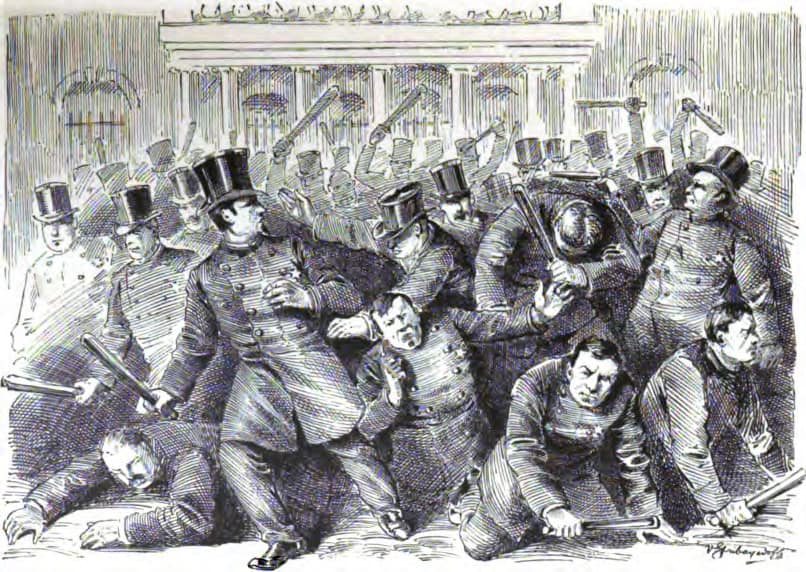
A police riot occurs when law enforcement officers themselves become the aggressors in violent confrontations. These disturbing events turn the concept of public safety on its head. Officers abandon their duty to protect and serve, instead becoming the very threat citizens need protection from.
The term gained widespread recognition after the 1968 Democratic National Convention in Chicago. But these incidents stretch back much further into American history. They reveal a pattern of institutional violence that challenges our basic assumptions about authority and order.
The Chicago Police Riot That Shocked America
The 1968 Democratic National Convention transformed Chicago into a battleground. Anti-war protesters gathered to voice their opposition to the Vietnam War. What happened next would forever change how Americans viewed police authority.
On August 28, 1968, Chicago police officers launched what witnesses described as an unprovoked assault. They attacked protesters, journalists, and innocent bystanders with clubs and tear gas. Television cameras captured the violence as it unfolded in real time.
The Walker Report later investigated these events for the National Commission on the Causes and Prevention of Violence. It concluded that police had engaged in “unrestrained and indiscriminate” violence against people who had “broken no law, disobeyed no order, made no threat.” This official report popularized the term “police riot” in American discourse.
Television footage showed officers removing their badge numbers before attacking civilians. Some covered their faces to avoid identification. These actions suggested premeditation rather than spontaneous crowd control gone wrong. The 1968 Chicago protests became a defining moment in American civil rights history.
Earlier Police Riot Incidents in American History
For more strange history, see: Famous Impostors: Bram Stoker’s Final Investigation into History’s Greatest Deceptions
The Haymarket Square incident of 1886 revealed early patterns of police violence against workers. Four striking workers had been killed by police at the McCormick Harvesting Machine Company. The next day, a peaceful demonstration in Haymarket Square turned deadly.
Someone threw a bomb that killed eight policemen. Police then opened fire on the crowd. At least four demonstrators died, with many more wounded. Accounts vary on whether police fired before or after shots came from the crowd.
The 1934 “Bloody Thursday” incident in San Francisco followed similar patterns. Police clashed with striking longshore workers, killing two picketers. The violence sparked a general strike that shut down the entire city. Critics began using the term “police riot” to describe such incidents.
These early cases established troubling precedents. Police consistently portrayed themselves as victims while witnesses described unprovoked attacks. The truth often remained buried beneath competing narratives and official investigations.
The White Night Police Riot and Hidden Badge Numbers
San Francisco’s Castro District experienced its own police riot on May 21, 1979. The incident followed protests over the lenient sentencing of Dan White. White had assassinated Mayor George Moscone and Supervisor Harvey Milk but received only a manslaughter conviction.
Angry demonstrators gathered at City Hall to protest the verdict. Later that evening, San Francisco police descended on the Castro District. Officers had taped over their badge numbers to avoid identification. They destroyed a gay bar and attacked civilians indiscriminately.
The systematic covering of badge numbers suggested coordination and planning. Officers in riot gear beat patrons and made dozens of arrests. Many victims later sued the police department successfully. The incident revealed how police could transform from protectors into predators within hours.
Witnesses described a scene of deliberate intimidation and violence. Police targeted the gay community in apparent retaliation for the earlier protests. The attacks continued for hours with little oversight or intervention from supervisors.
Modern Technology and Police Violence Documentation
The Tompkins Square Park incident of 1988 marked a turning point in documenting police violence. Video cameras captured officers attacking bystanders, artists, and homeless people. The footage showed unprovoked violence against people simply present in the park.
Police had attempted to enforce a new curfew, but their response escalated far beyond crowd control. Officers on horseback charged into crowds. Many had removed their name tags and badge numbers, following the pattern established in earlier incidents.
The video evidence proved crucial in exposing police misconduct. Unlike previous incidents that relied on witness testimony, cameras provided undeniable proof. The footage was broadcast widely, shocking viewers who witnessed police brutality firsthand.
Recent research has revealed disturbing patterns in modern policing. Studies show that seeing police in riot gear significantly increases feelings of unfair treatment among civilians. This psychological impact can escalate tensions and create the very conflicts police claim to prevent.
The documentation of police violence has become increasingly sophisticated. Body cameras, cell phone videos, and social media now capture incidents that might previously have gone unreported or been covered up by official accounts.
Police riot incidents continue to challenge our understanding of law enforcement’s role in society. These events reveal how quickly protectors can become aggressors. They force uncomfortable questions about authority, accountability, and the thin line between order and chaos. As technology makes documentation easier, the true scope of these incidents may finally be coming to light.
Related Posts
 Biblical Conspiracy Theory: The Hidden Truth About Sacred Texts and Secret Societies
 Gang Stalking: The Dark Web Communities Behind Modern Paranoia and Violence
 Magdalena Solís: The High Priestess of Blood and Mexico’s Most Terrifying Cult Leader
 Conspiracy Theory (legal Term): When Courts Embrace the Unthinkable