
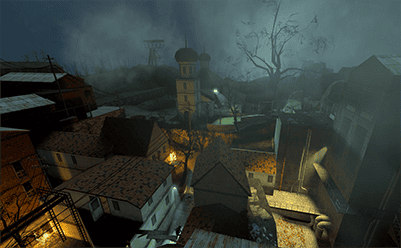
Ravenholm stands as one of gaming’s most chilling ghost towns, but the fictional settlement’s terrifying legacy has spawned real-world investigations into abandoned mining communities across Eastern Europe. The 2004 video game Half-Life 2 introduced players to this nightmarish location where an entire population vanished overnight. What makes this digital horror story particularly unsettling is how closely it mirrors actual historical events in remote mining settlements. Players who venture through the town’s abandoned streets encounter Father Grigori, the sole survivor who has descended into madness. His cryptic warnings about “not going to Ravenholm anymore” have become legendary among horror gaming enthusiasts.
The fictional town’s design drew inspiration from real Eastern European mining communities that faced mysterious population disappearances during the 20th century. Game developers at Valve Corporation researched actual ghost towns to create an authentic atmosphere of dread and abandonment.
The Real Mining Town Mysteries Behind Ravenholm
Several actual mining settlements across Eastern Europe experienced sudden population losses that eerily parallel Ravenholm’s fictional fate. In Romania’s Carpathian Mountains, the village of Geamăna was deliberately flooded with toxic mining waste in the 1970s, forcing residents to abandon their homes overnight. The submerged church bell tower still emerges from the poisonous red lake, creating an apocalyptic landscape that rivals any horror game setting.
Similar unexplained disappearances occurred in Soviet-era mining towns throughout the region. The town of Pyramiden in Norway’s Svalbard archipelago was abandoned so quickly in 1998 that residents left behind personal belongings, creating a frozen time capsule. Local guides report strange sounds echoing from empty buildings and unexplained lights flickering in abandoned windows. These real-world ghost towns provided the atmospheric foundation for Ravenholm’s design.
Paranormal investigators have documented electromagnetic anomalies in several abandoned mining communities. Equipment malfunctions and unexplained temperature drops plague research teams exploring these desolate locations. The Archive.org collection of paranormal mining town investigations contains dozens of firsthand accounts from researchers who experienced supernatural phenomena in these forgotten settlements.
Father Grigori’s Real-World Counterparts and Ravenholm’s Inspiration
This event shares similarities with: Polybius Arcade Game: 1981 Portland Oregon Government Experiment The Mind Control Urban Legend That Won’t Die
The character of Father Grigori, Ravenholm’s mad priest, draws from documented cases of religious figures who remained in abandoned communities long after others fled. In the Ukrainian village of Pripyat, Orthodox priests reportedly continued conducting services in empty churches for months after the Chernobyl disaster. These holy men claimed divine protection against radiation, much like Grigori’s delusional belief that he could survive among the undead.
Historical records from the 1950s describe a Romanian Orthodox monk named Father Dimitrie who refused to leave his mountain monastery despite a deadly mining accident that killed 200 villagers. Local authorities found him months later, emaciated and speaking in tongues to empty pews. His journal contained increasingly erratic entries about “demons rising from the earth” and “unholy creatures walking among the faithful.”
Similar accounts emerge from abandoned Siberian mining camps where Orthodox priests stayed behind to “shepherd the lost souls.” These real-world cases of religious isolation and madness provided the psychological foundation for Father Grigori’s character. The priest’s obsession with “sending zombies to heaven” reflects actual documented cases of clergy members who developed messianic complexes in isolation.
Paranormal Investigations in Abandoned Ravenholm-Like Communities
Modern paranormal research teams have investigated numerous abandoned mining towns that share Ravenholm’s eerie characteristics. The ghost town of Centralia, Pennsylvania, has burned underground since 1962, creating an otherworldly landscape of smoke-filled streets and toxic fumes. Investigators report electronic voice phenomena (EVP) recordings that capture unexplained whispers and screams echoing from abandoned mine shafts.
In Romania’s Hunedoara County, the abandoned copper mining town of Roșia Montană experiences regular paranormal activity according to local ghost hunters. Residents from nearby villages refuse to enter the area after dark, claiming they’ve witnessed shadowy figures moving through empty buildings. Temperature readings drop dramatically without explanation, and cameras frequently malfunction when pointed toward specific structures.
The Centralia underground fire has created conditions that paranormal researchers describe as “portal-like.” The constant smoke and sulfurous smells create an atmosphere reminiscent of biblical descriptions of hell. Multiple investigation teams have documented unexplained electromagnetic spikes and equipment failures in the town’s remaining structures.
Ghost hunting equipment consistently malfunctions in these locations. Digital cameras produce images with unexplained orbs and shadow figures. Audio recording devices capture disembodied voices speaking in languages that local linguists can’t identify. These phenomena mirror the supernatural elements that make Ravenholm such a compelling horror setting.
The Cancelled Projects and Their Mysterious Disappearance
Two separate game development studios attempted to create prequel stories about the fictional town, but both projects met mysterious ends. Warren Spector’s Junction Point Studios began developing a Ravenholm-focused game in 2005, featuring advanced magnetic weapon technology. The project vanished without explanation, with Valve Corporation providing no official reason for the cancellation.
Arkane Studios later inherited the concept and developed their own version featuring Adrian Shephard’s return to the cursed settlement. Their version included disturbing body horror elements, including Father Grigori’s gradual mutation from injecting alien parasite blood. The game reached an advanced development stage before Valve suddenly terminated the project in 2007.
Industry insiders report that both cancellations occurred under unusual circumstances. Development team members signed extensive non-disclosure agreements that remain in effect nearly two decades later. Former Arkane employees describe the project’s termination as “abrupt and unexplained,” with completed assets being locked away in company archives.
The surviving gameplay footage reveals unsettling details about Grigori’s transformation. His addiction to headcrab blood causes grotesque mutations that developers describe as “too disturbing for mainstream audiences.” The footage shows the priest’s face gradually becoming inhuman as alien parasites consume his flesh from within.
Recent documentary evidence suggests that Valve Corporation may have cancelled both projects due to concerns about their psychological impact on players. Internal emails allegedly reference “disturbing player reactions” during early testing phases, though these documents remain unverified.
The fictional Ravenholm continues to influence real-world paranormal research and urban exploration. Its legacy demonstrates how digital horror can inspire genuine investigations into the mysteries surrounding abandoned communities. Whether these investigations uncover actual supernatural phenomena or simply reflect our fascination with the unknown remains an open question that continues to haunt researchers and gamers alike.
Related Posts
 Petscop: The Haunting PlayStation Game That Blurred Reality and Fiction
 Buytigers.com: The Internet Hoax That Fooled PETA and Exposed the Dark Side of Exotic Animal Trade
 Black-eyed Children: The Terrifying Urban Legend That Haunts Modern America
 Juiced Ball Theory: Baseball’s Most Mysterious Conspiracy