
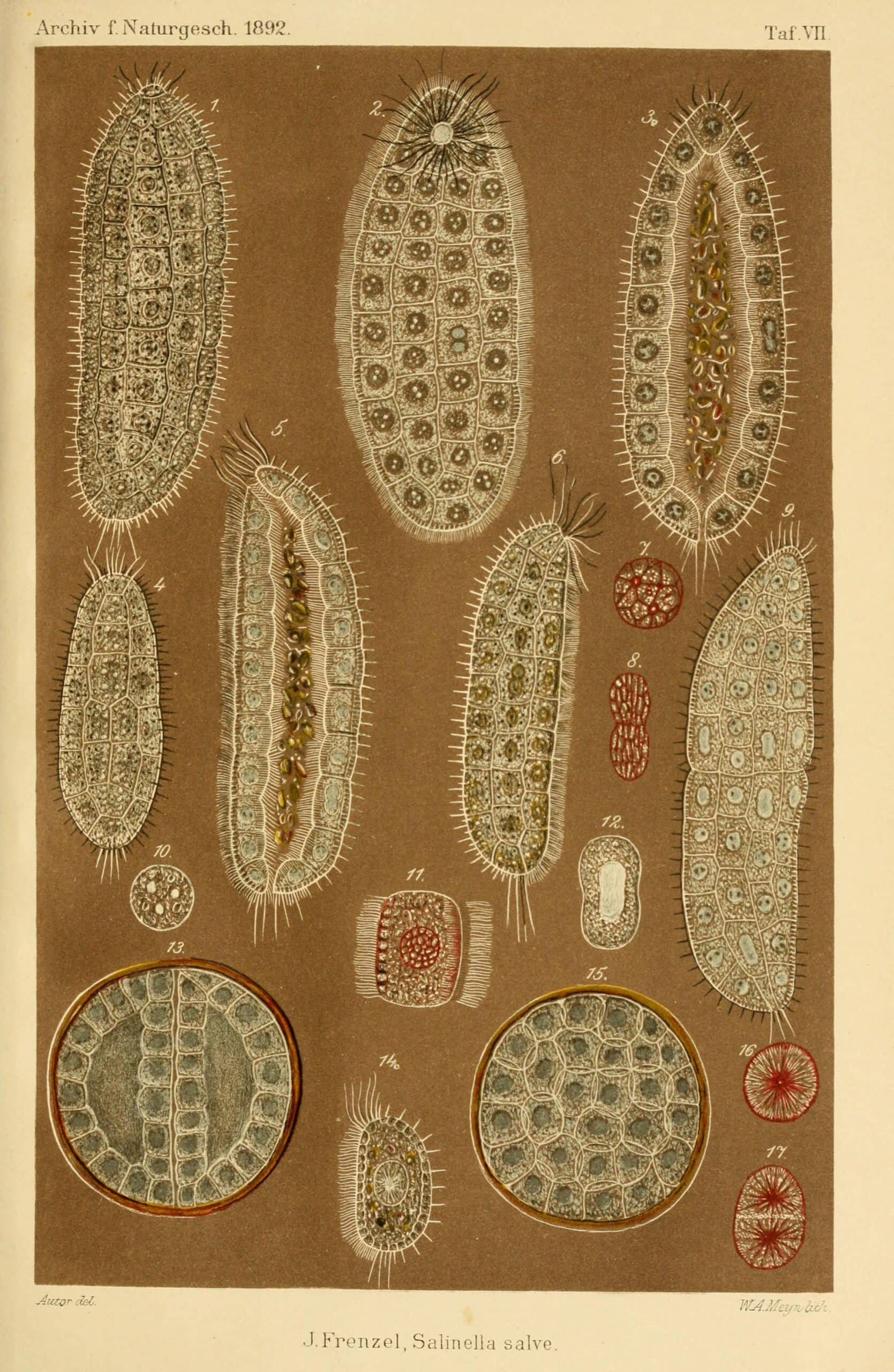
In 1892, German zoologist Johannes Frenzel made a discovery that would haunt the scientific world for over a century. Salinella Salve emerged from forgotten soil samples in his laboratory, defying every known rule of biology. This bizarre organism possessed characteristics that shouldn’t exist together in nature. It had the complexity of a multicellular animal but consisted of only a single layer of cells.
Frenzel found the creature in salt pan samples from Argentina’s Córdoba Province. The samples had sat neglected in his lab for weeks. When he finally examined them, he discovered something extraordinary crawling along the aquarium walls. The organisms were small, about 2 millimeters long, and moved with an otherworldly grace that captivated the scientist.
What made these creatures so unsettling was their impossible anatomy. They had distinct front and back ends, like complex animals. Yet they possessed only one cell layer, like the simplest life forms. Dense cilia covered their bodies, creating an almost fur-like appearance that rippled as they moved through the water.
The Mysterious Biology of Salinella Salve
The physical description of Salinella Salve reads like something from a fever dream. Frenzel observed creatures that were sausage-shaped and bilaterally symmetrical. They had what appeared to be a mouth at one end and an anus at the other. Both openings were surrounded by elongated cilia that waved hypnotically in the water.
Most disturbing was their method of reproduction. The organisms would simply split themselves in half through their middle. Each half would then regenerate into a complete creature. Frenzel suspected they might also reproduce sexually, but he never witnessed this mysterious process.
The creatures moved with purpose, gliding through the water with coordinated ciliary beats. Their single cell layer was ciliated on both sides, creating a shimmering effect as they swam. This unique feature has never been observed in any other known organism, making them biological impossibilities.
When Frenzel tried to preserve specimens with chemicals, they would completely disintegrate. This strange reaction made it impossible to create permanent samples for other scientists to study. The creatures seemed to dissolve into nothingness when exposed to preservatives, as if they were made of some ethereal substance.
The Hunt for Salinella Salve in Modern Times
This event shares similarities with: The Oak Island Mystery: Unveiling the Enigmatic Treasure Hunt
More than a century later, scientists still can’t explain what Frenzel discovered. In the early 2000s, Michael Schrödl from Munich’s Zoological State Collection became obsessed with finding these vanished creatures. He organized an expedition to Argentina, retracing Frenzel’s steps through the salt lakes of Córdoba Province.
Schrödl and his team collected samples from every salt lake they encountered across hundreds of miles. They used modern techniques that Frenzel could never have imagined. Advanced microscopy, DNA analysis, and sophisticated culturing methods were all brought to bear on the mystery. Yet despite their technological advantages, they found nothing.
The landscape had changed dramatically since Frenzel’s time. Modern research published in Current Biology suggests that environmental changes may have driven these creatures to extinction. Or perhaps they never existed at all, existing only in Frenzel’s imagination or as a case of mistaken identity.
The failure to rediscover Salinella Salve has led some scientists to question whether Frenzel fabricated the entire discovery. However, those who knew his work defend his reputation as a serious scholar. He made valuable contributions to anatomy, protozoology, and ornithology throughout his career.
Scientific Fraud or Genuine Mystery?
The case against Salinella Salve being real seems compelling at first glance. No scientist has ever independently confirmed their existence. The original specimens vanished without a trace, along with Frenzel’s preserved materials. Even the exact location where the soil samples originated remains unknown.
Some researchers suggest that Frenzel may have misidentified common protozoans or small multicellular animals. The creatures’ behavior and appearance could match certain ciliated organisms that are known to science. However, this explanation fails to account for the unique anatomical features that Frenzel described in meticulous detail.
Investigations by The Scientist magazine revealed additional complications in the story. Frenzel hadn’t actually collected the soil samples himself. A geologist friend had given them to him, making the chain of custody even murkier.
The timing of the discovery also raises questions. Frenzel made his announcement during a period of intense competition among biologists to discover new species. The pressure to publish groundbreaking findings may have influenced his interpretation of what he observed under the microscope.
Yet Frenzel’s detailed illustrations and descriptions suggest genuine scientific observation rather than deliberate deception. His drawings show consistent anatomical features across multiple specimens. The level of detail in his notes indicates careful, repeated observations over an extended period.
The Enduring Legacy of a Vanished Species
Today, Salinella Salve occupies a unique position in biological literature as a “species inquirenda” – a species of doubtful identity. It represents one of science’s most persistent mysteries, defying resolution despite modern technology and dedicated research efforts.
The creature’s supposed characteristics continue to puzzle evolutionary biologists. If real, it would represent a completely unknown branch of the animal kingdom. Its combination of primitive and advanced features doesn’t fit any known evolutionary pathway.
Some scientists maintain hope that these enigmatic organisms still exist somewhere, waiting to be rediscovered. Salt lakes around the world harbor many unique species that have adapted to extreme conditions. Perhaps Salinella Salve survives in some remote location, unchanged since Frenzel’s time.
The mystery has inspired modern researchers to examine other “lost” species that were described once and never seen again. These scientific ghost stories remind us how much we still don’t know about life on Earth. They also highlight the importance of preserving specimens and maintaining detailed records for future generations.
Whether Salinella Salve was real or imagined, its story continues to captivate scientists and mystery enthusiasts alike. The vanishing creature serves as a reminder that nature still holds secrets that may forever elude our understanding. In an age of advanced technology and global communication, some mysteries remain tantalizingly out of reach.
Related Posts
 Havana Syndrome: The Mysterious Illness Targeting American Officials Worldwide
 Tanganyika Laughter Epidemic: When Mass Hysteria Gripped East Africa
 January 2026 Solar Storm: The Celestial Event That Defied Scientific Predictions
 2025 Pn7 Quasi Moon: Earth’s Mysterious Shadow Companion That Shouldn’t Exist