
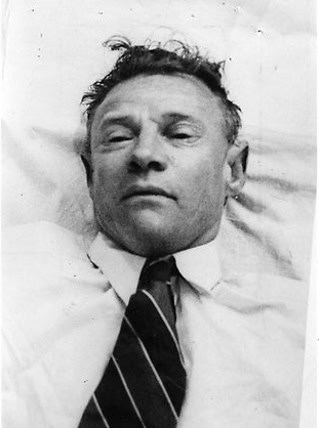
The Somerton Man mystery began on a cold December morning in 1948 when beachgoers discovered a lifeless body on Adelaide’s Somerton Beach. This wasn’t just another unexplained death. It became Australia’s most perplexing cold case, complete with secret codes, untraceable poison, and connections that stretched into the shadowy world of Cold War espionage. The man’s identity remained unknown for over 70 years, spawning countless theories about spies, lovers, and deadly secrets.
What made this case so chilling wasn’t just the mystery itself. It was the eerie details that seemed pulled from a spy thriller. A scrap of paper with Persian text meaning “it is finished.” A secret code that has never been cracked. A woman who fainted when shown the dead man’s face. These elements combined to create one of the most haunting mysteries in criminal history.
The discovery sent shockwaves through post-war Australia. This was 1948, and the Cold War was just beginning. Nuclear secrets were being stolen. Spies were everywhere. And now, a mysterious man had washed up on their shores with all the hallmarks of international intrigue.
The Somerton Man’s Mysterious Final Hours
Witnesses saw the man alive on the evening of November 30, 1948. He was lying in the exact same spot where his body would be found the next morning. But their accounts were deeply unsettling. One couple watched him extend his right arm fully, then let it drop lifelessly. Another pair observed him for thirty minutes without seeing any movement, though they sensed his position had somehow changed.
Most disturbing was their observation about the mosquitoes. The man didn’t react to them at all, even as they swarmed around his motionless form. The witnesses assumed he was drunk or sleeping. They had no idea they were watching a man die.
One witness reported seeing another figure. A man stood at the top of the beach steps, looking down at the motionless body below. This mysterious observer vanished before police arrived, adding another layer to an already complex puzzle.
The body’s position when found was almost theatrical. The man lay with his head against the seawall, legs extended, feet crossed. A half-smoked cigarette rested on his coat collar. Everything about the scene suggested careful staging, as if someone had arranged the corpse for maximum dramatic effect.
The Tamám Shud Code and Its Deadly Secrets
Related article: James Bartley: The Sailor Who Allegedly Survived Being Swallowed by a Whale
Months after the discovery, police found something that transformed the case from mysterious death to international intrigue. Hidden in a secret pocket of the dead man’s trousers was a tiny scrap of paper. On it were printed the words “tamám shud” – Persian for “it is finished.”
The paper had been torn from a rare edition of the Rubáiyát of Omar Khayyám, a collection of Persian poetry. When police located the book itself, they made an even more chilling discovery. Someone had written a coded message on the back cover, along with a phone number belonging to a woman named Jessica Thomson.
The code consisted of five lines of seemingly random letters. Despite decades of analysis by cryptographers, intelligence agencies, and amateur sleuths, no one has successfully decoded the message. Some experts believe it’s a book cipher. Others think it might be shorthand or even random letters designed to mislead investigators.
The case attracted attention from intelligence agencies worldwide, who recognized the hallmarks of Cold War espionage. The timing was perfect for a spy story – tensions between East and West were escalating, and Australia was becoming increasingly important in Pacific intelligence operations.
Jessica Thomson’s Terrifying Reaction
When police showed Jessica Thomson a plaster cast of the Somerton Man’s face, her reaction was immediate and dramatic. She turned pale, appeared ready to faint, and had to steady herself against a wall. Yet she insisted she had never seen the man before in her life.
Thomson’s background made her reaction even more suspicious. She was a former nurse who had studied Russian during World War II. Her ex-husband was connected to intelligence work. And most mysteriously, she had given birth to a son in 1947 – a child who bore a striking physical resemblance to the dead man.
The child, Robin Thomson, grew up to become a professional ballet dancer. He shared an extremely rare genetic trait with the Somerton Man – both had their lateral incisors missing, with canine teeth positioned directly next to their front teeth. This dental anomaly occurs in less than 2% of the population.
Thomson took her secrets to the grave. She died in 2007 without ever revealing the truth about her connection to the mysterious corpse. Her son Robin died two years later, also without providing answers about his possible paternity.
The phone number mystery deepened the intrigue. How did a dead man come to possess the private number of a woman who claimed not to know him? The connection suggested a relationship that someone desperately wanted to keep hidden.
Recent DNA Breakthrough and Lingering Questions
In 2022, researchers announced they had finally identified the Somerton Man through genetic genealogy. They claimed he was Carl “Charles” Webb, an electrical engineer from Melbourne who had disappeared in 1947. Webb’s wife had divorced him in absentia, citing his obsession with death and increasingly erratic behavior.
The identification seemed to solve the mystery, but it only raised new questions. If Webb was searching for his estranged wife, why did he have Jessica Thomson’s phone number? How did a Melbourne engineer end up dead on an Adelaide beach with spy-like paraphernalia?
Historical records from the period show that Webb had written numerous poems about death and had threatened friends with violence. His mental state was clearly deteriorating in the months before his disappearance.
The cause of death remains officially unknown. The autopsy revealed massive internal bleeding consistent with poisoning, but no traces of any toxin were found in his system. Professor Cedric Stanton Hicks testified that certain drugs could kill quickly while leaving no detectable trace – the perfect murder weapon for a spy or assassin.
Even with the DNA identification, the Somerton Man case refuses to provide easy answers. The coded message remains unbroken. The connection to Jessica Thomson stays unexplained. And the circumstances of his death continue to suggest something far more sinister than a simple case of mistaken identity or suicide.
The mystery endures because it touches on our deepest fears about identity, secrecy, and death. In an age of surveillance and digital tracking, the Somerton Man represents the ultimate unknown – a person who took his secrets to the grave and left behind only questions that may never be answered.
Related Posts
 Uvb-76: The Mysterious Russian Radio Station That Never Stops Broadcasting
 Tommy Lee Walker Exonerated: The Haunting Legacy of Dallas County’s Greatest Injustice
 Michael Malloy: The Unkillable Man Who Survived 40 Murder Attempts
 Jameson Affair: The Horrific Cannibalism Scandal That Shocked Victorian Society