
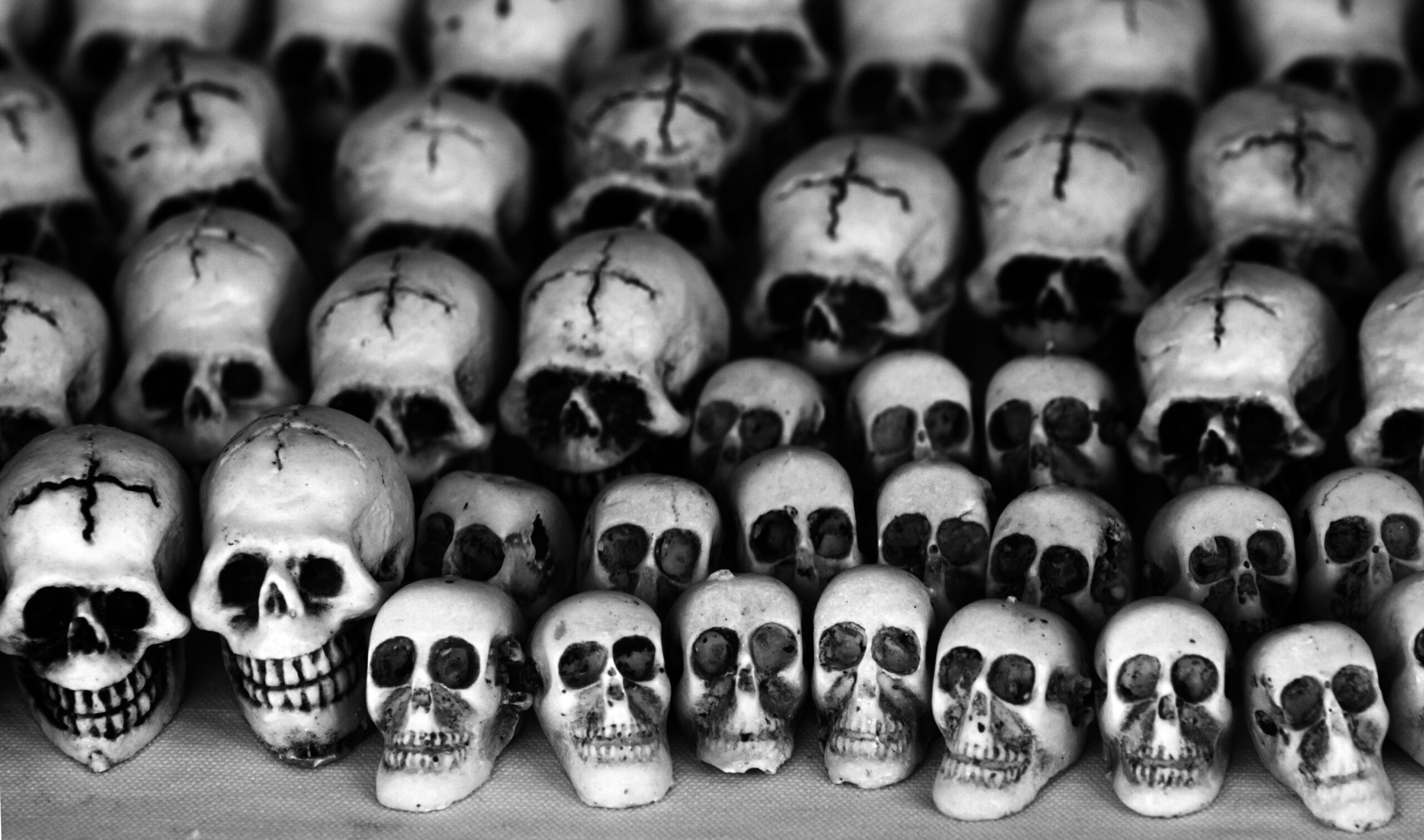
The Calaveras Skull is one of the strangest, most delicious cons in American scientific history. In 1866, deep in the gold rush country of California, miners pulled a human skull from the earth , and nearly rewrote human history with it. The find sent shockwaves through the scientific community. It supposedly proved that ancient humans had roamed North America alongside mammoths and mastodons millions of years ago. There was just one problem. The whole thing was a prank. A spectacular, years-long, Harvard-humiliating prank. And the story gets stranger the deeper you dig.
The Calaveras Skull Surfaces from the Deep Earth
On February 25, 1866, miners working a shaft in Calaveras County, California, made a jaw-dropping claim. They said they’d found a human skull buried 130 feet underground. It lay beneath a thick layer of ancient lava. That alone should have raised red flags. But the timing was perfect for one man in particular.
Josiah Whitney was California’s state geologist and a Harvard professor. He was already convinced that ancient humans had coexisted with Ice Age megafauna. He’d published that theory just the year before. So when this skull landed in his hands, it felt like destiny. Whitney rushed to announce the discovery at the California Academy of Sciences on July 16, 1866. He declared it proof of Pliocene-age humans in North America. That would make the skull at least two million years old.
The scientific world buzzed with excitement. Here was hard evidence. Bones pulled from deep in the California earth. Buried under lava. Ancient beyond imagination.
Except it wasn’t.
The miners of the Sierra Nevada, it turns out, didn’t much like Whitney. He was an Easterner with a stiff, reserved manner. They found him pompous. So they decided to have a little fun at his expense. They planted a skull , reportedly one dug from a nearby Native American burial site , and waited for the fireworks.
The fireworks lasted decades.
The Calaveras Skull Hoax Begins to Unravel
Related article: USS Craven (TB-10): The Cursed Torpedo Boat That Met a Fiery End
Doubt crept in almost immediately. Just three years after Whitney’s grand announcement, the San Francisco Evening Bulletin ran a bombshell story. A miner had confessed to a minister. The skull was a plant. A practical joke. A fake.
Whitney refused to believe it.
In 1879, Thomas Wilson of Harvard ran a fluorine analysis on the bone. It was the first time this technique had ever been used on human remains. The results were damning. The skull showed chemical properties consistent with a recent burial , not something millions of years old. Wikipedia’s overview of the Calaveras Skull notes this as a landmark moment in forensic analysis of archaeological materials.
Still, Whitney held firm. His successor at Harvard, Frederic Ward Putnam, also believed in the skull’s authenticity. Putnam traveled to California in 1901 determined to crack the case. He heard a new detail there. Someone had reportedly dug up a Native American skull from a nearby burial site in 1865 and deliberately planted it in the mine. Even then, Putnam couldn’t bring himself to call it a fake. He retreated into vague academic language, saying it might be “impossible ever to determine” where the skull was actually found.
The great poet and satirist Bret Harte wasn’t so diplomatic. In 1899, he wrote a wickedly funny poem called “To the Pliocene Skull,” mocking the whole affair. The scientific establishment had been made to look ridiculous. And they still couldn’t admit it.
Meanwhile, anthropologist William Henry Holmes from the Smithsonian Institution took a harder look. He examined the plant and animal fossils found near the skull. Those were genuine. But the skull itself was clearly too modern. Holmes wrote bluntly that to believe a human could remain physically unchanged for a million years “is to suppose a miracle.”
The Calaveras Skull Gets Its Final Verdict
The confession came in pieces. In 1911, investigator J.M. Boutwell tracked down one of the original participants in the discovery. The man admitted it plainly. The whole thing was a hoax from the start. Then came another revelation. A local shopkeeper named John C. Scribner claimed he was the one who had actually planted the skull. His sister revealed this story after his death.
But the scientific nail in the coffin came in 1992. Radiocarbon dating put the skull’s age at less than one thousand years old. Not two million years. Not even close. The skull belonged to a Native American who had died sometime in the late medieval period. It had been resting peacefully in the California soil until pranksters dug it up and used it to torment a pompous Harvard professor.
There’s a delicious irony buried in all of this. The core idea that Whitney was trying to prove , that ancient humans coexisted with mammoths and mastodons , turned out to be true. Just not in the way he imagined. Humans and these great Ice Age beasts did share the continent. But during the Pleistocene Epoch, only about 12,000 years ago. Not the Pliocene. Not two million years back.
Whitney had the right instinct. He just got tricked into defending the wrong evidence. Archaeology Magazine’s historical archives document numerous cases where scientific eagerness created blind spots exactly like Whitney’s.
To make things even stranger, careful comparison of the skull Whitney possessed with early descriptions of it revealed something unsettling. The skull he had wasn’t even the one originally found. Somewhere along the way, the skulls had been switched. Nobody knows exactly when or how.
The Legacy of a Prank That Shook American Science
The hoax didn’t die quietly. Creationists latched onto the Calaveras affair for decades. They cited it as proof that mainstream scientists ignore inconvenient evidence. The argument goes that if Whitney’s colleagues had been more open-minded, they might have accepted the skull’s implications. But that argument gets the story completely backwards. It was the scientific community that eventually exposed the fraud. Fluorine tests. Radiocarbon dating. Field investigations. Science did its job.
What makes this story so compelling isn’t just the deception. It’s the human drama underneath it. A group of rough-handed miners in the Sierra Nevada decided to humble a Harvard man. They planted a dead man’s skull in the earth. They waited. And they watched one of America’s top scientists build his reputation on a joke.
Whitney never admitted he’d been fooled. He went to his grave believing the skull was real. That’s the truly haunting part of this tale. Not the skull itself. But the image of a brilliant man, utterly certain, utterly wrong, and utterly unable to see it.
The name calaveras means “skulls” in Spanish. California’s gold rush county was named for the bones that early settlers found scattered along a riverbank. It seems fitting. This whole strange episode was built on bones , real ones, fake ones, switched ones , and the very human need to believe we’ve found something miraculous beneath the dirt.