
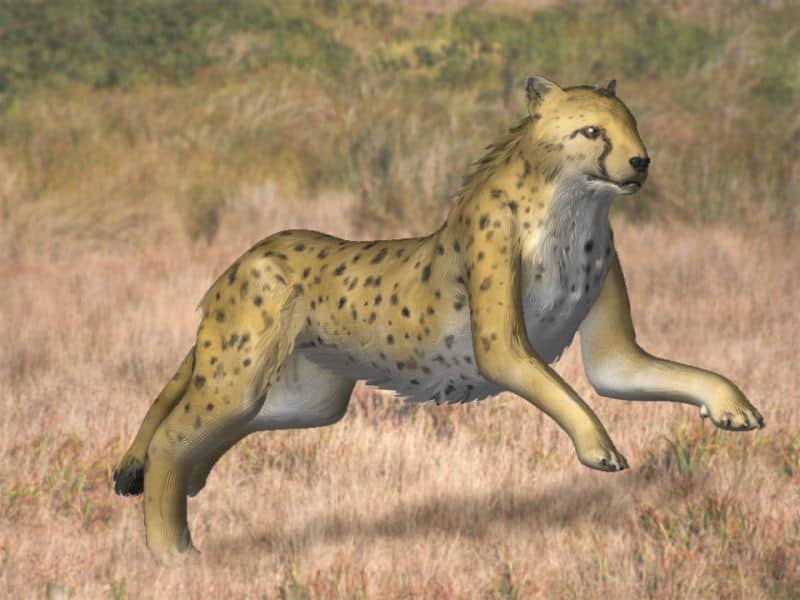
The story of Acinonyx Kurteni is one of the strangest deceptions in modern paleontology. It promised to rewrite the history of one of Earth’s fastest animals. It fooled respected scientists. It got published in a top journal. And then, slowly, it all unraveled into one of science’s most embarrassing moments. This wasn’t just a mistake. It was a fraud , and the cover-up made it even creepier.
In 2008, a fossil skull surfaced from the Linxia Basin in China’s Gansu Province. Researchers claimed it belonged to an ancient cheetah species from the Late Pliocene, roughly 2.2 to 2.5 million years ago. They named it the “Linxia cheetah.” The discovery seemed groundbreaking. It appeared to prove that cheetahs originated in the Old World, not the Americas as scientists had long believed. The scientific community took notice. National Geographic covered it. The world was impressed.
But something was very, very wrong.
The Discovery That Put Acinonyx Kurteni on the Map
The fossil was formally described in 2009 by Per Christiansen of the Zoological Museum in Copenhagen and Ji H. Mazák of the Shanghai Science and Technology Museum. Their paper appeared in the prestigious Proceedings of the National Academy of Sciences. It was a big deal. The skull appeared nearly complete. It had a tall, domed structure and enlarged frontal sinuses , features shared with the modern cheetah, Acinonyx jubatus. The upper premolars, however, looked more primitive. This combination suggested something ancient and transitional.
The species name honored Björn Kurtén, a beloved Finnish paleontologist who spent his career at the University of Helsinki. It seemed like a fitting tribute. Kurtén was legendary in the field, known for his work on Pleistocene mammals. Naming a “groundbreaking” fossil after him felt appropriate.
The skull appeared to be older than other known cheetah species. It predated the European Acinonyx pardinensis and the North African Acinonyx aicha. If real, it would have been the most primitive cheetah ever found. Scientists were excited. But one man smelled something rotten from the very beginning.
The Acinonyx Kurteni Forgery: Plaster, Ribs, and Lies
For more strange history, see: Delhi Purple Sapphire: The Cursed Amethyst That Terrorized Victorian London
Even before the paper was published, alarms were going off. Tao Deng, Professor of Paleontology at China’s Institute for Vertebrate Paleontology and Paleoanthropology, reviewed the manuscript early. He was horrified by what he saw. Just from the published photographs, Deng could tell something was off. Parts of the skull looked like they’d been glued together from unrelated bone fragments. The parietal area appeared to be a patchwork , different pieces stitched together to mimic a real cheetah skull.
Deng immediately reported his concerns to PNAS. He stated clearly that parts of the skull were made from plaster. He warned them not to publish. The editors denied his objection. Their reasoning? He hadn’t personally examined the fossil. That decision would haunt them.
Qiu Zhanxiang, a globally respected expert in mammalian skulls, also raised red flags. Other Chinese paleontologists joined the chorus of skepticism. But Mazák refused to let anyone else examine the original specimen. Disturbingly, Christiansen , the senior author , had never even seen the original fossil himself. He based his entire description on materials provided by Mazák. That’s a stunning admission.
By 2010, suspicion had spread widely through the scientific community. The two authors published a defense of their fossil. It convinced almost no one.
How the Acinonyx Kurteni Hoax Finally Collapsed
The unraveling came in 2012. Deng invoked PNAS’s own data access policy to finally gain access to the specimen. What he found was shocking , even by the standards of fossil forgeries. The zygomatic arches of the skull weren’t bone at all. They were made from ribs. The incisors were actually premolars taken from other carnivores. The posterior section of the skull was crude plaster. The whole thing was a Frankenstein’s monster of mismatched animal parts and filler material.
It got stranger. The fossil hadn’t even come from the reported location. Deng determined it was collected from Late Miocene red clay in Guanghe County , millions of years older than claimed, and from a completely different region than described. The entire geographic and temporal context was fabricated.
Deng demanded retraction. On August 20, 2012, Mazák finally conceded in a statement to PNAS. He wrote that “after further examination, it was determined that the fossil used in the study was a composite specimen from the late Miocene laterite and not from the early Pleistocene loess.” The paper was retracted. The Linxia cheetah was dead , officially exposed as a fake.
You can explore how fossil forgeries have damaged scientific credibility throughout history through peer-reviewed research on paleontological fraud detection, which highlights just how sophisticated modern fakes can become.
The Unanswered Questions Behind the Scandal
The retraction closed the scientific chapter. But it opened a darker one. Who actually created the forgery? That question was never definitively answered publicly. Someone assembled that skull with considerable skill. They knew enough about cheetah anatomy to construct something convincing to trained researchers. That takes knowledge. That takes intent.
How did Mazák obtain such a carefully constructed fake? Was he deceived himself, or was he complicit? These questions linger. The fossil black market in China has long been a serious problem. Farmers and collectors sometimes “enhance” specimens to increase their value. Some create composites. Others fabricate entirely. The Linxia Basin region, rich in genuine fossils, is also rich in opportunity for fraud.
The case also raises uncomfortable questions about peer review. PNAS published the paper despite early warnings from a credible expert. Deng’s objection was dismissed because he hadn’t touched the fossil. But he was right. The system failed spectacularly.
Christiansen apparently trusted Mazák completely and never demanded to see the specimen himself. That’s a breach of basic scientific protocol that allowed the hoax to survive years longer than it should have.
What’s truly unsettling is how close the fraud came to becoming permanent scientific fact. Had Deng not pushed , had he not invoked data access policies years later , the Linxia cheetah might still appear in textbooks today. A fake skull built from ribs and plaster might have permanently altered our understanding of big cat evolution.
The real cheetah’s remarkable evolutionary history, including its famous speed and unique physiology, deserves honest investigation. You can learn more about genuine cheetah research and conservation challenges through the full scientific record on cheetahs, which continues to evolve as legitimate fossils are discovered.
The ghost of Acinonyx Kurteni still haunts paleontology. It’s a reminder that science isn’t immune to deception , and that sometimes, the most dangerous forgeries are the ones that tell us exactly what we want to hear.
Related Posts
 Iron Maiden: The Medieval Torture Device That Never Existed
 Buytigers.com: The Internet Hoax That Fooled PETA and Exposed the Dark Side of Exotic Animal Trade
 Blue Star Tattoo Legend: The LSD Scare That Terrified Parents for Decades
 Fictitious Entry: The Dark Art of Literary Deception That Haunts Reference Works