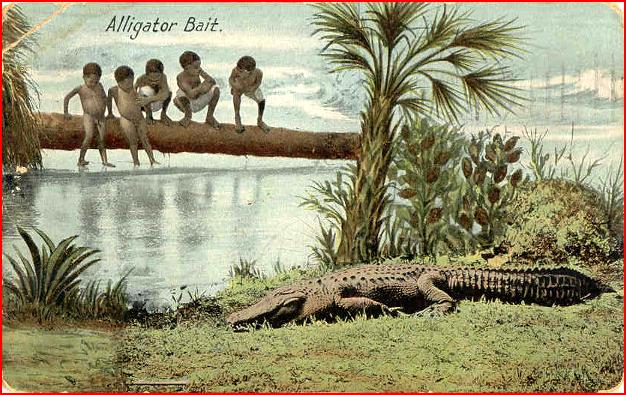
The term “Alligator Bait” represents one of the most disturbing chapters in American racist imagery. This vile trope depicted African-American children as expendable creatures meant to lure deadly alligators. The imagery spread like a disease through postcards, films, and sheet music during the late 1800s and early 1900s. What makes this phenomenon particularly chilling is how it transformed innocent children into monsters’ prey in the white American imagination.
The origins of this twisted concept remain shrouded in mystery. Some historians believe it connected African crocodiles with enslaved people who fled into Southern swamplands. Others suggest it evolved from real fears about children disappearing in alligator-infested waters. Whatever sparked this nightmare, it became a profitable industry of hate.
The imagery wasn’t just casual racism. It was systematic dehumanization designed to make Black children seem less than human. Companies mass-produced these horrific images, selling them to eager white customers across America.
The Sinister Origins of Alligator Bait Imagery
The true beginnings of Alligator Bait imagery remain lost in the murky waters of American racism. Historians can only piece together fragments of how this twisted concept emerged. The Southern swamplands held particular terror for both enslaved people and their oppressors. Alligators lurked in these dark waters, ready to devour anything that ventured too close.
Enslaved people often fled into these dangerous wetlands to escape capture. The swamps offered both refuge and death. Children were especially vulnerable to alligator attacks in these treacherous environments. This real danger may have planted the seeds for the racist imagery that followed.
The connection between African crocodiles and American alligators also played a role. White Americans already associated Africa with dangerous reptiles. They extended this fear to African-Americans living in alligator territory. The National Park Service documents how alligators became central to Southern folklore and fear.
Some primary sources mention actual use of Black children as alligator bait. However, these accounts remain disputed by modern historians. The stories may have been exaggerated or completely fabricated. What’s certain is that the idea took root in white imaginations, regardless of its truth.
How Alligator Bait Propaganda Spread Across America
Related article: Blown Off Course: How Unexpected Winds Changed History’s Greatest Voyages
The Alligator Bait trope exploded across American popular culture with shocking speed. Companies like Underwood & Underwood printed thousands of racist postcards. These “coon cards” depicted Black children being hunted by massive alligators. The images were crude, vicious, and deliberately dehumanizing.
Sheet music covers featured the same horrific imagery. Ironically, most songs had nothing to do with alligators or children. The pictures were purely symbolic weapons of racial hatred. Cigar boxes, greeting cards, and novelty items all carried these twisted images.
The American Mutoscope and Biograph Company produced two films in 1900 featuring this theme. “The ‘Gator and the Pickaninny” and “Alligator Bait” brought moving pictures to the racist imagery. These early films helped normalize the concept of Black children as monster food.
Perhaps most disturbing were the novelty letter openers shaped like alligators. Some came with tiny replicas of Black children’s heads to place in the alligator’s mouth. These desk accessories turned racist imagery into daily entertainment for white Americans.
The famous “Alligator Bait” photograph of 1897 became a massive commercial success. McCrary & Branson sold 11,000 copies, earning $5,000 (equivalent to nearly $189,000 today). A hardware store employee in Tennessee supposedly suggested the title as part of a naming contest.
The Psychological Terror of Alligator Bait Imagery
The Alligator Bait phenomenon went far beyond simple racist caricature. It represented a form of psychological warfare against Black children and families. The imagery suggested that Black children were naturally prey for monsters. This wasn’t just entertainment – it was systematic dehumanization.
White children grew up seeing these images as normal and funny. Black children faced constant reminders that white society viewed them as expendable. The trauma of seeing yourself depicted as monster food must have been devastating for young minds.
The trope connected to deeper fears about nature and civilization. Alligators represented the wild, untamed forces that white America claimed to have conquered. By depicting Black children as alligator prey, the imagery suggested they belonged to this savage realm rather than civilized society.
Historian Wilma King documented how these images portrayed Black children with “wide toothy grins, rolling white eyes, shiny dark faces, and uncontrollably kinky hair.” The children appeared “unsupervised and dispensable” – perfect victims for hungry reptiles.
The imagery also reinforced myths about Black people being closer to nature than whites. This “scientific” racism suggested that Black children naturally attracted dangerous animals. Such pseudoscience provided a veneer of legitimacy to pure hatred.
Legacy and Impact of This Disturbing Phenomenon
The Alligator Bait imagery gradually faded from mainstream culture by the mid-20th century. Civil rights movements and changing social attitudes made such blatant racism less acceptable. However, the psychological damage had already been done to generations of children.
The term “alligator bait” persisted as a racial slur long after the imagery disappeared. This linguistic violence carried the same dehumanizing message as the original pictures. Even today, some people use this phrase to inflict racial harm.
Modern scholars study these materials to understand how racism operated in American popular culture. The Library of Congress preserves many of these disturbing artifacts for historical research. Museums display them to educate visitors about America’s racist past.
The phenomenon reveals how profitable hatred could be in early American capitalism. Companies made fortunes selling racist imagery to eager white consumers. The market for such materials was vast and enthusiastic.
Understanding this history helps explain the deep roots of American racism. The Alligator Bait imagery wasn’t just offensive humor – it was a systematic campaign to dehumanize Black children. Its effects rippled through generations, shaping how Americans viewed race and childhood.
The disturbing legacy of Alligator Bait imagery serves as a stark reminder of how popular culture can weaponize hatred. These weren’t isolated incidents but part of a broader system designed to maintain racial hierarchy. By studying this dark chapter, we better understand the ongoing struggle for human dignity and equality in America.