In May 1996, an elderly Russian woman discovered something that would spark decades of mystery and speculation. Alyoshenka, a small humanoid creature found near Kyshtym, Russia, defied explanation from the moment it was discovered. The tiny being measured just 25 centimeters long and possessed features unlike any known human infant. Its large eyes dominated a skull lacking a lower jaw, while its greyish-green skin showed no signs of hair, ears, or typical human anatomy.
Tamara Vasilyevna Prosvirina, a 74-year-old woman, found the creature while collecting water from a well near her village home. She immediately took the being into her care, treating it as her own baby despite its bizarre appearance. The discovery would soon attract international attention and spawn theories ranging from premature birth defects to extraterrestrial origins.
The Strange Discovery of Alyoshenka
Prosvirina’s neighbors initially dismissed her claims about caring for a “baby” as the ramblings of an elderly woman losing her mental faculties. When she desperately sought medicine for the creature, banging on doors throughout her village, concerned residents contacted authorities. The being she protected displayed characteristics that challenged conventional understanding of human development.
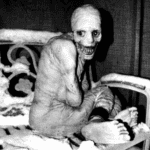
The creature’s skull featured smooth ridges that converged at a central point, resembling an unopened water lily bud. Dark spots covered its hairless head, while oversized eyes occupied most of its face. Most disturbing was the complete absence of typical infant features – no umbilical cord, no genital organs, and no lower jaw. These abnormalities fueled immediate speculation about the being’s true nature.
Prosvirina was subsequently committed to a psychiatric facility for evaluation. Medical staff dismissed her repeated pleas to return home and care for her “baby” as delusions brought on by her advanced age and deteriorating mental state. Left alone and without care, Alyoshenka died of starvation within days of Prosvirina’s hospitalization.
Scientific Analysis and the Alyoshenka Mystery
Another fascinating historical case is: Longyou Caves: China’s 2,000-Year-Old Underground Mystery That Defies Explanation
Dr. Irina Yermolaeva, who examined the remains, confirmed the body consisted of genuine mummified tissue rather than an elaborate hoax. Her analysis suggested the creature was a severely deformed fetus, possibly affected by radioactive fallout from the 1957 Kyshtym Disaster. This nuclear accident had contaminated the surrounding area with dangerous levels of radiation for decades.
However, other medical professionals who examined the remains reached different conclusions. The city morgue’s pathologist stated that at least 90% of the creature wasn’t human. The skeleton differed dramatically from human anatomy, particularly the pelvic structure, which appeared designed for both upright walking and movement on all fours.
Lyubov Romanowa, a clinical assistant with extensive experience examining birth defects, declared she had “never seen anything like this.” Despite her familiarity with severe deformities, she believed the creature was “not of human origin.” The skull contained only four bones with sharp edges, completely unlike human cranial structure.
In 2004, scientists issued an official statement declaring the remains belonged to a premature female human infant with severe deformities. DNA analysis reportedly showed human genetic material, though some researchers claimed to detect unknown genetic sequences alongside the human DNA.
The Vanishing of Alyoshenka and Mysterious Deaths
After Prosvirina’s hospitalization, neighbors turned the creature’s body over to local police for proper analysis and identification. However, the remains mysteriously disappeared from official custody, never to be recovered. Only photographs and video footage survived as evidence of the creature’s existence.
The disappearance sparked numerous theories about what happened to the body. Local ufologists claimed aliens had retrieved their fallen comrade. Others suggested wealthy collectors of curiosities had purchased the remains through underground channels. The truth remained as elusive as the creature itself.
Tragedy continued to plague those connected to the case. In 1999, Prosvirina died in a car accident while attempting to escape from the psychiatric hospital. Mark Milkhimer, an academic planning to use hypnotic regression to unlock Prosvirina’s memories, died of a sudden heart attack shortly after arriving in Kyshtym to investigate.
Vadim Chernobrov, the prominent Russian ufologist who examined the body and concluded it was extraterrestrial, became paralyzed from the waist down and died mysteriously in 2017. The string of deaths surrounding the case added another layer of intrigue to an already baffling mystery.
Theories and Cultural Impact
The case attracted international media attention, with Japanese television companies producing documentaries about the mysterious creature. Local residents capitalized on the attention, charging reporters fees for interviews and access to information about the discovery.
Eyewitness descriptions varied dramatically, adding to the confusion surrounding the case. Some described the creature as hairless with large protruding eyes, while others claimed it had hair and blue eyes. These conflicting accounts raised questions about the reliability of witness testimony and the possibility of multiple creatures or misidentification.
The 1957 Kyshtym Disaster provided a potential scientific explanation for the creature’s deformities. Nuclear fallout from the accident had contaminated the region for decades, potentially causing severe genetic mutations in local wildlife and human populations. A 2018 study of the similar Atacama skeleton revealed an extremely high number of mutations affecting bone and muscle formation, suggesting such severe deformities, while rare, were scientifically possible.
The Alyoshenka case remains one of Russia’s most enduring mysteries. Despite official statements classifying it as a deformed human fetus, questions persist about its true nature and origins. The creature’s unusual anatomy, the mysterious disappearance of its remains, and the tragic deaths of those involved continue to fuel speculation and debate.
Whether Alyoshenka represented an unknown species, a victim of nuclear contamination, or something far stranger may never be definitively answered. The case stands as a haunting reminder that some mysteries resist easy explanation, leaving us to wonder what other secrets might be hidden in the remote corners of our world.