
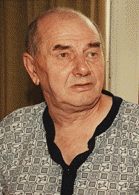
András Toma was a Hungarian soldier whose story represents one of World War II’s most extraordinary cases of prolonged captivity. Born in 1925, he was captured by Soviet forces in 1944 at just 19 years old. What followed was a 56-year ordeal that made him likely the last prisoner of war from the Second World War to be repatriated. His case fascinated psychiatrists and linguists worldwide due to his decades of enforced silence in a Russian psychiatric hospital.
Toma’s journey from a small Hungarian village to international headlines began in the rural hamlet of Sulyánbokor, near Nyíregyháza. He worked as a blacksmith’s apprentice before the war changed everything. His story highlights the human cost of global conflict and the bureaucratic failures that left countless individuals forgotten in the aftermath of war. The BBC documented his remarkable return to Hungary after more than half a century away from home.
Early Life and Military Service of András Toma
Born on December 5, 1925, in Újfehértó, eastern Hungary, András Toma lived a simple rural life before the war. He had two younger half-siblings through his father: János, who was 12 years younger, and Anna, who was 18 years younger. The family lived modestly in Sulyánbokor, where Toma learned the blacksmith’s trade as an apprentice.
In October 1944, at age 19, Toma was drafted into the Royal Hungarian Army during the final desperate months of World War II. Hungary had aligned with Nazi Germany, and by 1944, the Red Army was advancing rapidly through Eastern Europe. Toma served in an artillery regiment, experiencing combat during one of history’s most brutal conflicts.
His military service was brief but life-changing. While fighting near Auschwitz later that year, Soviet forces captured him. Like thousands of other Hungarian soldiers, he was transported eastward to a prisoner of war camp located east of Leningrad, now Saint Petersburg. This capture marked the beginning of an unimaginable journey that would span more than five decades.
Decades of Silence in Soviet Captivity
This event shares similarities with: Persian Princess: The Archaeological Hoax That Fooled the World in 2000
The prisoner of war camp where Toma was initially held closed in 1947. Instead of being repatriated like many other POWs, he was transferred to a mental hospital in Kotelnich, Russia. Soviet authorities diagnosed him with psychoneurosis, a decision that would have devastating consequences for his future.
This transfer removed Toma from official prisoner of war lists. Hungarian authorities lost track of him completely. In 1954, nearly a decade after the war’s end, he was officially declared dead. His family mourned him, never knowing he remained alive in a Russian psychiatric facility.
For 53 years, Toma lived under the name András Tamás in the hospital. He couldn’t communicate with staff or other patients because he never learned Russian, and nobody spoke Hungarian. This created an unprecedented situation of linguistic isolation. Psychiatrists and psycholinguists later studied his case with great interest, as he had essentially been deprived of meaningful conversation for over half a century.
The hospital became his entire world. He witnessed the collapse of the Soviet Union, the end of the Cold War, and the dawn of a new millennium, all while trapped in silence. His situation remained unchanged until a chance encounter in 1997 would finally break his decades of isolation.
Discovery and the Long Journey Home
In 1997, a Slovakian doctor named Karol Moravčík visited the psychiatric hospital in Kotelnich. Unlike the Russian staff, Moravčík spoke Hungarian and could communicate with Toma. This was the first real conversation Toma had experienced in over 50 years. Moravčík immediately recognized that this elderly patient was Hungarian and began efforts to help him.
The wheels of bureaucracy turned slowly, but eventually, Hungarian authorities became aware of Toma’s existence. On August 11, 2000, he finally arrived back in Hungary after 56 years of captivity. The challenge then became identifying this man who had been presumed dead for nearly half a century.
News of the mysterious Hungarian man spread quickly. Eighty-two families came forward, believing he might be their missing relative. The Guardian reported extensively on the identification process and the emotional reunions that followed. DNA testing eventually confirmed his identity, reuniting him with his surviving half-siblings on September 16, 2000.
His half-sister Anna, now in her fifties, had never stopped hoping her brother might return. The reunion was emotional and complex, as Toma struggled to readjust to a world that had changed dramatically during his absence. Hungary had transitioned from a communist state to a democratic nation, technology had advanced beyond recognition, and his family had aged without him.
Final Years and Recognition
The Hungarian government faced an unusual situation with Toma’s return. Since he had never been officially discharged from military service, he was technically still an active soldier. The Minister of Defence promoted him to sergeant major, recognizing his unprecedented length of service. More remarkably, since his military service had been continuous, authorities paid him his accumulated unpaid salary from 56 years of service.
Toma, now 74 years old, moved in with his half-sister Anna, who cared for him during his final years. The adjustment to modern life proved challenging. He had missed decades of technological advancement, social change, and family milestones. The world he returned to bore little resemblance to the one he had left in 1944.
Despite these challenges, Toma found some peace in his final years. He reconnected with his surviving family members and experienced the simple pleasures of home that had been denied to him for so long. His story captured international attention, highlighting the lasting human cost of war and the importance of never forgetting those left behind.
András Toma died on March 30, 2004, at age 78 in Nyíregyháza, Hungary. He was buried with full military honors, a fitting tribute to a man whose sacrifice and suffering embodied the experiences of countless forgotten victims of war. His case remains unique in military history as likely the longest documented period of captivity for any World War II prisoner of war.
His story serves as a powerful reminder of war’s lasting impact on individual lives and the importance of accounting for all military personnel. The decades of silence András Toma endured represent an extreme example of human resilience and the enduring hope for homecoming that sustains prisoners of war worldwide.
Related Posts
 Street fighting Throughout History: From Ancient Combat to Modern Urban Violence
 Urban Riot: The Explosive History of Civil Unrest in America’s Cities
 Alligator Bait: The Disturbing Racist Imagery That Haunted American Popular Culture
 Famous Impostors: Bram Stoker’s Final Investigation into History’s Greatest Deceptions