
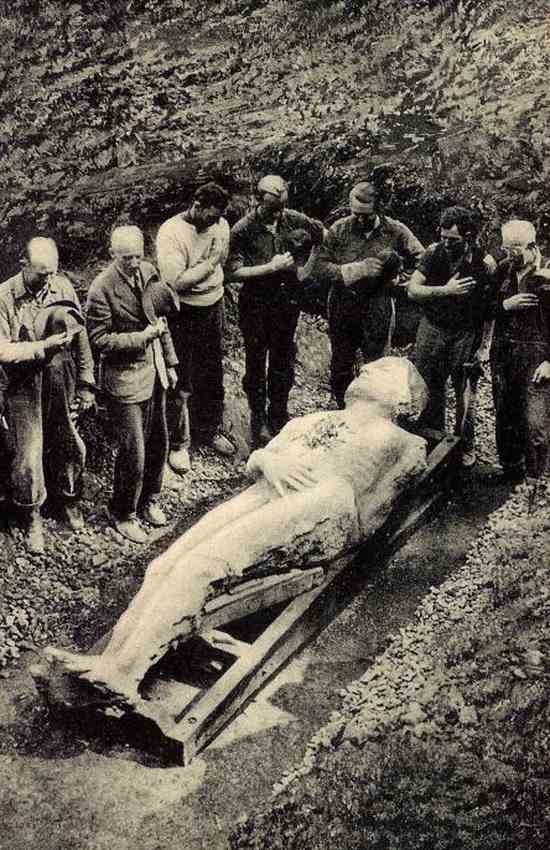
The Cardiff Giant is one of the strangest con jobs in American history. In October 1869, workers digging a well in Cardiff, New York, pulled a ten-foot stone “man” from the earth. What followed was a mass delusion. Thousands of people paid good money to stare at a fake corpse. Scientists argued. Preachers wept. And one very clever tobacco salesman laughed all the way to the bank. This is the story of a hoax so brazen it still shocks people today.
The Cardiff Giant and the Angry Skeptic Who Started It All
The man behind the hoax was George Hull. He wasn’t a scientist or a con artist by trade. He sold tobacco in New York. But Hull had a burning hatred for religious gullibility. It all started at a Methodist revival meeting in the late 1860s. Hull got into a fierce argument with a Reverend Turk. The debate was over Genesis 6:4, the Bible verse that says giants once walked the Earth. Hull was a skeptic. He lost the argument badly. The crowd sided with the reverend. Hull left furious.
But Hull didn’t just stew in anger. He hatched a plan. He would create a giant and bury it. Then he’d watch ordinary people convince themselves it was real. It was a revenge scheme dressed up as an archaeological discovery.
In 1868, Hull traveled to Fort Dodge, Iowa. He hired men to quarry a massive block of gypsum. He told them it was for a monument to Abraham Lincoln. That was a lie. He shipped the block to Chicago, where German stonecutter Edward Burkhardt hired two sculptors to carve the figure. Workers put up quilts around the workspace to muffle the sounds of chiseling. The whole operation was wrapped in secrecy.
The finished giant was modeled after Hull himself. It measured over ten feet long and weighed nearly 3,000 pounds. Hull consulted a geologist to make it convincing. He learned that hair wouldn’t survive petrification, so the figure was carved smooth. The surface was beaten with steel needles embedded in a board to fake skin pores. Sulfuric acid was rubbed in to age the color. Sand and water were used for a weathered finish. The full story of the Cardiff Giant’s creation reads like a criminal mastermind’s blueprint.
Hull spent the equivalent of $63,000 in today’s money on the scheme.
How the Cardiff Giant Fooled Thousands of Paying Visitors
Related article: Buytigers.com: The Internet Hoax That Fooled PETA and Exposed the Dark Side of Exotic Animal Trade
In November 1868, Hull had the figure buried on the farm of his cousin, William Newell, in Cardiff, New York. It sat underground for nearly a year. Then, on October 16, 1869, Newell hired two workers to dig a well. Gideon Emmons and Henry Nichols broke ground right where the giant was buried. It wasn’t an accident.
When they struck stone and began brushing dirt away, one worker reportedly cried out: “I declare, some old Indian has been buried here!” That single exclamation set off a firestorm.
Newell moved fast. He threw up a tent over the site. On the first day, he let people look for free. By the second day, he was charging fifty cents per person for a fifteen-minute viewing. That was real money in 1869. Hundreds of visitors flooded in daily. Hotels and restaurants in Cardiff were overwhelmed. The town had never seen anything like it.
People were desperate to believe. Some insisted the giant was a petrified man. They thought it was one of the biblical giants from Genesis. Others argued it was an ancient statue carved by a French Jesuit missionary centuries earlier. Almost nobody called it a fake at first. The sheer size of the thing was paralyzing. How could something that big be a lie?
Experts were called in. John F. Boynton, one of the first geologists on scene, declared it couldn’t be a fossilized human. But he still suggested it was a genuine ancient statue. Even skeptics couldn’t quite pull the trigger on calling it a total fraud.
Andrew D. White, the first president of Cornell University, was one of the few who saw through it quickly. He noticed something obvious. There was no logical reason to dig a well in that exact spot. A spring and stream were already nearby. The placement was suspicious from the start. White called it a hoax immediately. But his voice was drowned out by the roar of the believing crowd.
The Cardiff Giant Exposed: P.T. Barnum and the Double Fake
The hoax unraveled fast once the money started flowing. Investors bought a stake in the giant for $37,500. They moved it to Syracuse, New York, for a bigger exhibition. That’s when the showman P.T. Barnum came sniffing around.
Barnum offered to buy the giant outright. The investors refused. So Barnum did something audacious. He hired someone to secretly study the giant and then commissioned his own copy. He put his fake version on display and claimed it was the real one. He even suggested the Cardiff version was the fake.
Now America had two fake giants competing for audiences. Barnum’s copy drew massive crowds. The original investors sued him. The judge reportedly told them they couldn’t claim damages over a stone fake without first proving their stone fake was real. The case collapsed into absurdity.
Meanwhile, Hull’s original stonecutters began talking. Geological analysis confirmed the figure was carved gypsum, not a petrified human. The acid staining, the fake pores, the deliberate aging , it all came out. Hull eventually confessed. He had pulled off one of the most spectacular public deceptions in American history. Scientific American covered the giant controversy in 1869, capturing the debate as it unfolded in real time.
Why Americans Fell For It , And What That Says About Us
The Cardiff hoax worked because people wanted it to work. In 1869, America was wrestling with big questions. Darwin’s theory of evolution had only recently arrived. Religious communities were pushing back hard. The idea that a giant biblical man had been found in the American soil was deeply comforting to many believers. It felt like proof. It felt like vindication.
Hull understood that. He didn’t just carve a rock. He carved a mirror. He showed America exactly what it wanted to see. And America paid fifty cents to look at it.
The hoax also exposed how easily authority figures could be fooled. Geologists hedged. Professors speculated. Only a handful had the nerve to say the obvious truth out loud. The rest were swept up in the excitement.
Both the original giant and Barnum’s copy still exist today. The original sits at the Farmers’ Museum in Cooperstown, New York. Barnum’s version is at Marvin’s Marvelous Mechanical Museum in Michigan. Two stone fakes. Both still drawing curious eyes. Hull’s joke never really ended. It just keeps going, carved in gypsum, waiting for the next crowd to gather round and wonder.