
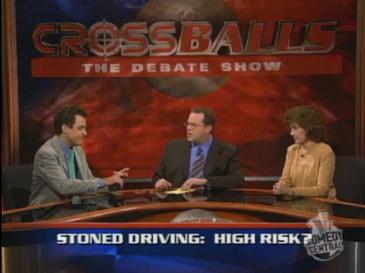
Crossballs: the Debate Show was one of the strangest experiments in television history. It aired on Comedy Central in the summer of 2004. The premise was deceptively simple , and genuinely unsettling in its execution. Comedians posed as credentialed experts. Real commentators, activists, and pundits sat across from them. Nobody told the real guests they were on a fake show. The result was a bizarre social experiment disguised as a cable news parody. It ran for just eight weeks. Then it vanished , partly because someone threatened to sue. What happened behind the cameras is weirder than most people remember.
How Crossballs: the Debate Show Tricked Real People Into Arguing With Actors
The show launched on July 6, 2004. It was created by Matt Besser and Charlie Siskel. Chris Tallman hosted as a straight-faced news anchor type. The format mimicked shows like CNN’s Crossfire and MSNBC’s Hardball with Chris Matthews. Those shows were already theatrical. That’s what made the prank so effective.
Real guests were booked under false pretenses. They believed they were appearing on a legitimate political debate program. They prepared arguments. They brought their talking points. Then they sat down across from comedians playing characters like “Dr. Ronald Snerd” or other invented experts with fake credentials.
The real guests argued in good faith. The fake guests said increasingly absurd things. Some real guests got frustrated. Others doubled down. A few seemed to sense something was off , but couldn’t quite name it. That psychological discomfort is what made the show so strange to watch.
CNN’s Crossfire was already known for its heated, performative arguments. Crossballs weaponized that format against unsuspecting participants. It exposed something uncomfortable: how easily confident people can be manipulated when the setting feels familiar.
Notable real guests included Chris Simcox, founder of the Minuteman Civil Defense Corps. Wiley Drake, an outspoken Southern Baptist evangelist, also appeared. Jackie Christie, wife of NBA player Doug Christie, sat across from fake experts. None of them knew they were being pranked.
The Buried Episode of Crossballs: the Debate Show That Never Aired
This event shares similarities with: The Strange Tale of Mister Mosquito: Japan’s Most Bizarre Video Game Phenomenon
Twenty-three episodes made it to air. The twenty-fourth did not. Episode 24 was titled “Pistol Whipped America.” It was taped. It was ready. Then it was buried forever.
A real guest named James March threatened to sue Comedy Central. That was enough. The network pulled the episode and never aired it. March’s legal threat effectively killed the episode , and arguably the show itself. The final aired episode was “Sex Battle USA,” which ran on August 25, 2004.
This kind of legal threat isn’t unusual for prank-based programming. But it reveals something darker about the show’s format. Real people were being put in genuinely uncomfortable situations. Their reputations were on the line. Their arguments were being used as props in a comedy sketch they hadn’t agreed to join.
The show walked an ethically strange line. Was it journalism? Was it comedy? Was it a social experiment? The answer was probably all three , and that ambiguity made it legally and morally complicated.
Jacob Sullum wrote about this ethical puzzle for Reason magazine in October 2004. His piece asked a genuinely unsettling question: why didn’t the real guests figure out the joke? The answer said something disturbing about human psychology. People trust familiar formats. A TV studio with cameras and a host feels authoritative. That feeling overrides skepticism.
The Stolen Concept Accusation That Haunted Crossballs: the Debate Show
The legal threats didn’t stop with James March. Radio comedian Phil Hendrie publicly accused the show’s creators of theft. He claimed they stole the concept from a pitch he made to Comedy Central back in 1998. He also said the format mirrored his own Phil Hendrie Show, where callers would argue with fictional characters without realizing they weren’t real.
Hendrie’s accusation added another layer of strangeness to the show’s short history. Here was a prank show , built on deception , being accused of deceiving its own creators’ inspirations. The irony was almost too perfect.
Whether the accusation had legal merit was never publicly resolved. But it cast a shadow over the show’s legacy. Comedy Central never renewed it for a second season. The show disappeared quietly, leaving behind 23 aired episodes, one buried episode, and a cloud of unresolved questions.
The cast included some genuinely talented performers. Matt Besser appeared as a fake guest debater. Mary Birdsong, Andrew Daly, and Jerry Minor rounded out the core team. Sean Conroy and Rich Fulcher appeared in occasional episodes. These were skilled improvisers. Their job was to stay in character while real people grew increasingly confused or angry around them.
Why This Strange Little Show Still Matters Today
Crossballs only ran for eight weeks in 2004. It left almost no cultural footprint compared to other Comedy Central hits. But it deserves to be remembered , for strange reasons.
It predicted something. Cable news in 2004 was already performative. Pundits already played characters. Debates were already theater. The show simply made that theater explicit. It stripped away the pretense and showed what was underneath: people performing certainty they didn’t always have, in formats designed to generate heat rather than light.
The show also raised questions that haven’t gone away. How do we know when we’re being manipulated by a familiar format? What does it mean to argue in good faith against someone who isn’t? These questions feel more urgent now than they did in 2004.
The full episode list and cast details are documented on Wikipedia, though the show itself remains difficult to find in full. Most episodes have never been officially released. The buried twenty-fourth episode may never surface at all.
Crossballs: the Debate Show was weird, ethically murky, and legally troubled. It was also ahead of its time. In a media landscape where the line between performance and reality keeps blurring, this forgotten little prank show from 2004 looks less like a curiosity , and more like a warning.
Related Posts
 The Poppy Fields: The Bizarre Musical Hoax That Fooled the World
 Japanese Paleolithic Hoax: The Divine Hand That Fooled a Nation for Decades
 Bananadine: The Great Banana Peel Hoax That Fooled America in 1967
 Buytigers.com: The Internet Hoax That Fooled PETA and Exposed the Dark Side of Exotic Animal Trade