The Crying Boy paintings became Britain’s most feared artwork in 1985 when firefighters discovered something chilling. These mass-produced prints of tearful children were surviving house fires that destroyed everything else around them. The discovery sparked nationwide panic about cursed paintings that seemed immune to flames.
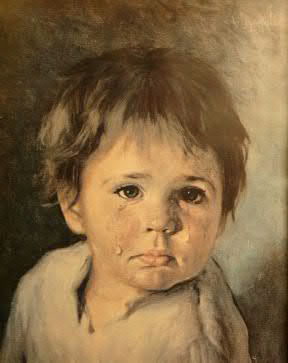
Italian artist Bruno Amadio, working under the pen name Giovanni Bragolin, created the original painting in the 1950s. The artwork showed a young boy with tears streaming down his face. Mass production made these prints incredibly popular in British homes. Thousands of families hung them on their walls, unaware of the terror that would follow decades later.
The paintings depicted various crying children, both boys and girls. Each version showed the same haunting expression of sadness. The artist’s signature “G Bragolin” appeared in the corner of every print. These weren’t expensive masterpieces but affordable decorations found in ordinary homes across the UK.
The Crying Boy Curse Ignites Public Fear
On September 5, 1985, The Sun newspaper published a story that changed everything. An Essex firefighter claimed he’d found undamaged Crying Boy prints in the ruins of burned houses. The paintings lay face-down on floors where everything else had turned to ash. This wasn’t an isolated incident but a pattern spanning multiple fire scenes.
The firefighter’s account sent shockwaves through Britain. People remembered their own house fires where the paintings had mysteriously survived. Stories poured in from across the country. Fire crews in Yorkshire reported finding the prints intact after devastating blazes. Rotherham fire officer Alan Wilkinson logged 50 separate incidents where the paintings survived fires.
The media frenzy intensified as more witnesses came forward. Families shared terrifying tales of unexplained fires starting near their Crying Boy paintings. Some claimed the fires began without any obvious cause. Others reported strange occurrences before the blazes started. The curse seemed to target homes displaying these particular artworks.
By November 1985, panic reached fever pitch. The Sun organized mass bonfires where readers could destroy their paintings. Thousands of people brought their Crying Boy prints to be burned. The newspaper treated it like a public service, helping families rid themselves of cursed objects.
Scientific Investigation Debunks the Crying Boy Mystery
Related article: The Bélmez Faces: Spain’s Most Terrifying Paranormal Mystery That Haunts Scientists Today
Steve Punt, a British comedian and writer, decided to investigate the curse scientifically. In 2010, he conducted experiments for BBC Radio 4’s “Punt PI” program. Punt purchased a Crying Boy print and attempted to burn it under controlled conditions. The results were revealing but far from supernatural.
The Building Research Establishment helped with the investigation. They discovered the prints were treated with fire-retardant varnish during manufacturing. This chemical coating protected the artwork from flames. The varnish was standard for mass-produced prints in the 1970s and 1980s.
The investigation also explained the paintings’ positioning after fires. The string holding the artwork to walls would burn first during house fires. This caused the paintings to fall face-down onto floors. The face-down position protected the image from direct flame exposure. The backing material also resisted burning better than the surrounding furniture.
Material analysis revealed more practical explanations. The prints used high-density hardboard backing that resisted ignition. This compressed material charred rather than fully combusting. Combined with the fire-retardant coating, these factors explained the paintings’ survival. Science had debunked the supernatural explanation.
The Don Bonillo Legend and Modern Investigations
In 2000, author Tom Slemen added a sinister backstory to the curse. He claimed the crying child was named Don Bonillo, a Spanish orphan whose parents died in a fire. According to this tale, the artist’s studio later burned down, killing the child model. The story suggested the boy’s spirit haunted the paintings, causing fires wherever they hung.
Investigative journalist David Clarke thoroughly researched these claims. He found no evidence supporting the Don Bonillo story. Clarke stated there was “absolutely no truth whatsoever” to the legend. The backstory appeared to be complete fiction, created decades after the original panic. This fabricated history added dramatic flair but lacked any factual basis.
Modern paranormal investigators continue studying the paintings. Skeptical Inquirer magazine examined the curse claims in detail, confirming the scientific explanations. Recent cases from New Zealand and other countries occasionally surface on social media. However, no verified new incidents have been documented since the 1980s.
The legend persists in digital spaces despite scientific debunking. TikTok creators share spooky stories about the paintings. YouTube channels dedicated to haunted objects feature the curse regularly. These modern retellings often ignore the scientific explanations, preferring the supernatural narrative.
Legacy of Britain’s Most Notorious Artwork
The Crying Boy phenomenon represents a perfect storm of coincidence, fear, and media amplification. Mass production meant these prints appeared in thousands of British homes. When house fires occurred, the fire-resistant materials helped some paintings survive. Selective reporting created the illusion of a supernatural pattern.
The 1985 panic demonstrates how urban legends spread in pre-internet society. Newspaper coverage transformed isolated incidents into nationwide hysteria. The Sun’s bonfire events became cultural spectacles, burning thousands of innocent artworks. Fear overcame rational explanation as families rushed to destroy their paintings.
Original Crying Boy paintings now command higher prices at auctions. The curse notoriety has given them collector value beyond their artistic merit. Some pieces sell for hundreds of dollars, far exceeding their original retail price. The legend has transformed mass-produced prints into sought-after curiosities.
The story continues evolving in digital age folklore. New generations discover the legend through online content creators. Social media algorithms spread the tale to global audiences. The Crying Boy curse has transcended its British origins to become international urban legend material.
Today, the paintings serve as a fascinating case study in mass hysteria and urban legends. They remind us how easily fear can override scientific reasoning. The Crying Boy curse may be debunked, but its cultural impact remains undeniably real.