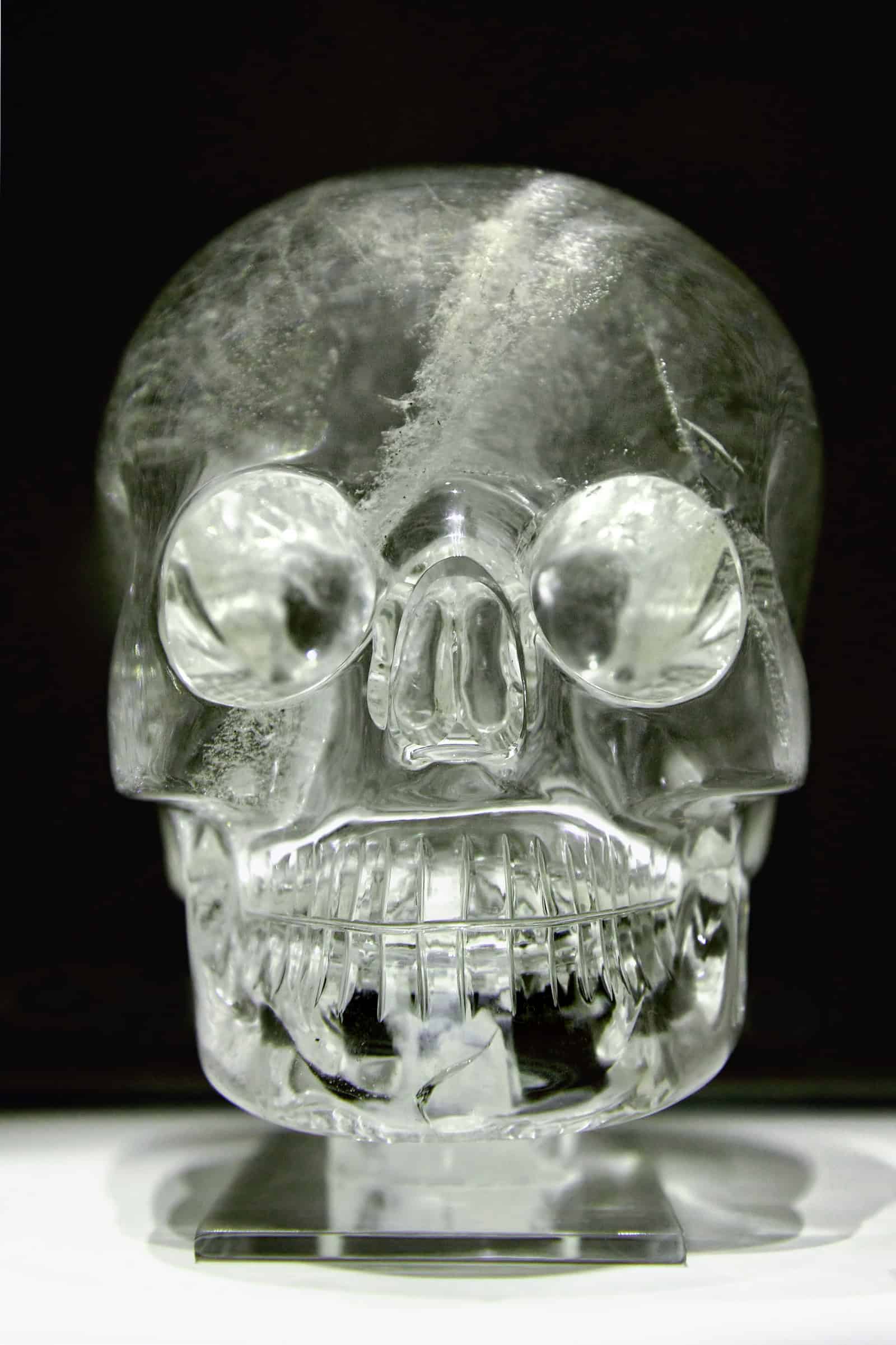
The Crystal Skull phenomenon represents one of history’s most enduring archaeological hoaxes. These mysterious quartz carvings captivated Victorian collectors and continue to inspire supernatural beliefs today. What appeared to be ancient Mesoamerican artifacts turned out to be elaborate 19th-century European forgeries that fooled major museums for decades.
In the shadowy world of antiquities dealing, few objects have generated as much intrigue as these translucent skulls. Their perfectly carved features and eerie transparency created an immediate sense of otherworldly power. Victorian-era collectors eagerly purchased them, believing they possessed genuine pre-Columbian artifacts with mystical properties.
The skulls’ journey from European workshops to prestigious museum collections reveals a fascinating tale of deception, scientific investigation, and supernatural claims that persist despite overwhelming evidence of their fraudulent origins.
The Crystal Skull Deception: Eugène Boban’s Victorian Scheme
Eugène Boban operated as the mastermind behind the Crystal Skull trade in 19th-century Paris. This French antiquities dealer opened his shop in 1870 and quickly established himself as a supplier to major museums worldwide. Boban understood Victorian society’s fascination with death symbolism and ancient mysteries.
The British Museum’s crystal skull first appeared in Boban’s network in 1881. He claimed it originated from ancient Mexico, complete with elaborate backstories about Aztec priests and sacred rituals. Museums eagerly acquired these pieces, displaying them as genuine pre-Columbian artifacts.
Boban’s operation extended beyond Paris. He sold skulls to the Smithsonian Institution, the British Museum, and France’s Musée de l’Homme. Each transaction included carefully crafted provenance stories designed to authenticate the skulls’ supposed ancient origins.
The dealer’s success stemmed from perfect timing. The 1860s French intervention in Mexico created opportunities for acquiring “ancient” artifacts. Boban served as official archaeologist to Emperor Maximilian I’s regime, lending credibility to his claims.
Scientific Analysis Exposes the Crystal Skull Fraud
Another fascinating historical case is: Operation Snow White: The Church of Scientology’s Massive Government Infiltration Conspiracy
Modern scientific techniques demolished the Crystal Skull authenticity claims with devastating precision. In 1967, the British Museum conducted the first detailed analysis using electron microscopy. The results shocked researchers and exposed the elaborate Victorian-era deception.
Microscopic examination revealed tool marks consistent with 19th-century jeweler’s equipment. The carved teeth showed indentations made by rotary tools invented in the 1800s. Pre-Columbian craftsmen lacked such sophisticated machinery, making ancient origins impossible.
X-ray crystallography provided additional damning evidence. The quartz material contained chlorite inclusions found only in Madagascar and Brazil. Ancient Mesoamerican civilizations had no access to these specific crystal types, further proving the skulls’ European manufacture.
The Smithsonian Institution’s 1992 investigation of an anonymous skull donation confirmed these findings. Researchers discovered silicon carbide abrasive marks on the surface. This synthetic compound wasn’t invented until the 1890s, dating the skull’s creation to the 20th century.
The Mitchell-Hedges Crystal Skull: Supernatural Claims and Strange Powers
Anna Mitchell-Hedges transformed her inherited skull into a supernatural phenomenon through decades of mystical claims. She insisted the artifact could cause visions, cure cancer, and even kill people through its magical properties. Her dramatic stories captivated New Age believers and paranormal enthusiasts.
The skull allegedly showed Anna a premonition of President Kennedy’s assassination. She claimed it possessed computer-like abilities, recording energy and vibrations from ancient civilizations. These supernatural assertions attracted thousands of visitors to her Canadian home.
Smithsonian researchers found no evidence supporting these paranormal claims. The Mitchell-Hedges skull showed identical manufacturing techniques to other proven fakes. Tool marks revealed modern carving methods inconsistent with ancient craftsmanship.
Despite scientific debunking, supernatural believers continue promoting crystal skull mysticism. They claim the artifacts channel ancient wisdom, heal illnesses, and provide psychic insights. These persistent beliefs demonstrate the enduring power of Victorian-era marketing combined with human fascination for the mysterious.
German Workshops and the Truth Behind the Carvings
The town of Idar-Oberstein emerged as the likely manufacturing center for these elaborate forgeries. This German community specialized in crafting objects from imported Brazilian quartz during the late 19th century. Local artisans possessed the skills and materials necessary for creating convincing skull replicas.
German workshops imported high-quality quartz from Brazil, the same material found in museum skulls. Skilled craftsmen used advanced lapidary techniques to achieve the smooth surfaces and precise details that fooled Victorian collectors. The town’s reputation for intricate crystal work made it the perfect location for such sophisticated forgeries.
Archaeological evidence supports German origins for multiple skulls. The Journal of Archaeological Science published detailed studies confirming European manufacture. Researchers found consistent tool marks and material compositions across different museum specimens.
Modern investigations continue revealing the scope of this 19th-century deception. Jane MacLaren Walsh, a leading Smithsonian expert, estimates that dozens of fake skulls entered collections worldwide. Her research exposes the systematic nature of Victorian-era antiquities fraud and its lasting impact on archaeological understanding.
The Crystal Skull saga demonstrates how scientific analysis can expose even the most elaborate historical hoaxes. These Victorian forgeries continue fascinating people despite overwhelming evidence of their fraudulent origins. Their story serves as a cautionary tale about the intersection of commerce, mysticism, and archaeological authenticity in the modern world.