
The Dyatlov Pass Incident stands as one of the most chilling unsolved mysteries of the 20th century. On February 1, 1959, nine experienced Soviet hikers ventured into the northern Ural Mountains. They never returned alive. What happened on that frozen mountainside defies rational explanation even today.
Igor Dyatlov led his group of fellow students from the Ural Polytechnical Institute. They planned a challenging winter trek to Otorten Mountain. The team included seasoned hikers who knew the dangers of Siberian wilderness. None expected to become part of history’s strangest tragedy.
The last known photograph shows the team setting up camp on February 1st. They pitched their tent on the eastern slope of Kholat Syakhl mountain. The name translates to “Mountain of the Dead” in the local Mansi language. Perhaps it was an omen.
The Dyatlov Pass Incident Discovery That Shocked Investigators
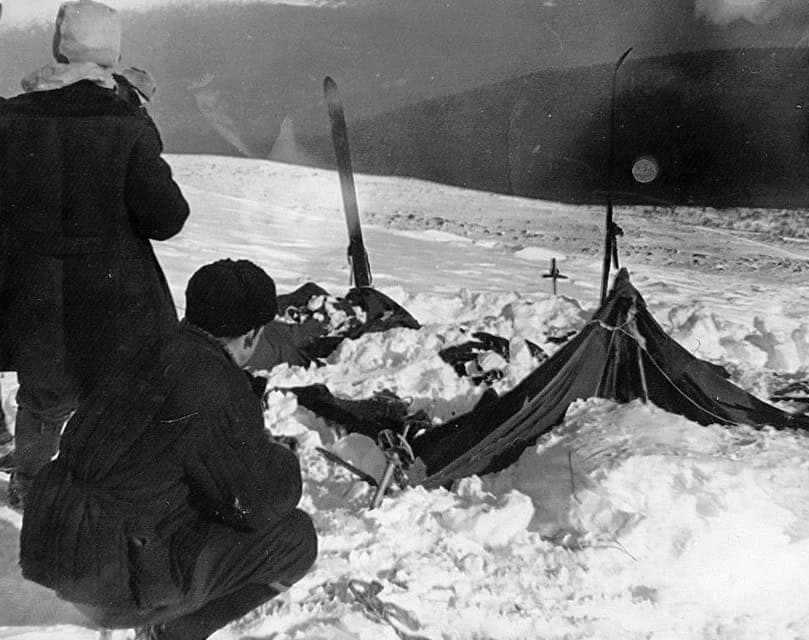
Search teams found the abandoned campsite on February 26, 1959. What they discovered defied all logic. The tent was cut open from the inside. Nine sets of footprints led away into the snow. The hikers had fled barefoot or in socks into -40°F temperatures.
The scene looked like something from a nightmare. Personal belongings lay scattered inside the intact tent. Food and warm clothing remained untouched. No signs of struggle or external attack existed. Yet something had terrified these experienced mountaineers enough to slice through their shelter and run into certain death.
Investigators followed the footprints for over a mile. The trail led to a cedar tree near a frozen creek. There, they made their first grisly discovery. Two bodies lay beneath the tree, wearing only underwear. Their hands were burned from trying to climb the tree and start a fire. Broken branches 15 feet high suggested desperate attempts to spot something in the distance.
The official investigation would uncover increasingly bizarre details. Three more bodies appeared between the tree and the tent. They seemed to be heading back to camp when hypothermia claimed them. But the final four hikers presented an even stranger puzzle.
Impossible Injuries and Radioactive Clues in the Dyatlov Pass Incident
For more strange history, see: Grave Creek Stone: The Mysterious Inscription That Divided Archaeologists for Centuries
The remaining four bodies weren’t found until May, buried under 12 feet of snow in a ravine. Their condition shocked forensic experts. These hikers had suffered massive internal injuries without external wounds. One victim’s skull was fractured. Another had severe chest trauma that would require “the force of a car crash” according to the medical examiner.
Most disturbing of all, two hikers were missing their eyes. One was also missing her tongue. The soft tissues had been removed with surgical precision. No animal could have caused such wounds. The bodies showed no signs of decomposition despite months in the wilderness.
Radiation detectors revealed another mystery. Some clothing contained radioactive contamination. The levels weren’t immediately lethal but were significantly above normal. How did mountain hikers encounter radioactive materials in 1959 Soviet wilderness?
Lead investigator Lev Ivanov noted other strange details. The tent fabric was burned in places. Some clothing glowed when examined under certain conditions. Geiger counters “clicked a lot” around certain items. Ivanov later admitted he had no rational explanation for what he witnessed.
Witnesses Report Strange Lights During the Dyatlov Pass Incident
The mystery deepened when witnesses came forward. Multiple people reported seeing strange lights in the sky on the night the hikers died. Students from another expedition saw glowing orbs moving across the mountain range. Weather station workers observed similar phenomena.
G. Atamanaki, a local resident, watched a bright sphere hovering over Otorten Mountain on February 1st. The object pulsed with orange light before disappearing. Other witnesses described fireballs that changed direction in ways no known aircraft could manage.
Military personnel at a nearby base also reported unusual aerial activity. Bright objects moved against the wind at impossible speeds. Some witnesses claimed the lights appeared to respond to ground activity. The sightings coincided exactly with the time frame of the hikers’ deaths.
Years later, Ivanov revealed he’d been ordered to suppress these reports. High-ranking Soviet officials demanded he dismiss all UFO-related testimony. The investigator complied but privately believed “flying spheres” played a role in the tragedy. His final report blamed “an unknown compelling force” for the deaths.
Theories and Modern Investigations
Decades of speculation have produced numerous theories about what killed the Dyatlov hikers. Avalanche remains the most popular scientific explanation. In 2020, Russian prosecutors officially blamed a delayed slab avalanche for the incident. Swiss researchers supported this theory with computer simulations and field studies.
However, the avalanche theory struggles to explain many key details. Why were there no avalanche debris at the scene? How did hikers suffer such severe internal injuries from snow? What caused the radiation and mysterious lights?
Other theories range from military weapons testing to infrasound-induced panic. Some suggest the hikers encountered a secret Soviet experiment. The area was known for missile testing and nuclear research. The 1957 Kyshtym disaster had contaminated nearby regions with radioactivity.
Contemporary accounts from the era documented similar unexplained incidents across the Soviet Union. Strange lights, missing persons, and covered-up investigations became recurring themes during the Cold War period.
The sole survivor of the original group, Yuri Yudin, turned back before reaching the fatal campsite due to illness. Until his death in 2013, he maintained that something extraordinary killed his friends. “If I could ask God one question,” he said, “it would be: What really happened to my friends that night?”
The Dyatlov Pass Incident continues to generate new evidence and theories. Recent expeditions have documented actual avalanches at the site, lending credibility to natural explanations. Yet the radioactivity, impossible injuries, and witness testimony of strange lights remain unexplained. Perhaps some mysteries are meant to stay unsolved, haunting us with questions we’re not ready to answer.