
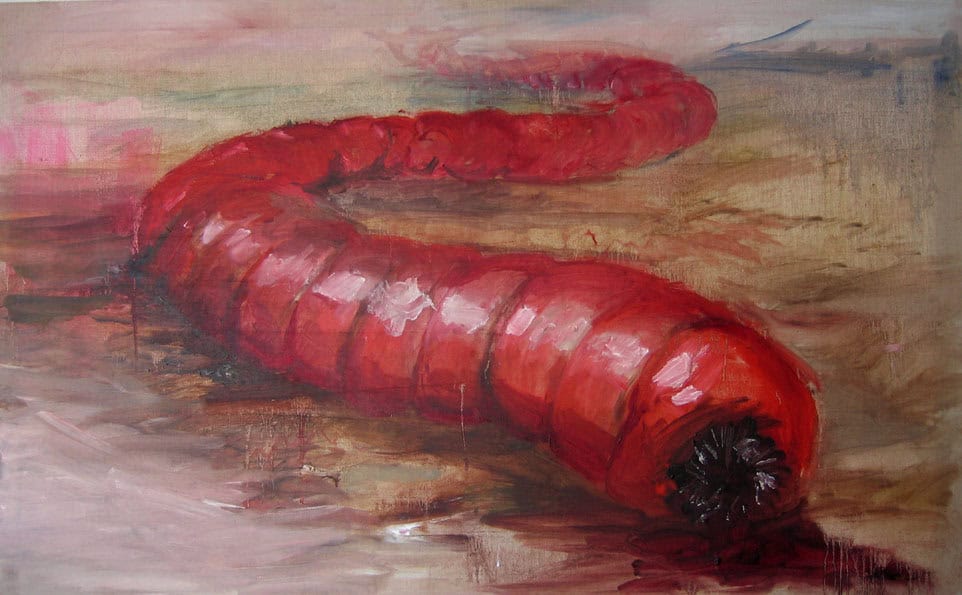
The Mongolian Death Worm strikes fear into the hearts of desert nomads across the vast Gobi. This legendary creature, known locally as “olgoi-khorkhoi,” translates to “large intestine-worm.” The beast allegedly lurks beneath the sand dunes, emerging only to kill with deadly precision.
Local Mongolians describe a sausage-shaped monster about two feet long. It has no visible head or legs. The creature’s most terrifying feature isn’t its appearance,it’s its ability to kill at a distance. Some say it spits corrosive venom that melts flesh on contact. Others claim it generates powerful electric shocks that can stop a human heart instantly.
The Western world first learned of this desert demon through paleontologist Roy Chapman Andrews in 1926. He documented secondhand accounts from Mongolian officials who had never seen the creature themselves. Yet they believed in its existence completely. They described it in vivid, terrifying detail during gatherings in remote desert outposts.
The creature’s reputation spread like wildfire through cryptozoological circles. Soon, brave researchers would venture into the harsh Gobi Desert. They sought to prove or disprove the existence of this legendary sand dweller.
Mongolian Death Worm Sightings Peak in the 1950s
Eyewitness accounts of the Mongolian Death Worm reached their highest frequency during the 1950s. Local herders reported mysterious livestock deaths during this period. Animals were found with strange burns covering their bodies. Some carcasses showed signs of acid-like wounds that couldn’t be explained.
Nomads described seeing the sand ripple and move in unnatural patterns. These disturbances suggested something massive traveled beneath the surface. Witnesses claimed to see sudden flashes of red light before the creature vanished. The attacks happened so quickly that victims had no chance to escape.
One particularly chilling account came from a 90-year-old former policeman. He claimed to have encountered the beast in 1930. The man described watching the sand part like water as something moved underneath. He felt an electric charge in the air moments before fleeing the scene.
The creature’s hunting patterns seemed to follow seasonal rainfall. Locals noticed more sightings occurred after desert storms. This led to theories that the worm emerged to hunt near temporary water sources. The connection between moisture and appearances became part of the growing legend.
Scientific Expeditions Hunt the Mongolian Death Worm
Related article: Loveland Frog: Ohio’s Mysterious Humanoid Cryptid That Sparked Decades of Terror
The first serious scientific expedition occurred in 1990 when Ivan Mackerle led a team into the Gobi. Inspired by Frank Herbert’s novel “Dune,” Mackerle constructed a motor-driven “thumper” device. He believed rhythmic vibrations might draw the creature to the surface. The team even used small explosions to try attracting their quarry.
Mackerle’s efforts were hampered by Mongolian government restrictions. Officials had banned searches for the death worm, fearing international ridicule. Eventually, the prohibition was lifted, allowing researchers to continue their investigations.
In 2005, the Centre for Fortean Zoology mounted the most comprehensive expedition to date. Richard Freeman led a team of cryptozoologists into the desert for four weeks. They interviewed numerous locals who claimed firsthand encounters with the beast.
The CFZ team recorded detailed testimonies from desert dwellers. Most descriptions matched a short, brown-scaled creature resembling a large snake. These accounts suggested the legend might be based on sightings of the Tartar sand boa.
Television crews joined the hunt in 2006 when “Destination Truth” filmed an expedition. New Zealand reporter David Farrier followed in 2009 with his own documentary crew. Both expeditions returned empty-handed despite extensive searches and local interviews.
The Truth Behind the Desert Legend
Scientific analysis suggests the Mongolian Death Worm legend stems from misidentified animals. In 1983, researchers showed locals a photograph of a Tartar sand boa. The nomads immediately identified it as the same creature they had witnessed. This discovery provided the most plausible explanation for the sightings.
The Tartar sand boa is a real snake species that inhabits the Gobi Desert. It burrows underground and emerges after rainfall, matching reported behavior patterns. The snake’s thick, cylindrical body resembles the described “sausage” shape. Its lack of distinct head and tail sections could confuse untrained observers.
However, the sand boa cannot explain the creature’s alleged supernatural abilities. No known desert animal can spray corrosive venom or generate electric shocks. These elements likely represent folkloric embellishments added over generations of storytelling.
Cryptozoologist Richard Freeman concluded that the worm’s deadly powers were apocryphal. He suggested that reported sightings involved unknown species of worm lizards or amphisbaenians. These creatures share similar body shapes and burrowing behaviors with the legendary beast.
The absence of physical evidence remains the strongest argument against the creature’s existence. The Gobi’s dry climate preserves organic matter exceptionally well. If a population of large predatory worms existed, researchers should have found remains by now.
Modern Legacy and Cultural Impact
The Mongolian Death Worm has transcended its cryptozoological origins to become a pop culture phenomenon. The creature inspired the Graboids in the “Tremors” movie franchise. Video games like “Ark: Survival Evolved” feature death worms as dangerous enemies.
The 2010 Syfy channel movie “Mongolian Death Worm” brought the legend to mainstream audiences. The film depicted the creatures as enormous underground predators terrorizing oil workers. While scientifically inaccurate, it captured the public’s fascination with desert monsters.
Local Mongolians continue to treat the subject with superstitious reverence. Many nomads still avoid discussing the creature, believing it brings bad luck. Some regions remain off-limits to herders due to persistent fears of encounters.
The legend serves as a reminder of how isolation breeds mystery. The Gobi Desert’s vast emptiness provides the perfect backdrop for unexplained phenomena. Without modern communication, remote communities developed their own explanations for strange occurrences.
Despite decades of investigation, the Mongolian Death Worm remains unproven. New expeditions continue to venture into the desert, hoping to solve this enduring mystery. The creature’s legacy lives on in the imaginations of cryptozoology enthusiasts worldwide. Whether real or mythical, the death worm has earned its place among the world’s most intriguing cryptids.
Related Posts
 Kayeri: The Mushroom-Headed Cryptid That Devours Cattle in Colombian Rainforests
 Alyoshenka: The Mysterious Kyshtym Dwarf That Vanished Without a Trace
 Anguila Peluda: The Terrifying Hairy Eel That Haunted Tenerife’s Dark Waters
 Snallygaster: Maryland’s Terrifying Winged Beast That Terrorized Communities for Centuries