
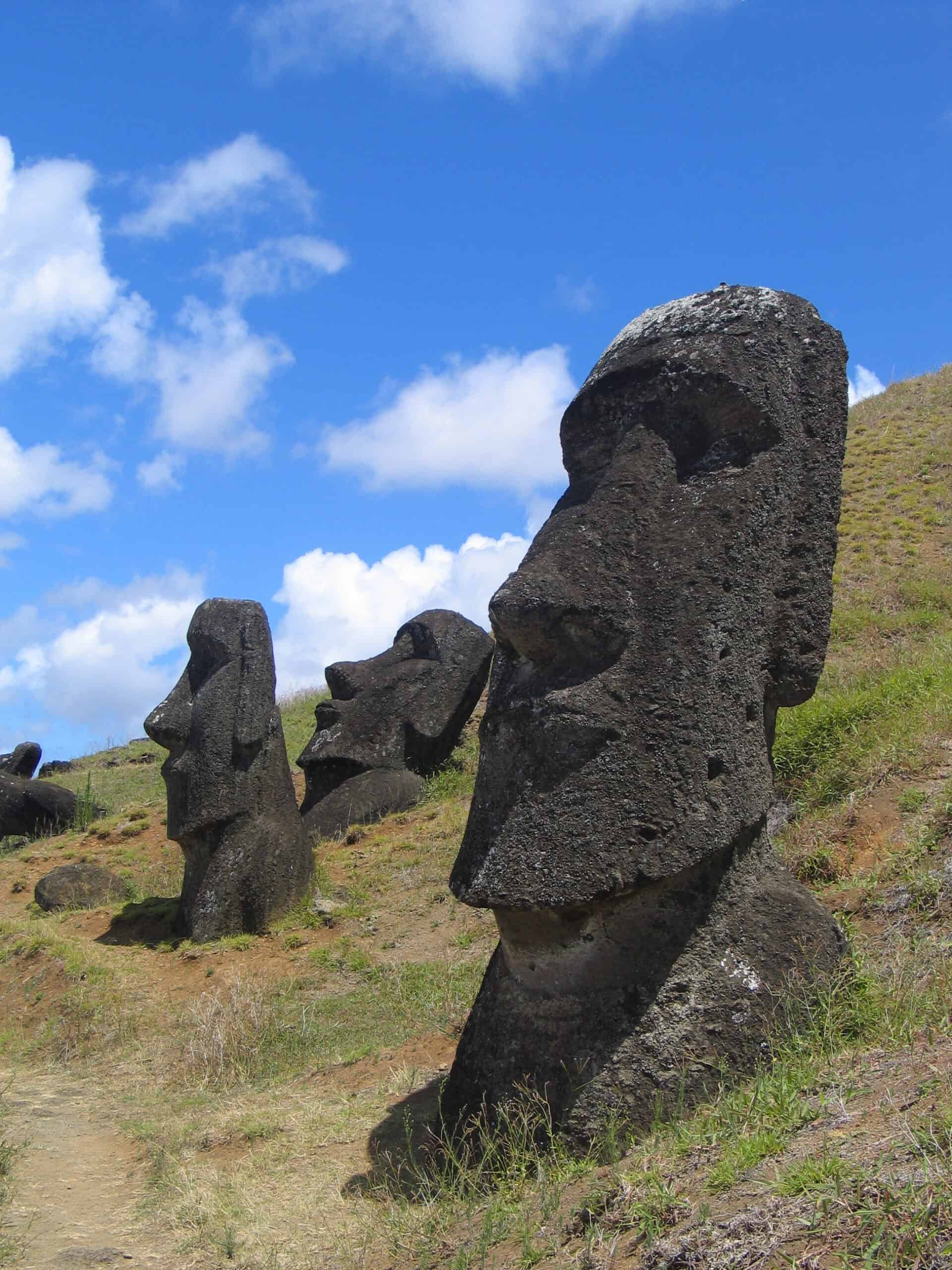
The Easter Island Moai have haunted human imagination for centuries. These massive stone heads , some towering over 30 feet tall , stand on a remote speck of land in the South Pacific, staring at nothing. Or maybe at everything. Nobody fully understands why the ancient Rapa Nui people carved nearly a thousand of them. Nobody knows exactly how they moved them across the island. And in 2023, a brand-new one appeared from the mud of a dried volcanic crater , as if it had been waiting to be found. The more scientists dig, the stranger the story gets. These aren’t just ancient sculptures. They’re a mystery wrapped in stone, surrounded by legends of curses, spiritual power, and a civilization that may have destroyed itself in their shadow.
The Easter Island Moai That Walked in the Dark
For decades, researchers argued about how the Rapa Nui moved their massive statues. The leading theory was grim. Thousands of workers. Wooden rollers. Widespread deforestation. A civilization slowly choking itself to death just to drag rocks across an island.
That theory is now crumbling.
New research from Carl Philipp Lipo of Binghamton University and Terry Hunt of the University of Arizona has changed everything. Using physics, 3D modeling, and live field experiments, their team demonstrated that the statues literally walked. Just 18 people could “walk” a 4.35-ton replica moai roughly 330 feet in 40 minutes. They used ropes in a zig-zag rocking motion , tipping the statue side to side like a refrigerator being moved down a hallway.
The statues weren’t dragged. They were guided.
The team surveyed 962 statues and found that 62 along ancient roads share a distinctive D-shaped base and a forward lean of 6 to 15 degrees. That lean wasn’t decorative. It was engineering. The statues were built to rock. Built to move. Built to walk.
This changes the entire collapse narrative. If no wooden rollers were needed, the deforestation theory weakens considerably. So why did the civilization fall? That question now hangs in the air, darker than before.
Learn more about the moai on Wikipedia
Easter Island Moai Rising from the Mud
Another fascinating historical case is: Cleveland sports curse
In February 2023, something deeply strange happened at Rano Raraku , the volcanic crater where most statues were originally carved. A prolonged drought had dried out the lagoon inside the crater. When researchers walked into the exposed lakebed, they found a new moai. Small. Partially buried. Completely unknown to modern science.
Salvador Atan Hito, vice president of the Ma’u Henua Indigenous community, confirmed the discovery. The statue had simply been hiding under water and mud for an unknown length of time. Nobody knew it was there.
Professor Terry Hunt told reporters that his team believes more statues may still be submerged in that same lakebed. Think about that. A thousand-year-old mystery, and we’re still finding new pieces of it emerging from the earth.
The Rano Raraku crater was the island’s primary quarry. Hundreds of statues were carved there and never moved. Some are buried up to their chins , which is why people once thought they were just heads. They’re not. They have full bodies. Hidden bodies. Bodies that have been underground for centuries, waiting.
What else is buried there? Nobody knows.
The discovery sent a chill through the archaeological world. These statues don’t just stand on the island. In some ways, they seem to grow from it.
The Easter Island Moai Were Made by Many Hands , Not One Power
For years, researchers assumed a single powerful ruler commanded the construction of the moai. A god-king. A central authority. Someone who forced an entire civilization to carve stone in his honor.
A November 2025 study published in PLOS One destroyed that idea.
Researchers used 3D scanning technology to examine 426 moai in various stages of production. They also mapped 341 extraction trenches and 133 voids left in the quarry rock. The data revealed something unsettling. There was no central workshop. No single authority directing the work.
The moai were created by many separate groups. Different communities. Different hands. Different intentions.
This raises a terrifying question. If no single ruler commanded this, then why did so many different groups , independently, across generations , feel compelled to carve these enormous stone faces? What were they building toward? What did they believe the statues could do?
The Smithsonian Institution has explored the Rapa Nui culture in depth
The Rapa Nui people believed the moai held a spiritual force called mana , divine power. The statues weren’t decorations. They were containers. Vessels for the energy of dead ancestors. When a chief died, his spirit entered the stone. The moai watched over the living. They protected crops. They controlled rain.
When rival clans went to war, they didn’t just kill people. They toppled each other’s statues. Destroying the moai meant destroying the ancestors themselves.
Curses, Collapse, and the Island That Ate Itself
The Rapa Nui civilization collapsed before European contact , though exactly why remains bitterly debated. Theories range from overpopulation to warfare to introduced rats that ate the island’s palm seeds, preventing forest regrowth.
European sailors who arrived in the 18th century found a fraction of the original population. The forests were gone. The people were starving. The statues had been knocked down.
And then came the slave raids. In the 1860s, Peruvian slave traders kidnapped roughly 1,500 Rapa Nui , including nearly the entire educated class. The people who knew the island’s history, its writing system, its rituals. Gone. When a handful were eventually returned, they brought smallpox with them. The population dropped to around 110 people.
The knowledge died with them.
That’s the real horror of Easter Island. It’s not just that we don’t know why the moai were built. It’s that the people who knew , the last ones who truly understood , were stolen away and never came back.
The island today is a UNESCO World Heritage Site. Tourists photograph the statues. Scientists scan them with lasers. New ones emerge from dried lakebeds. But the answers remain buried, just like those stone bodies under the mud of Rano Raraku.
The Easter Island Moai keep their secrets well. They’ve had a thousand years of practice.
Related Posts
 Tarim Basin Mummies: Ancient Secrets and Bizarre Burial Rituals in China’s Desert
 Derinkuyu Underground City: Turkey’s Mysterious 18-Level Subterranean Labyrinth
 The Antikythera Mechanism: Ancient Greece’s Impossible Computer from the Deep
 Stonehenge: The Ancient Mystery That Has Haunted Humanity for Millennia