
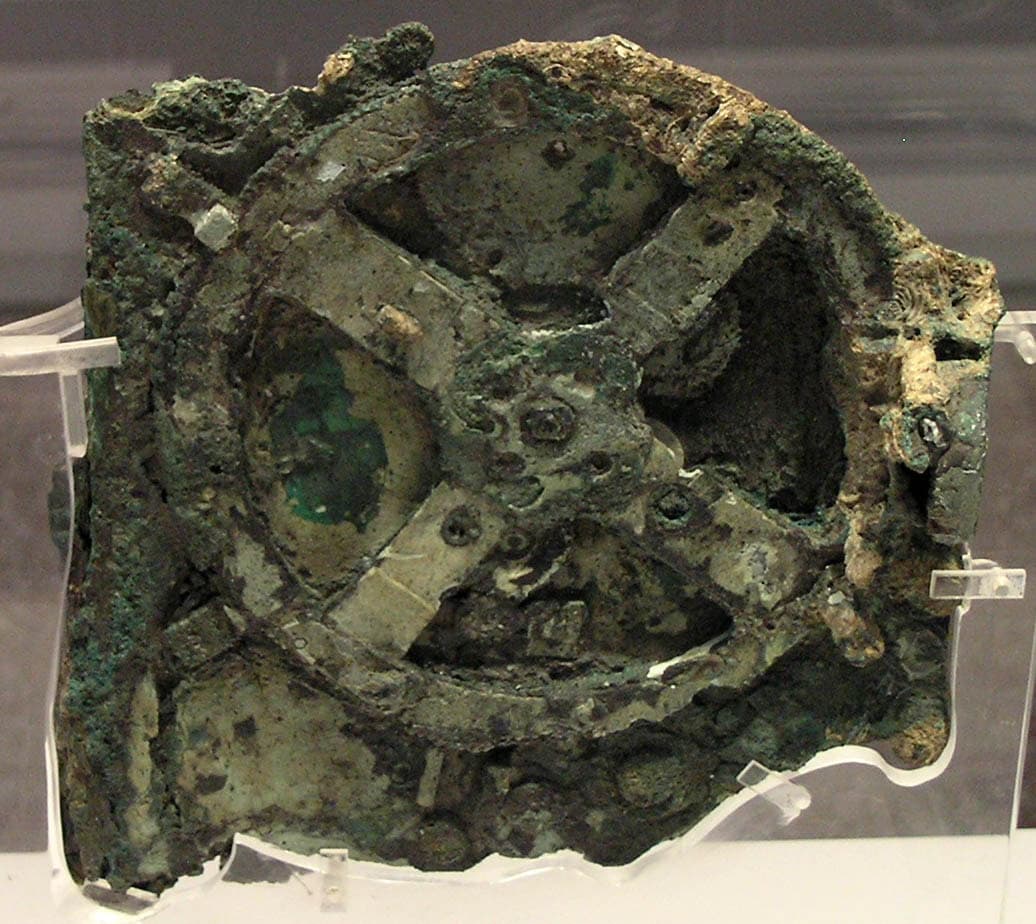
The Antikythera Mechanism shouldn’t exist. That’s the honest truth. Found rusting at the bottom of the Aegean Sea, this ancient Greek device could calculate the movements of stars and planets with stunning precision. It predicted eclipses decades in advance. It tracked the cycles of the Olympic Games. And it did all of this roughly 2,000 years before anyone thought such technology was possible. When researchers finally understood what they were looking at, the scientific world went quiet. How did ancient Greeks build something this sophisticated? And why did the knowledge vanish completely for over a thousand years?
This isn’t a story about a simple artifact. It’s a story about a gap in human history so strange it borders on the terrifying. Something was known. Then it was lost. And we still don’t fully understand how either happened.
The Antikythera Mechanism Rises from a Sunken Roman Ship
In 1900, a crew of sponge divers from the Greek island of Symi stumbled onto something extraordinary. Their boat had been blown off course near the island of Antikythera. Diving into the deep water, they found a massive Roman cargo ship resting on the seafloor. The wreck sat at 45 meters down. It was packed with bronze statues, marble figures, glassware, and jewelry.
Recovery efforts with the Hellenic Royal Navy began almost immediately. Workers hauled up treasures one by one. Then, in 1901, they pulled up what looked like a lump of corroded bronze and rotting wood. Nobody paid it much attention. Museum staff in Athens set it aside while they focused on the glamorous statues.
For two years, the lump sat ignored.
Then, in May 1902, Greek politician Spyridon Stais visited the National Archaeological Museum in Athens. He noticed something strange inside the corroded mass. A gear. A tiny, perfectly formed bronze gear. His cousin, museum director Valerios Stais, began the first formal study of the fragment. What they found was deeply unsettling. This wasn’t a decoration. It was a machine.
The bronze had transformed into a mineral called atacamite during its centuries underwater. When it was brought to the surface, it cracked and shrank. The original dimensions were lost forever. What remained was eventually separated into 82 fragments. According to researchers who have studied it extensively, four of those fragments contain gears. Many others carry inscriptions in ancient Greek.
What the Antikythera Mechanism Could Actually Do
This event shares similarities with: Wow! Signal: The Mysterious 1977 Radio Transmission That Still Haunts SETI Scientists
Here’s where things get genuinely eerie. This device, built somewhere between 205 BC and 87 BC, could do things that Western civilization wouldn’t manage again until the 14th century AD. That’s a gap of over a thousand years. A millennium of lost knowledge.
The mechanism had at least 35 meshing bronze gears. The largest gear measured about 13 centimeters across and originally had 223 teeth. Working together, these gears could track the Moon’s position through the zodiac. They could model the Moon’s irregular orbit , the fact that it moves faster when closer to Earth and slower when farther away. This was cutting-edge astronomy for the 2nd century BC. The astronomer Hipparchus of Rhodes had studied this exact phenomenon. Some researchers believe he may have been directly involved in designing the device.
But the machine didn’t stop there. It could predict solar and lunar eclipses years in advance. It tracked the four-year cycle of the ancient Olympic Games. Later analysis of its inscriptions, completed in 2016, revealed connections to the synodic cycles of Venus and Saturn. There’s even speculation that a missing portion of the mechanism tracked all five planets known to the ancient world.
In 2005, a team from Cardiff University used X-ray tomography and high-resolution scanning to peer inside the encrusted fragments. What they found confirmed the device’s staggering complexity. The technology to build something like this simply wasn’t supposed to exist yet.
The Antikythera Mechanism and the Mystery of Lost Knowledge
This is the part that keeps historians up at night. The Antikythera Mechanism represents a level of mechanical sophistication that disappeared completely after it was built. No similar devices appear in the historical record for over a thousand years. Nothing remotely comparable shows up in Europe until the medieval astronomical clocks of the 1300s.
So what happened?
The Roman cargo ship carrying the mechanism sank sometime between 70 and 60 BC. The device was likely already old by then. Some researchers think it was built around 87 BC. Others place its origins as far back as 205 BC. A 2022 study suggested its initial calibration date may have been December 23, 178 BC , though other experts argue for 204 BC.
Nobody knows who built it. Nobody knows where it was going. Nobody knows if other devices like it ever existed. The ancient world may have been full of such machines. Wars, fires, and the simple passage of time could have erased every trace.
Scientific reports on the mechanism note that the inscriptions covering its outer casing functioned like an instruction manual. Someone built this to be used. It wasn’t a curiosity or a display piece. It was a working tool. A computer. And whoever operated it understood concepts that the rest of the world wouldn’t rediscover for centuries.
The Impossible Question Nobody Can Answer
What makes the Antikythera story truly unsettling isn’t what we know. It’s what we don’t.
We don’t know who the genius was behind its construction. We don’t know if there was a whole tradition of such devices that simply vanished. We don’t know why this level of mechanical knowledge didn’t spread further or survive longer. The ancient Greeks clearly had the capability. They built it. Then, somehow, the knowledge died.
Some fringe theorists have used the mechanism to argue for lost civilizations or even outside influence. Mainstream historians reject those claims. But even the most cautious scholars admit the device raises uncomfortable questions about how we understand ancient technology.
The fragments sit today in the National Archaeological Museum in Athens, alongside reconstructions that show how the gears once fit together. Visitors can see the largest gear, roughly the size of a human palm, and try to imagine the mind that designed it.
The Antikythera Mechanism is proof that human ingenuity has always been capable of breathtaking things. It’s also a reminder that knowledge can vanish completely. Whatever workshop produced this device, whatever tradition it came from , it’s gone. The machine survived. The makers didn’t. And the silence they left behind is one of history’s strangest mysteries.
Related Posts
 Phaistos Disc: The Mysterious Clay Artifact That Defies All Attempts at Translation
 Tarim Basin Mummies: Ancient Secrets and Bizarre Burial Rituals in China’s Desert
 Derinkuyu Underground City: Turkey’s Mysterious 18-Level Subterranean Labyrinth
 Ancient Olympic Ghosts: Spectral Athletes Still Competing in the Afterlife