
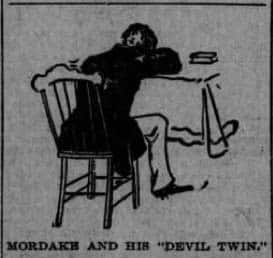
The legend of Edward Mordake stands as one of history’s most disturbing tales of human deformity and supernatural torment. Born in 19th-century England as heir to a noble peerage, Mordake carried a terrible burden that would ultimately drive him to take his own life. His story speaks to our deepest fears about the nature of evil and the fragile boundary between the physical and spiritual worlds.
According to the chilling accounts that have survived, Mordake possessed remarkable grace and classical beauty. His natural face resembled that of Antinous, the beloved companion of Roman Emperor Hadrian. But this divine beauty came with a horrific curse. On the back of his head grew a second face – reportedly female, with its own pair of eyes and a mouth that constantly drooled.
This wasn’t merely a physical deformity. The duplicate face seemed to possess a malevolent intelligence all its own. While it couldn’t see, eat, or speak audibly, witnesses claimed it would sneer when Mordake was happy and smile when he wept. The face appeared to mock his every emotion, creating a living hell for the young nobleman.
The Demonic Whispers of Edward Mordake
The most terrifying aspect of Edward Mordake’s condition wasn’t what others could observe, but what only he could hear. Night after night, the second face would whisper to him in silence, speaking words that “one would only speak about in Hell.” These weren’t random mutterings or meaningless sounds. According to Mordake’s own desperate pleas to his physicians, the face tempted him with unspeakable wickedness.
The tormented heir described his affliction as punishment for “some unforgiven wickedness of my forefathers.” He believed himself bound to a fiend that never slept, never rested, and never ceased its evil counsel. The psychological torture proved unbearable. Mordake begged doctors Manvers and Treadwell to remove the demonic face, even if the operation killed him.
“I beg and beseech you to crush it out of human semblance, even if I die for it,” he reportedly pleaded. No physician would attempt such a dangerous procedure. The medical knowledge of the 19th century couldn’t explain his condition, let alone cure it. Modern experts suggest he may have suffered from craniopagus parasiticus, an extremely rare form of conjoined twinning.
Edward Mordake’s Life of Isolation
This event shares similarities with: Andretti Curse: The Indianapolis 500 Hex That Haunts Racing’s First Family
The burden of his condition forced Edward Mordake into complete seclusion. He refused visits from family members and lived as a hermit in his chambers. Despite his torment, he remained intellectually gifted. Contemporary accounts describe him as a profound scholar and musician of rare ability. His talents made his suffering all the more tragic.
The isolation wasn’t just physical but spiritual. How could someone explain the constant presence of evil whispering in their ear? How could they describe the sensation of carrying a malevolent entity that mocked their every joy and amplified their every sorrow? Medical curiosities of the Victorian era often faced similar social isolation, but few endured such psychological torment.
The young nobleman’s scholarly pursuits may have provided temporary escape from his demon twin. Music and learning offered brief respites from the endless whispers. But even these moments of peace were tainted by the sneering presence on the back of his skull.
The Final Tragedy of Edward Mordake
At age 23, Edward Mordake could endure no more. Despite careful watching by his physicians and family, he managed to obtain poison. The method of his suicide remains unclear, but his final letter revealed the depth of his despair. He requested that the “demon face” be destroyed before his burial, fearing it would continue its dreadful whisperings in the grave.
His final wish was granted. At his own request, he was buried in a waste place without stone or legend to mark his grave. The location remains unknown, perhaps deliberately lost to prevent the site from becoming a macabre curiosity. Some versions of the tale claim the second face was indeed destroyed before burial, though others suggest it was left intact.
The circumstances surrounding his death raise questions about the nature of his affliction. Was this purely a medical condition, or was there something genuinely supernatural about his torment? The vivid descriptions of the face’s apparent intelligence and malevolent behavior suggest something beyond mere physical deformity.
The Origins and Legacy of a Dark Legend
The earliest known account of this tragic figure appeared in an 1895 Boston Post article by fiction writer Charles Lotin Hildreth. He claimed to have discovered the case in reports from the “Royal Scientific Society,” though no such organization existed at the time. The story was later included in the 1896 medical encyclopedia “Anomalies and Curiosities of Medicine” by Drs. George Gould and David Pyle.
Modern investigations have found no historical evidence for Edward Mordake’s existence. No birth records, death certificates, or contemporary medical documentation support the tale. The story appears to be a work of Victorian sensationalism, designed to thrill readers with tales of human oddities and supernatural horror.
Yet the legend persists because it touches something deep in human psychology. The idea of being tormented by an evil presence we cannot escape resonates across cultures and centuries. Whether real or fictional, the story of Edward Mordake represents our fears about the nature of evil and the possibility that some burdens cannot be shared or understood by others.
The tale has inspired numerous retellings in literature, television, and film. It continues to fascinate those drawn to stories of medical mysteries and supernatural torment. Perhaps that’s the true power of the Edward Mordake legend – not its historical accuracy, but its ability to embody our deepest fears about isolation, evil, and the fragility of sanity itself.