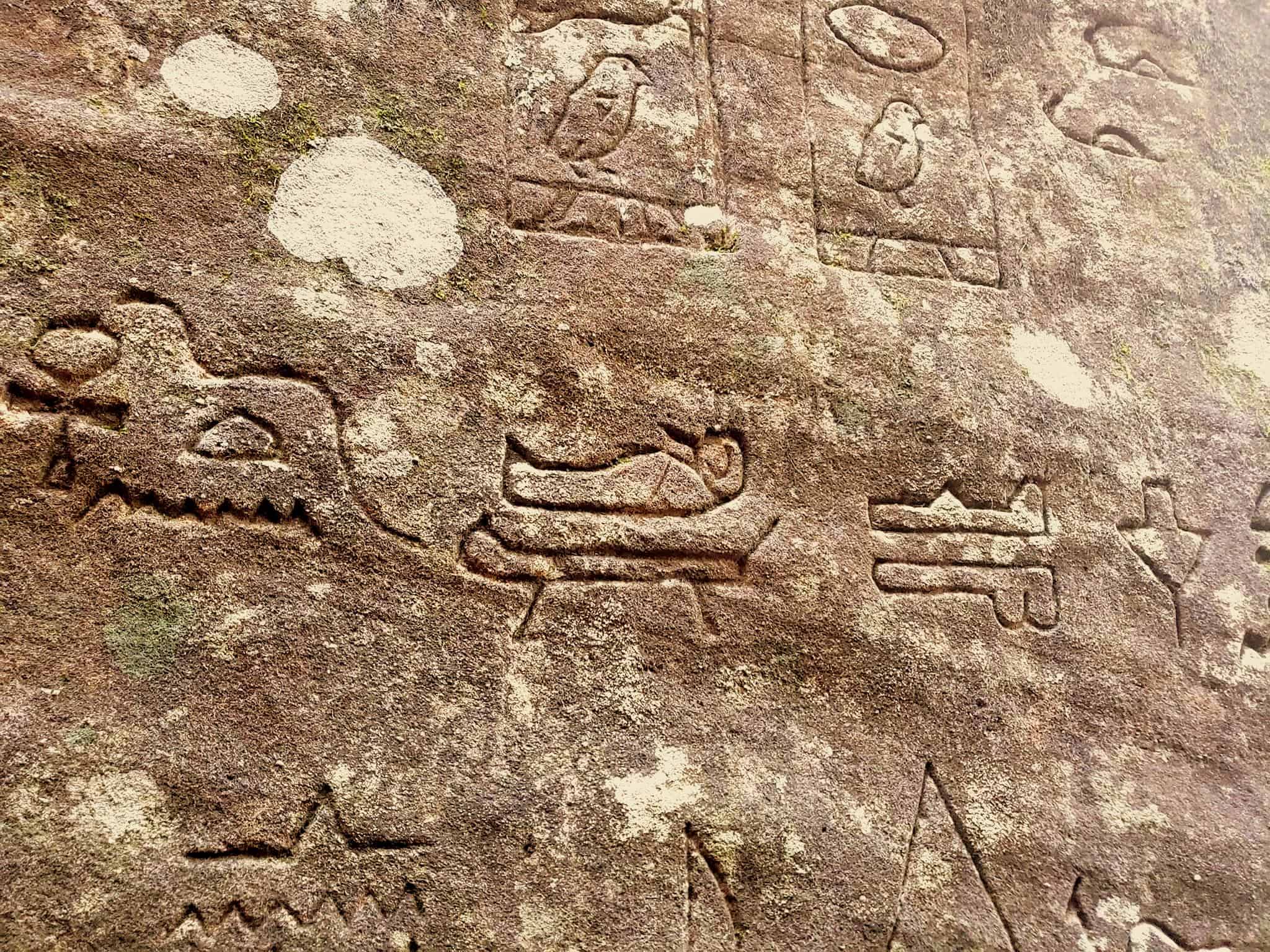
Deep in the bushland of New South Wales, something strange waits in the sandstone. The Gosford Glyphs are approximately 300 Egyptian-style hieroglyphs carved into rock walls in Kariong, Australia. They sit inside Brisbane Water National Park, between Gosford and Woy Woy. They look completely out of place. Ancient Egyptian symbols , boats, owls, dogs, and even the god Anubis , carved into Australian rock. The question that has haunted researchers, conspiracy theorists, and curious visitors for decades remains unanswered: who put them there, and why?
Some believers claim ancient Egyptians sailed to Australia 4,500 years ago. They say a royal expedition became shipwrecked and carved their story into the stone before dying far from home. It’s a wild theory. But when you stand between those two narrow sandstone walls and stare at cartouches bearing the name of Pharaoh Khufu, it’s hard not to feel a chill.
The Gosford Glyphs Discovery That Shocked a Surveyor
Alan Dash was a local surveyor working for Gosford Council. He had been walking through that area for seven years. He never saw anything unusual. Then, in 1975, he spotted the carvings for the first time. That detail alone is deeply strange. How do you miss 300 hieroglyphs carved into rock walls for seven years?
Dash kept returning. Each visit, he found new glyphs. Fresh ones. Ones that hadn’t been there before.
By 1983, rock art conservator David Lambert from the National Parks and Wildlife Service investigated the site. He found clean-cut hieroglyphs he estimated to be less than twelve months old. Someone was actively carving new symbols. But no one ever caught them in the act.
The site had been buried under sand, rocks, and thick vegetation before Dash’s discovery. That fact fuels both sides of the debate. Believers say the burial preserved ancient carvings. Skeptics say it gave cover for modern forgers working in secret.
The symbols themselves are extraordinary in their detail. Two cartouches appear to name Egyptian kings. One clearly references Khufu, the pharaoh of the Fourth Dynasty who reigned around 2637–2614 BC. There’s a carving of Anubis , the jackal-headed god of death. There are boats, stick figures, an ankh, the Eye of Horus, and what appears to be a sarcophagus. The imagery is rich and unsettling.
Why Experts Say the Gosford Glyphs Are a Hoax
For more strange history, see: Seven Gates of Hell: Pennsylvania’s Most Terrifying Urban Legend
The academic world is not impressed. Professor Boyo Ockinga, an Egyptologist, laid out the problems clearly. The carvings aren’t made the way ancient Egyptian rock inscriptions were made. They’re disorganized. The shapes of the signs are wrong. Most damning of all , some of the hieroglyphic forms used weren’t even invented until 2,500 years after the reign of Khufu. You simply cannot have a carving from 2600 BC using symbols that didn’t exist until 100 BC.
Professor Naguib Kanawati, another Australian Egyptology expert, went further. He concluded the hieroglyphs were constructed in the early 1980s. He pointed out that symbols within the same panels came from wildly different historical periods. Some were carved backwards. It’s the kind of mistake an ancient Egyptian would never make. It’s exactly the kind of mistake someone would make copying hieroglyphs from a textbook.
Geologists added another nail to the coffin. Sandstone erodes fast in that environment. Nearby Aboriginal petroglyphs at the Bulgandry Aboriginal Art Site are around 250 years old. They show significant erosion. The Gosford carvings show far less wear. That suggests they’re much more recent.
The National Parks and Wildlife Service stated they became aware of the engravings in the early 1980s , right when most were thought to have been made.
Strange Theories Behind the Gosford Glyphs Mystery
If not ancient Egyptians, then who? The theories get stranger the deeper you dig.
Professor Ockinga suggested Australian soldiers returning from Egypt after World War One. There was enormous public fascination with ancient Egypt in the early 1920s. Howard Carter’s discovery of Tutankhamun’s tomb in 1922 sent the entire world into Egyptian fever. Soldiers who had served in Egypt during the war brought that obsession home. There’s even a documented example of a returning soldier carving shapes of the Sphinx and a pyramid in Australia.
Another theory points to high school students in the 1970s. Bored teenagers, a textbook full of hieroglyphs, and a remote sandstone wall. It’s not glamorous, but it’s plausible.
A third theory names a Yugoslavian immigrant with a deep interest in Egyptology. He allegedly etched the symbols into the rock during the early 1980s. No one has ever confirmed this.
What makes the mystery genuinely unsettling isn’t the carvings themselves. It’s the fact that new ones kept appearing. Someone was adding to the site actively. Someone was watching visitors arrive and quietly expanding the hoax. Or , if you want to go darker , something else was at work.
The site sits in an area already thick with genuine Aboriginal petroglyphs. The land itself carries ancient markings. Adding Egyptian symbols to that sacred landscape feels like a desecration. Or perhaps a very strange tribute.
Kenneth Feder’s Encyclopedia of Dubious Archaeology places the Gosford carvings firmly in the category of archaeological fraud , alongside Atlantis claims and other pseudohistorical fantasies.
The Site Today and What Remains Unexplained
The mystery hasn’t faded. If anything, it’s grown stranger with time.
In late 2023, the National Parks and Wildlife Service began dislodging boulders near the site. They said the rocks were unsafe. Local residents and an environmental protection group pushed back hard. They called the work unnecessary and extreme. Some wondered if authorities were quietly destroying evidence , or destroying the hoax itself before more people could see it.
Pseudohistorians still make pilgrimages to the site. They bring cameras, measuring equipment, and unshakeable belief. They point to the Anubis carving , the largest on the site , and ask how a high schooler with a textbook could produce something so detailed.
The honest answer is: easily. Teenagers and obsessed amateurs have produced remarkable forgeries throughout history. The human capacity for elaborate deception is well documented.
But the nagging questions remain. Why did Alan Dash miss the carvings for seven years? Why did new glyphs keep appearing after discovery? Who was carving them, and why did they stop?
The Gosford Glyphs sit in their sandstone walls, silent and strange. They don’t care what you believe. They’ve already done their job , planting doubt, inspiring wonder, and making people stare at rock walls in the Australian bush asking impossible questions. Whether ancient fraud or modern hoax, they’ve earned their place among history’s great unsolved mysteries.