
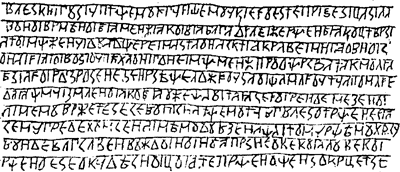
The Book of Veles is one of history’s most bizarre and contested documents. It supposedly contains sacred Slavic religious texts carved onto wooden planks thousands of years ago. It vanished during World War II. Scholars call it a fake. And yet, some people treat it as holy scripture. The story behind this mysterious text involves a looted mansion, a White Russian soldier, a San Francisco émigré newspaper, and a conspiracy that still sparks furious debate today. Whether it’s a sacred relic or a masterful deception, the tale is genuinely strange , and deeply unsettling.
The Book of Veles and Its Mysterious Discovery
The story begins in 1919, during the chaos of the Russian Civil War. A White Army lieutenant named Fedor Arturovich Izenbek allegedly stumbled upon a pile of wooden planks inside a looted aristocratic mansion near Kharkiv, Ukraine. The planks were covered in strange, ancient-looking script. Izenbek grabbed them and carried them across war-torn Europe.
When the White Army collapsed, Izenbek fled. He landed in Belgrade, where he reportedly tried to sell the planks to a library and a museum. Nobody wanted them. He moved again, this time to Brussels. There, around 1925, he handed the planks to a man named Yuriy Mirolyubov.
Mirolyubov spent years copying the text by hand. He claimed the planks were too fragile to photograph properly. He said they crumbled when touched. Only one blurry photograph of a single plank ever surfaced.
Then, in 1941, Izenbek died. The planks disappeared entirely. No one has seen them since.
The timing is suspicious. World War II was raging across Europe. Records were destroyed. People vanished. It’s the perfect cover story for a forgery , or, if you believe the faithful, the perfect tragedy for a genuine sacred artifact lost to history forever.
The text first appeared publicly in the mid-1950s in a Russian émigré newspaper based in San Francisco. Mirolyubov published his handwritten transcriptions there. That’s when the controversy truly exploded.
What the Book of Veles Actually Claims
This event shares similarities with: Crystal Skull: The Victorian Hoax That Fooled Museums and Spawned Supernatural Legends
The content of the text is wild. It supposedly covers roughly 1,500 years of Slavic history. The earliest events allegedly date back to the 7th century BC. The latest reach the 9th century AD.
The planks describe ancient Slavic gods, tribal migrations, battles, and religious rituals. The book opens with a dedication: “To Veles this book we devote.” Veles is a genuine Slavic deity , the god of the underworld, cattle, and magic. His inclusion gave the text a veneer of authenticity.
The content mixes religious passages with historical accounts. Some sections read like moral lessons. Others describe epic migrations across Eurasia. It paints a picture of a proud, ancient Slavic civilization with deep spiritual roots.
For Slavic neopagans today, this is powerful stuff. The text gave them something Christianity had for centuries , an ancient sacred book. Some communities still use it in religious ceremonies. In Ukraine, the book became politically charged. Politicians cited it as proof of Ukrainian ethnic heritage. In 1999, it was actually added to the Ukrainian high school curriculum as a genuine historical document. Academics were horrified.
Why Scholars Say the Book of Veles Is a Forgery
The linguistic evidence against the text is damning. Professional linguists tore it apart.
The language is a mess. It mixes vocabulary from multiple modern Slavic languages. It uses grammatical forms that never existed in ancient Slavic. It handles nasal vowels inconsistently , sometimes following Polish patterns, sometimes Serbian patterns, with no logic. Reduced vowels appear randomly. Invented word forms pop up throughout.
The philologist O.V. Tvorogov put it bluntly. He said the text was clearly written by someone with only superficial knowledge of ancient Slavic. That person couldn’t even create a consistent fake grammar system.
Andrey Zaliznyak, one of Russia’s greatest linguists, agreed. So did Boris Rybakov, Leo Klejn, and virtually every academic historian and linguist who examined it. The consensus is overwhelming. The text was almost certainly created in the 1940s or 1950s. A minority of scholars think it might date to the early 19th century, possibly forged by a Russian collector named Alexander Sulakadzev, who was known for faking ancient manuscripts.
The most damning detail? Different published editions of the book contain different versions of the text. A genuine ancient document doesn’t change between printings. A forgery does , especially when the forger is still editing it.
You can explore how linguistic forgeries have been detected throughout history through historical archives documenting manuscript fraud.
The Cult That Refuses to Let It Die
Here’s where things get truly strange. Despite the academic consensus, the Book of Veles won’t go away.
Slavic neopagan communities across Eastern Europe and the diaspora embrace it completely. For them, the scholarly rejection is itself suspicious. They see it as establishment suppression of pre-Christian Slavic identity. The more academics attack the text, the more sacred it becomes to believers.
In Ukraine, the political dimension made things worse. The book offered a narrative of ancient Ukrainian identity stretching back millennia. Politicians loved it. Levko Lukyanenko, a prominent Ukrainian politician, publicly cited it as genuine history. The high school curriculum inclusion in 1999 legitimized it for an entire generation of students.
The wooden planks themselves remain missing. No physical evidence exists to test. No carbon dating. No forensic analysis. Just Mirolyubov’s handwritten copies and one blurry photograph.
That absence is either proof of a cover-up or proof of a con. Take your pick.
The Book of Veles sits in a strange liminal space. It’s almost certainly fake. But it functions as a real sacred text for real communities. It shaped real political decisions. It entered real school classrooms. A forgery that becomes genuinely holy , is it still just a forgery?
The wooden planks are gone. The truth may be gone with them. And that mystery, perhaps more than anything else, is what keeps this strange story alive.
—
The Book of Veles claims to reveal ancient Slavic history on wooden planks. But is it a sacred relic or a chilling modern hoax?
Related Posts
 The Marzeah Papyrus: The “Oldest Hebrew Manuscript” That Was Almost Certainly a Fake
 Russian Sleep Experiment: The Terrifying Creepypasta That Fooled the World
 Prillwitz Idols: The Bronze Forgeries That Fooled European Nobility for Decades
 Pompey Stone: The 70-Year Archaeological Hoax That Fooled New York’s Best Scholars