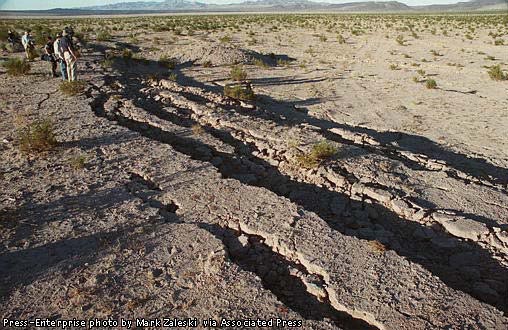
The Hector Mine earthquake of October 16, 1999, remains one of California’s most peculiar seismic events. This magnitude 7.1 tremor didn’t just shake the Mojave Desert,it created a chain of bizarre incidents that still puzzle scientists today. The earthquake took its name from an abandoned clay mine in San Bernardino County, but the strange phenomena surrounding this event extend far beyond simple ground shaking.
At 2:46 AM on that fateful October morning, the earth split open along a 30-mile fault line. The timing couldn’t have been more dramatic. Passengers aboard Amtrak’s Southwest Chief were jolted from their sleep as their train derailed just 24 minutes after the main shock. Twenty-one cars left the tracks near the epicenter, creating one of the most surreal disaster scenes in railroad history. Remarkably, no cars overturned or separated,a testament to the train’s construction that amazed investigators.
The Hector Mine Earthquake’s Mysterious Precursors
Scientists detected strange atmospheric disturbances in the days leading up to the Hector Mine earthquake. Researchers identified anomalous changes in the ionosphere’s total electron content starting one week before the tremor struck. These atmospheric anomalies appeared exactly five days before the main event,October 11, 1999. Some scientists suggested these precursory phenomena could predict future earthquakes, though others remain skeptical.
The earthquake’s behavior defied conventional understanding. Portions of fault lines experienced retrograde motion,moving opposite to their normal geological direction. This backward slipping created a phenomenon so unusual that seismologists had rarely documented it before. Interferometric radar observations revealed surface deformation patterns that challenged existing earthquake models.
Underground, the fault zone showed damage extending 75 to 100 meters wide. Seismic waves trapped within this damaged zone revealed velocity reductions of 40 to 50 percent compared to surrounding rock. The earth itself had been fundamentally altered by the rupture process.
Strange Tales from the Hector Mine Disaster Zone
Another fascinating historical case is: Cleveland sports curse
The Amtrak derailment created an otherworldly scene in the desert darkness. One hundred fifty-five passengers found themselves stranded in rail cars scattered across the Mojave landscape. Four people suffered minor injuries, but the psychological impact ran deeper. Passengers described the terrifying sensation of their sleeper cars swaying violently before lurching off the tracks.
Railroad dispatchers typically halt all train traffic immediately after earthquakes above magnitude 5.0. The 24-minute gap between the earthquake and derailment raised troubling questions. Why hadn’t the train stopped? The timeline,2:46 AM for the earthquake, 3:10 AM for the derailment,seemed impossibly long for standard safety protocols.
In Las Vegas, 140 miles away, residents reported dizziness and difficulty walking. The earthquake’s effects reached far beyond its epicenter, creating a web of disorientation across the desert Southwest. Emergency rooms in multiple cities treated patients complaining of balance problems and nausea,symptoms that persisted for hours after the shaking stopped.
The Abandoned Mine’s Dark History
The original Hector Mine had its own troubled past long before lending its name to the earthquake. From 1931 to 1961, mining companies extracted clay and other minerals from the desert site. The operation faced constant challenges,flooding, equipment failures, and dangerous working conditions plagued the facility.
In 1961, water flooded the mine through a ventilation shaft. Workers couldn’t pump out the water, forcing the Inerto Company to abandon their operations. The flooded mine shafts remained filled with water, creating an underground lake in the desert. Local residents reported strange sounds emanating from the abandoned workings,metallic groaning and unexplained echoes that carried across the desert at night.
The mine’s clay production had supplied beer clarifiers and paint manufacturers across the country. Hectorite, a mineral first discovered at the site, gave the location scientific importance. But the mine’s legacy became forever tied to seismic catastrophe rather than industrial success.
Ongoing Mysteries and Unanswered Questions
Twenty-four years later, the earthquake continues generating scientific puzzles. Researchers discovered that earlier tremors in 1996,magnitude 4.3 and 4.1 events,may have triggered the larger earthquake through a complex chain reaction. These smaller quakes occurred within two kilometers of the eventual epicenter, suggesting a delayed triggering mechanism that scientists still don’t fully understand.
The fault zone’s unusual bifurcation created two parallel rupture paths. One broke the surface along the Lavic Lake fault, while the other remained buried at seismogenic depth. This dual-pathway rupture pattern challenges traditional earthquake models and raises questions about fault behavior in desert environments.
Modern studies using advanced imaging techniques continue revealing new details about the rupture process. Some researchers suspect additional slip occurred along nearby fault zones, but definitive proof remains elusive. The earthquake’s complexity suggests that our understanding of seismic processes in the Mojave Desert remains incomplete.
The Hector Mine earthquake stands as a reminder that nature’s most dramatic events often carry the deepest mysteries. From atmospheric precursors to train derailments, from flooded mine shafts to bifurcated fault zones, this desert tremor created a web of strange phenomena that continues challenging our understanding of how the earth moves beneath our feet.