The Hodag burst into American folklore in 1893 when Wisconsin land surveyor Eugene Shepard claimed to have captured a terrifying beast near Rhinelander. This wasn’t just any ordinary creature story. Shepard described a seven-foot-long monster with the head of a frog, grinning face of an elephant, and razor-sharp claws that could tear a man apart. The beast supposedly breathed fire and smoke with an odor combining “buzzard meat and skunk perfume.” What followed became one of America’s most elaborate and successful cryptid hoaxes, fooling thousands of visitors and nearly deceiving scientists from the Smithsonian Institution.
According to Shepard’s chilling account, the creature weighed 185 pounds and possessed green eyes that glowed in the darkness. Its black hair covered a dinosaur-like back lined with curved spikes. Four short legs ended in three forward-facing claws and one pointing backward. Most terrifying of all, flames and smoke poured from its nostrils when agitated. Shepard claimed the beast was born from the ashes of cremated oxen, representing the accumulated abuse these animals suffered at the hands of cruel masters.
The Hodag’s Violent Capture and Mysterious Origins
Shepard’s original story painted a picture of extreme violence and supernatural terror. He gathered a group of local men to hunt the beast in the dense Wisconsin forests. The creature proved so ferocious that conventional weapons couldn’t kill it. The hunting party reportedly needed dynamite to finally destroy the monster. They released a photograph of the charred remains to newspapers, showing what appeared to be a genuine prehistoric creature.
The backstory grew even more bizarre through Luke Sylvester Kerney’s embellishments. According to Kerney’s book “The Hodag: And Other Tales of the Logging Camps,” these creatures could only be born under specific supernatural conditions. An ox had to endure severe verbal abuse from its handlers throughout its life. When the animal died, its body couldn’t be burned for exactly seven years. Only then would the accumulated suffering and rage transform into a living Hodag.
Shepard claimed to have discovered scientific evidence linking his creature to ancient species. After visiting King Tutankhamun’s tomb in Egypt, he declared the beast was originally called the “Selblatkey.” He positioned it as a missing evolutionary link between the Ichthyosaurus and Mylodon, lending false scientific credibility to his fantastic claims.
The Living Hodag Exhibition That Terrified Visitors
This event shares similarities with: Sablon, California: The Forgotten Railroad Ghost Town of the Mojave Desert
Three years later, Shepard announced an even more shocking discovery. In 1896, he claimed to have captured a living Hodag. This time, he and several bear wrestlers used chloroform on a long pole to overcome the beast in its cave. The capture story itself read like something from a horror novel, with brave men risking their lives against an otherworldly predator.
Shepard displayed his living creature at the first Oneida County Fair, where thousands of people paid to witness the beast. He constructed a darkened stall where visitors could only glimpse the creature momentarily. Hidden wires allowed Shepard to move the monster suddenly, sending terrified spectators fleeing from the display. The combination of darkness, movement, and frightening sounds created an atmosphere of genuine terror.
The exhibition continued at Shepard’s own property, where he built a special shanty to house the creature. Visitors came from across Wisconsin and neighboring states to see the legendary beast. Period newspapers reported that many people left the display genuinely convinced they had witnessed a living prehistoric monster.
Scientists Expose the Hodag Deception
As news of the living creature spread nationally, it caught the attention of the scientific community. The Smithsonian Institution in Washington, D.C., announced that a team of researchers would travel to Rhinelander to examine Shepard’s discovery. This announcement marked the beginning of the end for the elaborate hoax.
Faced with impending scientific scrutiny, Shepard knew his deception couldn’t survive professional examination. The creature was actually crafted from sculpted wood, cowhide, and cattle horns. Hidden strings controlled its movements, while Shepard himself provided the frightening sounds and smoke effects. The realistic construction had fooled casual observers, but trained scientists would immediately recognize the fake.
Rather than face exposure and potential legal consequences, Shepard admitted the hoax before the scientists arrived. The revelation shocked the thousands of people who had paid to see the creature and genuinely believed in its existence. However, instead of anger, many locals appreciated Shepard’s creativity and showmanship. The hoax had put Rhinelander on the national map and brought significant tourism revenue to the area.
Legacy of Wisconsin’s Greatest Monster Hoax
The original Hodag was destroyed in a fire during the early 20th century, but its legend lived on. Rhinelander adopted the creature as its official symbol, embracing the hoax that had made their town famous. The Hodag became the mascot of Rhinelander High School and inspired countless local businesses and organizations.
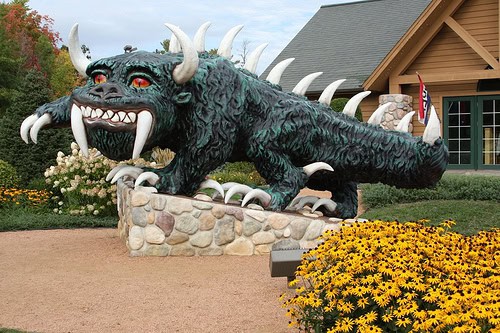
P.T. Barnum himself traveled to Rhinelander, hoping to purchase the creature for his famous circus. Modern visitors can see a larger-than-life fiberglass sculpture at the Rhinelander Area Chamber of Commerce, where thousands still come to photograph the legendary beast. The Wisconsin Historical Society maintains extensive archives documenting the hoax and its cultural impact.
Today, local golfers still blame missing golf balls on Hodags, while anglers swear the creatures steal fish from their lines. In 2021, Wisconsin Governor Tony Evers officially proclaimed May 21 as Hodag Day, cementing the creature’s place in state folklore. The beast that began as Eugene Shepard’s elaborate prank has become an enduring symbol of Wisconsin’s North Woods, proving that sometimes the best monsters are the ones we create ourselves.