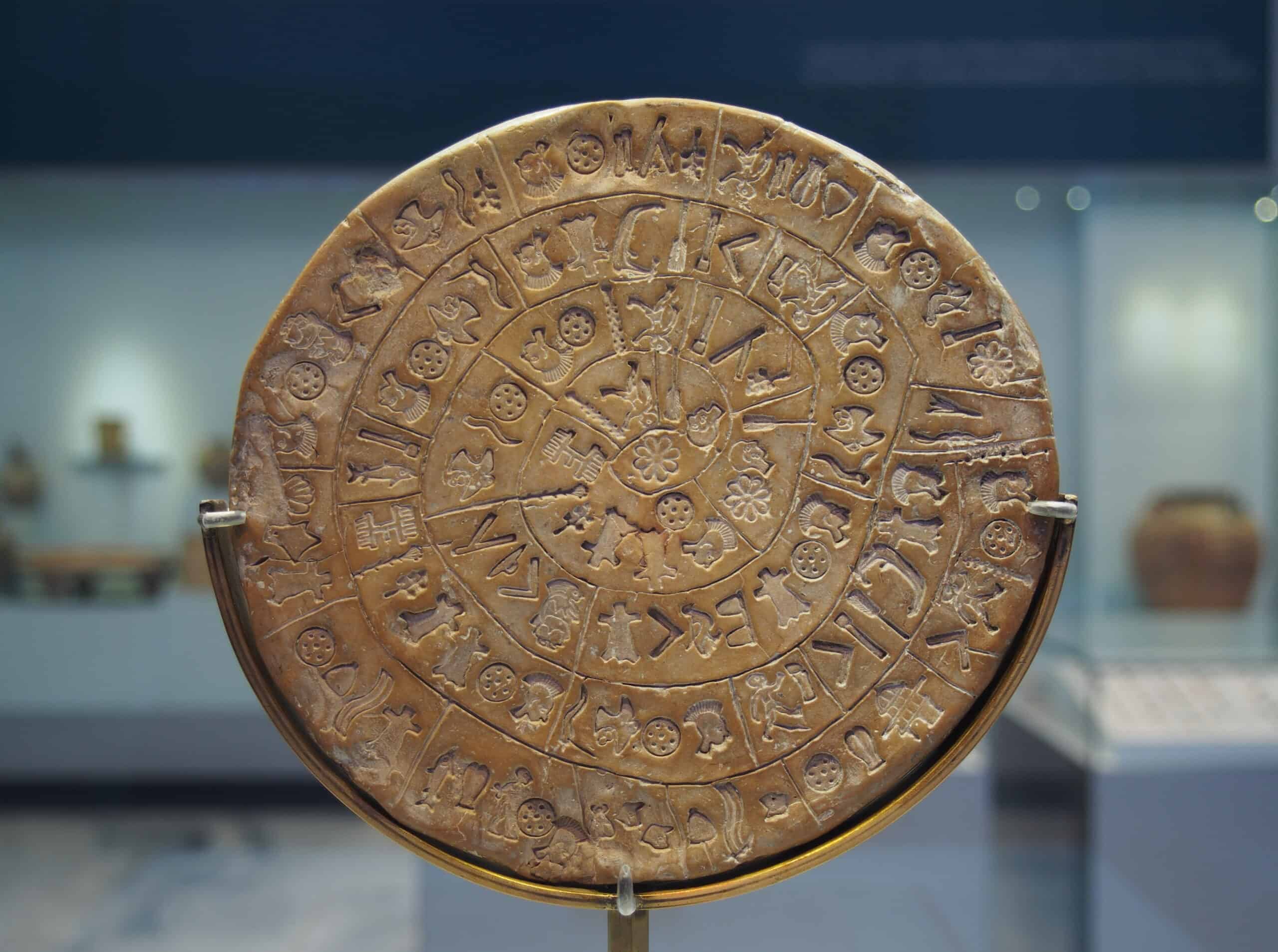
The Phaistos Disc stands as one of archaeology’s most baffling mysteries. This small clay artifact has confounded scholars for more than a century. Found in 1908 on the Greek island of Crete, the disc bears 241 mysterious symbols arranged in a spiral pattern. No one has successfully deciphered its meaning. The strange markings seem to mock every attempt at translation.
Italian archaeologist Luigi Pernier discovered the disc in the ruins of an ancient Minoan palace. He found it buried in a basement room filled with ash and burnt animal bones. The location itself was eerie – an underground chamber accessible only from above. The room had been sealed with fine plaster, as if someone wanted to hide its contents forever.
What makes this discovery even stranger is how the disc was created. Each symbol was pressed into soft clay using individual stamps before firing. This makes it one of the earliest examples of movable-type printing, predating Gutenberg by thousands of years. Someone in ancient times possessed remarkably advanced printing technology.
The Phaistos Disc Discovery That Changed Everything
The circumstances surrounding the disc’s discovery add to its mystery. Pernier found it on July 3, 1908, in what he called a “temple depository.” The underground chamber contained few precious artifacts but was rich with black earth and ashes. Burnt bovine bones were scattered throughout the debris.
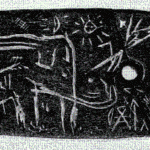
Just centimeters away from the disc, archaeologists found a Linear A tablet. This proximity suggests both items were buried together intentionally. Someone wanted these mysterious writings preserved – or hidden – in this underground vault. The careful placement hints at ritual significance or desperate concealment.
The disc itself defies easy categorization. Made from fine-grained clay, it measures about 6 inches across and nearly an inch thick. Its edges are rounded, giving it an almost organic appearance. Side A is slightly concave while side B bulges outward. These physical characteristics suggest it wasn’t meant for casual handling.
Deciphering Attempts and the Phaistos Disc Conspiracy
Related article: Salinella Salve: The Vanishing Creature That Defied Science for Over a Century
Dozens of scholars have attempted to crack the disc’s code over the past century. Their theories range from religious prayers to astronomical calendars. Some claim it’s a board game, others insist it’s a hymn to ancient goddesses. Every proposed solution has been challenged and debunked.
In 2024, linguist Gareth Owens claimed he’d deciphered 99 percent of the disc’s content. According to his research, it’s a prayer to a pregnant mother goddess. He identified repeated words that might mean “mother” and “goddess” in an ancient Minoan language. Yet other experts remain skeptical of his claims.
The most unsettling theory suggests the disc might be a forgery. Some scholars argue that Luigi Pernier himself commissioned a fake to compete with discoveries at other archaeological sites. They point to suspicious elements in his excavation reports and the disc’s convenient discovery in a sealed chamber.
However, recent evidence supports the disc’s authenticity. Archaeologists found pottery at Phaistos bearing identical symbols to those on the disc. The Heraklion Archaeological Museum, where the disc is housed, maintains it’s genuine despite ongoing controversies.
Strange Properties and Unexplained Features of the Phaistos Disc
The disc exhibits several bizarre characteristics that deepen its mystery. Analysis suggests the clay might not be local to Crete. This raises questions about where it was actually made and how it arrived at Phaistos. Did ancient traders carry it across vast distances? Or does it originate from a lost civilization?
The symbols themselves display an otherworldly quality. They include human figures, animals, plants, and geometric shapes. Some symbols appear multiple times while others occur only once. The arrangement follows a spiral pattern that draws the eye inward, creating an almost hypnotic effect.
Most disturbing is the refusal to conduct thermoluminescence testing. This scientific method could determine exactly when the clay was fired, settling authenticity questions once and for all. Yet museum authorities consistently deny permission for such testing. Their reluctance fuels speculation about what they might be hiding.
The disc’s creator made several corrections during its production. Some symbols were erased and reimpressed. Margins were widened to accommodate text. These human touches suggest someone labored carefully over its creation, treating it as something precious or sacred.
Modern Mysteries and Unanswered Questions
Today, the disc remains displayed at the Heraklion Archaeological Museum in Crete. It has become a symbol of the island and attracts thousands of visitors annually. Yet its meaning stays locked away, taunting researchers and amateur codebreakers alike.
Recent computer analysis has revealed new puzzles. The text appears to be non-linear, meaning it doesn’t follow normal reading patterns. Some sections seem to reference astronomical events while others might describe religious rituals. The complexity suggests a sophisticated writing system that disappeared without trace.
Perhaps most mysteriously, no similar artifacts have ever been found. The Phaistos Disc stands alone in archaeological history. If it represents a writing system, where are the other examples? If it’s a religious object, why is it unique? Linear A tablets from the same period remain undeciphered, but at least multiple examples exist.
The disc continues to inspire wild theories and desperate attempts at translation. Some researchers claim it contains prophecies about the future. Others believe it maps ancient trade routes or astronomical observations. New decipherment attempts appear regularly, each promising to unlock its secrets.
Whether the Phaistos Disc is an ancient masterpiece or an elaborate hoax, it has achieved a kind of immortality through mystery. Its symbols continue to whisper across the centuries, carrying messages we may never understand. In our age of instant communication and decoded genomes, this small clay disc reminds us that some secrets refuse to be revealed. The ancient Minoans took their knowledge to the grave, leaving behind only this cryptic puzzle to torment future generations.