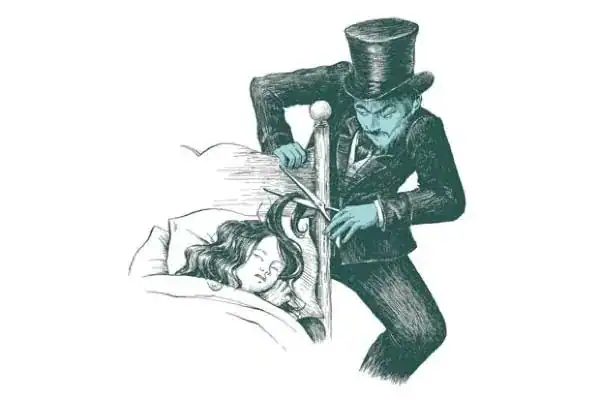
The Phantom Barber of Pascagoula stalked the night streets of Mississippi in 1942, leaving behind a trail of terror and shorn hair that defied explanation. This mysterious figure crept into homes under cover of darkness, drugging victims with chloroform before carefully cutting locks of hair from their heads. The case would grip the small Gulf Coast town in fear and paranoia during the height of World War II, creating one of America’s most bizarre unsolved mysteries.
What made this phantom so terrifying wasn’t just the violation of breaking into homes. It was the methodical, almost ritualistic nature of the hair cutting. Victims would wake to find perfectly trimmed sections missing from their hair, with no other signs of theft or assault. The perpetrator seemed to possess an almost supernatural ability to enter locked homes, complete their strange task, and vanish without a trace.
The Phantom Barber of Pascagoula’s Reign of Terror Begins
The first documented incident occurred on June 5, 1942, at the Our Lady of Victories convent. Two young girls sleeping in their beds were discovered the next morning with sections of their hair cleanly cut away. The nuns found no signs of forced entry, yet someone had clearly been inside the building during the night. The precision of the cuts suggested someone with barbering experience, leading locals to dub the mysterious intruder the “Phantom Barber.”
Word spread quickly through Pascagoula’s tight-knit community. Parents began checking on their children throughout the night. Families installed extra locks and barricaded doors. Yet the phantom continued to strike with disturbing regularity. Mary Evelyn Briggs later described her attacker as “sorta short, sorta fat, and he was wearing a white sweatshirt.” She remembered the sickening smell of chloroform filling her nostrils before losing consciousness.
The phantom’s methods became increasingly bold. Mrs. R.R. Taylor reported waking to find “something with a sickening smell” passing over her nose. Police confirmed chloroform had been used to render victims unconscious. In another chilling incident, Carol Peattie’s parents discovered a sandy footprint on an empty bed, presumably left by the mysterious hair collector.
Violence Escalates as the Phantom Barber of Pascagoula Turns Deadly
For more strange history, see: The Oak Island Mystery: Unveiling the Enigmatic Treasure Hunt
The case took a violent turn on June 13, 1942, when the phantom attacked a couple named Heidelberg. This time, the intruder didn’t just cut hair. He brutally assaulted both victims with an iron pipe, leaving them bloodied and traumatized. The escalation from hair cutting to attempted murder sent shockwaves through the community and marked a terrifying new chapter in the phantom’s reign of terror.
Local authorities struggled to make sense of the attacks. The psychological profile didn’t fit any known criminal pattern. Why would someone risk breaking into homes just to cut hair? And why suddenly turn to violence after months of relatively harmless, albeit deeply disturbing, incidents? The historical newspaper accounts from the period reveal a community gripped by paranoia and fear.
The timing couldn’t have been worse for Pascagoula. The town’s population had swelled from 4,900 in 1940 to 14,000 by 1942 due to wartime shipbuilding at Ingalls Shipyard. Men refused to work night shifts, claiming they needed to protect their families from the phantom. This directly impacted crucial war production efforts, adding national security concerns to an already bizarre criminal case.
William Dolan’s Arrest and the Phantom Barber Mystery Deepens
In August 1942, police arrested William Dolan, a 57-year-old German-born chemist. Dolan had run a pharmacy in New Orleans before retiring to Pascagoula. His background in chemistry made him a suspect capable of using chloroform effectively. Authorities charged him with attempted murder in connection with the Heidelberg attack, though they never directly linked him to the hair-cutting incidents.
The arrest should have ended the mystery, but it only deepened the enigma. Dolan maintained his innocence throughout his trial and imprisonment. In 1948, he passed a polygraph test administered by Governor Fielding Wright and was released early. The governor declared Dolan rehabilitated in 1951, suggesting doubts about his guilt had persisted at the highest levels of state government.
The strangest twist came in 1954. A man claiming to be Dolan died in Bay St. Louis, but FBI fingerprint analysis revealed the deceased had different fingerprints entirely. Meanwhile, the real Dolan was arrested for vagrancy in Sacramento, California, giving his age as 70 with no mention of his Mississippi past. Who was buried in Bay St. Louis? The insurance company refused to pay Dolan’s wife’s claim, leaving yet another unanswered question.
Theories and Unanswered Questions That Haunt Pascagoula
Modern researchers examining the case conclude that Dolan likely served as a scapegoat for the hair-cutting incidents. Some theorists propose the activities were acts of wartime sabotage. German U-boats had been spotted in the Gulf of Mexico off Pascagoula’s coast, possibly attempting to frighten residents away from the vital shipyard through psychological warfare.
The phantom’s intimate knowledge of Pascagoula’s layout suggested a long-time resident rather than a foreign agent. Police noted the perpetrator knew which homes had children and exactly how to enter without detection. This local knowledge contradicted the sabotage theory but raised equally disturbing questions about neighbors living secret lives.
Some sources claim hair-cutting incidents continued while Dolan was imprisoned, though these reports remain unverified. If true, they would definitively prove Dolan’s innocence regarding the phantom’s activities. The documented case details reveal a mystery that grows more complex with each new piece of evidence.
The psychological profile remains baffling. Criminal experts struggle to explain why someone would escalate from hair collecting to violence, only to presumably return to their original pattern. The methodical nature of the hair cutting suggests obsessive-compulsive tendencies, yet the sudden burst of extreme violence doesn’t fit this behavioral pattern.
The Phantom Barber of Pascagoula case continues to fascinate true crime enthusiasts and paranormal researchers alike. In 2024, a new comic book “Mississippi Macabre” brought renewed attention to the mystery, while podcasters and authors continue examining the evidence for clues. The real phantom was never identified and likely never will be, leaving Pascagoula with one of America’s most enduring unsolved mysteries. Whether the truth involves wartime espionage, a disturbed local resident, or something even stranger, the phantom barber’s nocturnal visits remain an unexplained chapter in Mississippi’s dark history.