The Russian Sleep Experiment stands as one of the internet’s most terrifying and convincing horror stories. This fictional tale of Soviet test subjects driven to madness has fooled countless readers since 2010. The story describes five political prisoners exposed to an experimental gas that prevents sleep for fifteen days. What begins as a scientific experiment quickly descends into nightmarish horror as the subjects transform into violent, inhuman creatures.
Created by an anonymous user named “OrangeSoda” on the Creepypasta Wiki, the story gained massive popularity almost immediately. Many readers believed it was real. The tale’s convincing scientific details and historical context made it seem plausible. News organizations like Snopes had to debunk the story as entirely fictional.
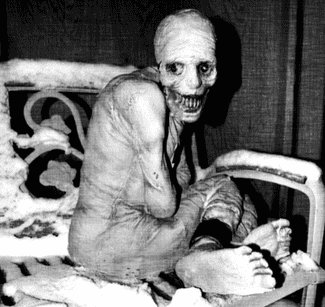
The story’s power lies in its masterful blend of Cold War fears and body horror. It taps into our deepest anxieties about government experimentation and human nature. The accompanying image of a grotesque, emaciated figure only adds to the horror. However, this image is actually of a Halloween prop called “Spazm,” not a real test subject.
The Russian Sleep Experiment’s Fictional Horror Unfolds
The story begins in a covert Soviet facility in 1947. Five political prisoners volunteer for an experiment in exchange for freedom. Scientists pump a mysterious gas into their chamber to keep them awake for thirty days. The gas works too well. The subjects stay conscious but begin showing disturbing behavior.
By day five, the prisoners stop talking to researchers. They whisper among themselves constantly. Their conversations become increasingly paranoid and disturbing. The subjects tear pages from books and paste them over the observation windows. They smear the pages with their own feces.
On day nine, one subject begins screaming. He continues for three hours straight until his vocal cords rupture. The others don’t react to his agony. They just continue whispering. When the screaming stops, the remaining subjects tear books apart with their bare hands. They eat the pages.
The experiment takes a horrifying turn on day fifteen. When researchers try to end the test, the subjects beg to keep receiving the gas. They’ve become addicted to staying awake. The prisoners have mutilated themselves beyond recognition. They’ve torn off their own flesh and eaten it. Their wounds don’t seem to cause them pain.
Real Soviet Sleep Research Behind the Russian Sleep Experiment
For more strange history, see: Alligator Bait: The Disturbing Racist Imagery That Haunted American Popular Culture
While the Russian Sleep Experiment is fiction, real sleep deprivation studies did occur in the Soviet Union. Russian scientists like Vladimir Bekhterev and Ivan Pavlov pioneered neurological research in the early 20th century. They studied fatigue and sleep cycles extensively. During the 1920s and 1930s, Soviet researchers explored “stress states” and sensory manipulation.
However, these real experiments were nothing like the fictional horror story. Soviet sleep studies typically lasted one to three days, not weeks. They focused on understanding sleep’s role in learning and memory. The research was primitive compared to modern sleep science.
The longest documented period without sleep is around 264 hours or eleven days. This record belongs to Randy Gardner, an American student who stayed awake for a science project in 1964. Sleep deprivation symptoms become apparent very quickly, including hallucinations after just three or four days.
Medical experts confirm that no substance can keep humans awake for thirty days. Dr. Po-Chang Hsu notes that some drugs might grant a couple of days without sleep, but thirty days is impossible. The human body would shut down long before reaching such extremes.
The Russian Sleep Experiment’s Cultural Impact and Adaptations
The story’s popularity exploded across social media platforms. It became one of the most shared creepypastas ever created. Dread Central’s Josh Millican called it “one of the most shocking and impactful urban legends of the Internet Age.” The tale spawned countless discussions about its authenticity.
Academic scholars have analyzed the story’s cultural significance. Tosha R. Taylor wrote that it “reflects residual political anxieties as it purports to reveal a top-secret effort by Russian scientists in World War II.” The story resonates because it aligns with known historical atrocities and government experiments.
The creepypasta inspired multiple adaptations across various media. Jeremy Bates published a novel based on the story in 2019. Several film adaptations followed, including “The Soviet Sleep Experiment” starring Chris Kattan. A psychological thriller directed by John Farrelly was released in 2022.
The story’s enduring appeal lies in its believable premise. It fits with common knowledge about unethical human experiments during the 1940s. World War II saw horrific medical experiments by Nazi doctors. The CIA’s MK-Ultra program later conducted similar unethical research on unwilling subjects.
Why This Internet Legend Continues to Terrify Readers
The story’s success stems from its perfect blend of historical plausibility and psychological horror. It presents itself as a leaked government document rather than fiction. The clinical, scientific tone makes the horrific events seem more real. Readers encounter the story without knowing it’s fake.
The tale exploits our fears about government secrecy and human experimentation. It suggests that authorities conduct terrible experiments on prisoners and dissidents. This fear resonates across cultures and political systems. People worry about what their governments might do in secret.
The story also taps into primal fears about sleep and consciousness. Sleep is a vulnerable state where we lose control. The idea of being forced to stay awake indefinitely is deeply disturbing. The subjects’ transformation into monsters represents our fear of losing our humanity.
The story became a global phenomenon precisely because it feels possible. In an age of government surveillance and corporate experimentation, the line between fiction and reality blurs easily. The Russian Sleep Experiment reminds us that sometimes the most effective horror stories are those that could theoretically be true.
The tale’s legacy continues to grow as new readers discover it daily. It stands as a testament to the power of internet storytelling and our collective fascination with the macabre. Whether viewed as entertainment or cautionary tale, this fictional experiment has permanently embedded itself in digital folklore.