
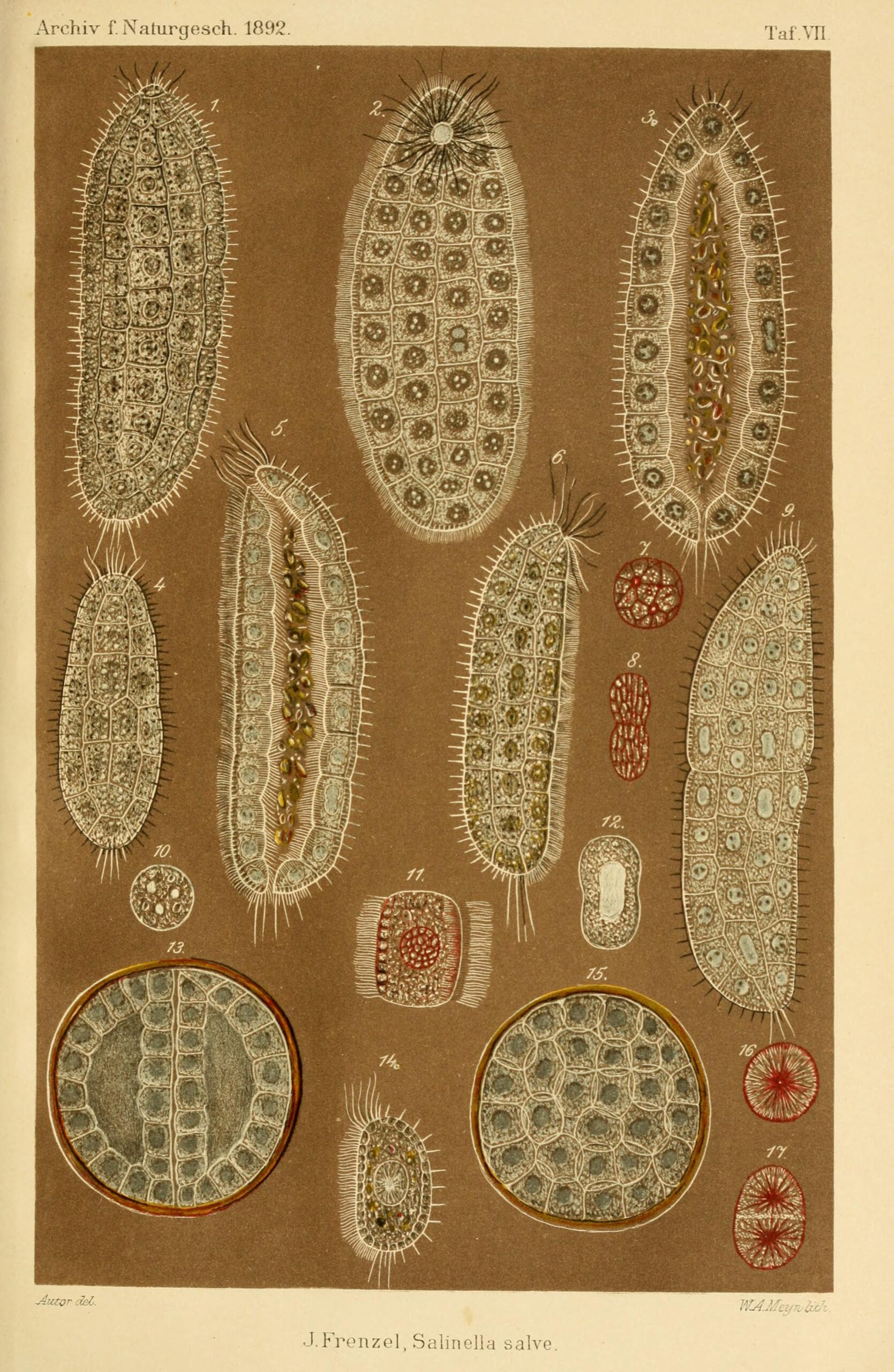
In 1892, German zoologist Johannes Frenzel made a discovery that would haunt the scientific world for over a century. Salinella Salve, a microscopic creature unlike anything ever seen, appeared in his laboratory from Argentine salt flat samples. Then it vanished forever. No scientist has found another specimen since, leaving researchers to question whether this enigmatic organism ever truly existed.
The story begins with a forgotten jar of soil. Frenzel received samples from salt pans near Río Cuarto, Argentina, courtesy of his colleague Wilhelm Bodenbender. He mixed the soil with water, added a few drops of iodine, and left the container in sunlight for weeks. When he finally examined it, something extraordinary was clinging to the glass walls.
What Frenzel observed defied classification. The creatures were sausage-shaped, about 2 millimeters long, with dense cilia covering their entire bodies. They had a mouth at one end and an anus at the other, connected by a simple gut. Most bizarre of all, their bodies consisted of just one layer of cells – yet they moved and fed like complex animals.
The Mysterious Discovery of Salinella Salve
Frenzel’s detailed illustrations show creatures that shouldn’t exist according to modern biology. Salinella Salve possessed characteristics that placed it somewhere between single-celled protozoa and true multicellular animals. The organisms reproduced by splitting in half, creating identical copies of themselves. Sexual reproduction remained unobserved, though Frenzel suspected it occurred.
The German scientist tried desperately to preserve specimens for future study. Every attempt failed catastrophically. The delicate creatures disintegrated when exposed to preservatives, leaving behind only sketches and descriptions. By the time Frenzel returned to Germany in 1891, his living cultures had died. The type specimens – the original examples that define a species – simply vanished.
Frenzel’s location description reads like a cryptic treasure map. He mentioned “salt flats in the Río Cuarto region” but provided no specific coordinates. The vague directions would plague future researchers for generations. Modern scientists describe his field notes as “one of the most ambiguous discovery accounts in zoological history.”
Failed Expeditions to Find Salinella Salve
Related article: Havana Syndrome: The Mysterious Illness Targeting American Officials Worldwide
The hunt for Salinella Salve resumed in the early 2010s when Michael Schrödl from Munich’s Zoological State Collection organized an expedition to Argentina. His team bought a rusty car and spent weeks scouring the Córdoba Province salt flats. They collected samples from hundreds of locations, following Frenzel’s cryptic protocol exactly.
The results were devastating. Despite growing numerous microorganisms in their laboratory cultures, no trace of Salinella appeared. The team found tardigrades, rotifers, and countless bacterial species – but nothing matching Frenzel’s descriptions. Modern molecular techniques that could definitively identify the creature found only empty salt and disappointment.
Schrödl’s failure wasn’t unique. Every subsequent expedition has ended the same way. The original habitat may no longer exist – much of the Río Cuarto salt flat region has been converted to farmland. Agricultural development destroyed the precise environmental conditions that might have supported these enigmatic organisms.
A February 2025 expedition represents the most recent attempt to solve the mystery. Researchers returned to the exact coordinates Frenzel described, armed with advanced DNA sequencing equipment. Their preliminary results remain unpublished, but early reports suggest another failure.
The Phantom Phylum: What Was Salinella Salve?
In 1963, American biologist R. Blackwelder created an entire taxonomic phylum for this single species. Monoblastozoa – meaning “single-layered animals” – became one of biology’s most controversial classifications. The designation suggests Salinella Salve represented a completely unique branch of animal evolution, separate from all other known life forms.
Critics argue that Frenzel simply misidentified a known organism or fell victim to contamination. The creature’s impossible anatomy – cilia on both sides of a single cell layer – violates basic principles of animal development. No other multicellular organism possesses such a body plan. Skeptics suggest Frenzel observed damaged specimens of existing species, possibly tardigrades or rotifers.
Believers counter that the detailed illustrations show features no known animal possesses. The bilateral symmetry, distinct mouth and anus, and unique cellular organization don’t match any described species. If Frenzel fabricated the discovery, why create something so anatomically implausible? Recent scientific reviews describe Salinella as potentially representing “a lost evolutionary experiment” – a failed attempt at multicellularity that died out before spreading.
The timing adds another layer of mystery. Frenzel died in 1897, just five years after his discovery. He never had the opportunity to search for additional specimens or defend his findings against critics. His reputation as a meticulous observer and skilled illustrator lends credibility to the account, but death silenced any chance of verification.
Modern Theories and Continuing Mystery
Contemporary biologists propose several explanations for the Salinella enigma. The contamination theory suggests laboratory cultures mixed different organisms, creating chimeric creatures that appeared novel. Environmental factors in 1890s Argentina might have produced temporary mutations in common species. Climate change could have eliminated the specific conditions necessary for Salinella survival.
The hoax theory remains unpopular among scientists familiar with Frenzel’s work. His other discoveries proved accurate and his illustrations showed remarkable attention to detail. Creating an elaborate fake would have required extensive knowledge of animal anatomy and development – knowledge that would have revealed the impossibility of his creation.
DNA analysis of museum specimens from Frenzel’s other collections might provide clues. Contaminating organisms could have left genetic traces that modern sequencing could identify. Unfortunately, most 19th-century biological collections lack the preservation quality necessary for genetic analysis.
The mystery deepens with each failed expedition. If Salinella Salve never existed, why hasn’t anyone found the “real” organism Frenzel supposedly misidentified? If it did exist, what environmental catastrophe could have driven it to complete extinction within decades of discovery?
Recent expeditions focus on extreme environments that might harbor surviving populations. Underground salt deposits, isolated brine pools, and geothermal springs represent potential refugia. The search continues in laboratories worldwide, where researchers culture samples from increasingly exotic locations.
The legend of Salinella Salve endures as one of biology’s greatest unsolved mysteries. Whether phantom or reality, this vanishing creature challenges our understanding of life’s diversity and evolution’s possibilities. In the salt flats of Argentina, something extraordinary may still be waiting for rediscovery – or perhaps it never existed at all, living only in the faded illustrations of a long-dead German zoologist who saw something impossible in a forgotten jar of brine.
Related Posts
 USS Davidson: The Navy Frigate That Vanished Beneath Mysterious Waters
 January 2026 Solar Storm: The Celestial Event That Defied Scientific Predictions
 2025 Pn7 Quasi Moon: Earth’s Mysterious Shadow Companion That Shouldn’t Exist
 Disappearance of Owen Parfitt: The 1760s Mystery That Defied All Logic