
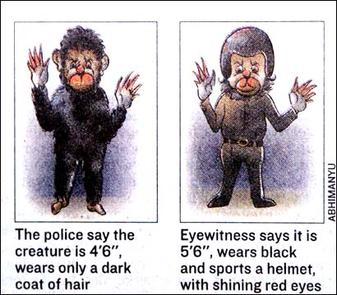
The Monkey-man of Delhi emerged from the shadows of India’s capital in May 2001, sparking one of the most bizarre cases of mass hysteria in modern history. This mysterious creature allegedly terrorized residents across New Delhi for weeks, leaving behind a trail of panic, injuries, and unexplained deaths. Eyewitness accounts described a nightmarish being that defied explanation – part monkey, part machine, and entirely terrifying.
What made this urban legend particularly chilling was its consistency across hundreds of independent sightings. Witnesses reported a creature standing four to eight feet tall, covered in thick black hair with glowing red eyes. Most disturbing were the reports of metal claws and a metallic helmet, suggesting something far more sinister than an ordinary primate. The creature allegedly wore three buttons on its chest and, according to some accounts, roller skates that allowed it to glide silently through the night.
The panic reached fever pitch when residents began sleeping on rooftops to escape the stifling heat during rolling blackouts, making them perfect targets for the prowling beast. Police received over 350 official reports, with approximately 60 people sustaining injuries during alleged encounters or panicked escapes.
The Monkey-man of Delhi’s Reign of Terror
The first documented sighting occurred on April 5, 2001, when Anil Gopal reported an encounter in neighboring Ghaziabad. However, it wasn’t until May 13 that the creature truly announced its presence in Delhi’s eastern districts. Word spread like wildfire through the densely populated slums, where residents lived in cramped quarters and relied heavily on oral communication.
Witnesses described hearing distinctive calls – “ohu-ohu,” “she-she,” or “ho-ho” – echoing through the narrow alleyways before attacks occurred. The creature allegedly possessed superhuman abilities, leaping between buildings with ease and vanishing without a trace when pursued. Some victims claimed it could fly using a mysterious black belt and red-striped suit, while others insisted it wore an astronaut-like helmet with a glowing light.
The attacks followed a disturbing pattern. The entity would strike in the early morning hours, typically between 2 and 4 AM, when victims were most vulnerable. It seemed to target people sleeping on rooftops or terraces, scratching and clawing at them before disappearing into the darkness. The official police investigation documented increasingly frantic reports as the phenomenon spread throughout the city.
Eyewitness Accounts of the Delhi Monkey-man
This event shares similarities with: Proctor Valley Monster: The Hairy Giant Terrorizing San Diego’s Back Roads
The testimonies from alleged victims painted a picture of pure terror. Residents described being awakened by the sound of metal scraping against concrete, followed by the appearance of glowing red eyes peering through windows or over rooftop walls. The creature’s face was consistently described as having a vulpine or fox-like snout, with sharp teeth visible when it snarled.
One particularly chilling account came from a family in East Delhi who claimed the beast attempted to break into their home. They reported hearing metallic scratching sounds on their roof before seeing a dark, hairy figure silhouetted against the night sky. The creature allegedly stared at them through their window for several minutes before bounding away across neighboring rooftops.
Physical evidence remained frustratingly elusive. While victims displayed scratch marks and bite wounds, forensic analysis revealed these injuries were inconsistent with animal attacks. Dr. Nimesh Desai, who led the investigation for the Institute of Human Behavior and Allied Sciences, discovered that most scratches appeared on the outer forearm rather than inner areas typically targeted by attacking animals.
The psychological impact proved devastating. Families abandoned their homes, sleeping in groups for protection. Vigilante groups formed to patrol neighborhoods, sometimes attacking innocent people mistaken for the creature. The fear became so pervasive that normal urban sounds – cats fighting, monkeys chattering, or metal objects falling – triggered panic attacks among residents.
Deaths and Injuries Linked to the Monkey-man
The most tragic aspect of the Delhi phenomenon involved the deaths of at least three people who died not from direct attacks, but from terror-induced accidents. A pregnant woman fell down a stairwell while fleeing what she believed was the creature. Another victim, a man sleeping on his rooftop, leaped to his death when he thought he spotted the beast approaching.
The Indian Journal of Medical Sciences documented exactly 397 police reports filed between May 10-25, 2001, though only 52 individuals required actual medical attention. The majority of alleged victims were young males from the poorest sections of East Delhi, areas where superstition and folklore held strong influence over daily life.
Medical examination of the injured revealed a disturbing pattern. Most wounds appeared to be self-inflicted during panicked attempts to escape, rather than from creature attacks. Specialists noted that the injuries showed characteristics of “acute panic reaction developing against a background of high suggestibility.” Some victims had scratches from rats, cats, or ordinary monkeys, while others bore marks from accidental domestic injuries sustained during frantic midnight flights.
Vigilante violence added another layer of danger to the situation. Innocent people were beaten by mobs convinced they had captured the creature. A van driver was dragged from his vehicle and severely assaulted by residents who believed he was the monster in disguise.
Scientific Investigation and Theories
As the hysteria peaked, scientists and rationalists stepped forward to investigate the phenomenon. Sanal Edamaruku of the Indian Rationalists Association conducted extensive fieldwork, interviewing witnesses and examining alleged evidence. His investigation revealed significant inconsistencies in eyewitness accounts and a complete lack of physical proof.
The official police conclusion, released on June 19, 2001, attributed all sightings to “fear and panic” rather than an actual creature. However, this explanation failed to satisfy many residents who remained convinced of their experiences. The case became a textbook example of mass psychogenic illness, where psychological distress manifests as physical symptoms across a population.
Researchers identified several factors that contributed to the hysteria. The extreme heat forcing people to sleep outdoors, frequent power outages creating an atmosphere of vulnerability, and the dense urban environment where rumors spread rapidly all played crucial roles. The phenomenon demonstrated how collective fear could create and sustain a shared delusion across thousands of people.
Interestingly, similar creatures have been reported in other parts of the world, including the Bukit Timah Monkey Man in Singapore and various “spring-heeled” entities in historical accounts. These parallels suggest that the Delhi incident tapped into deeper, perhaps universal, fears about the unknown lurking in urban shadows.
The Monkey-man of Delhi remains one of India’s most documented cases of mass hysteria, continuing to fascinate researchers studying the intersection of psychology, folklore, and urban legend. While science may have debunked the creature’s existence, the terror it inspired was undeniably real, leaving an indelible mark on Delhi’s collective memory and serving as a reminder of how quickly fear can transform ordinary city streets into landscapes of nightmare.
Related Posts
 Siren Head: The Terrifying Digital Legend That Stalks Modern Folklore
 The Lavender Town Syndrome: When Pokémon’s Haunting Music Allegedly Drove Children to Suicide
 Ravenholm: The Cursed Mining Town That Inspired Gaming’s Most Terrifying Ghost Story
 The Poppy Fields: The Bizarre Musical Hoax That Fooled the World