
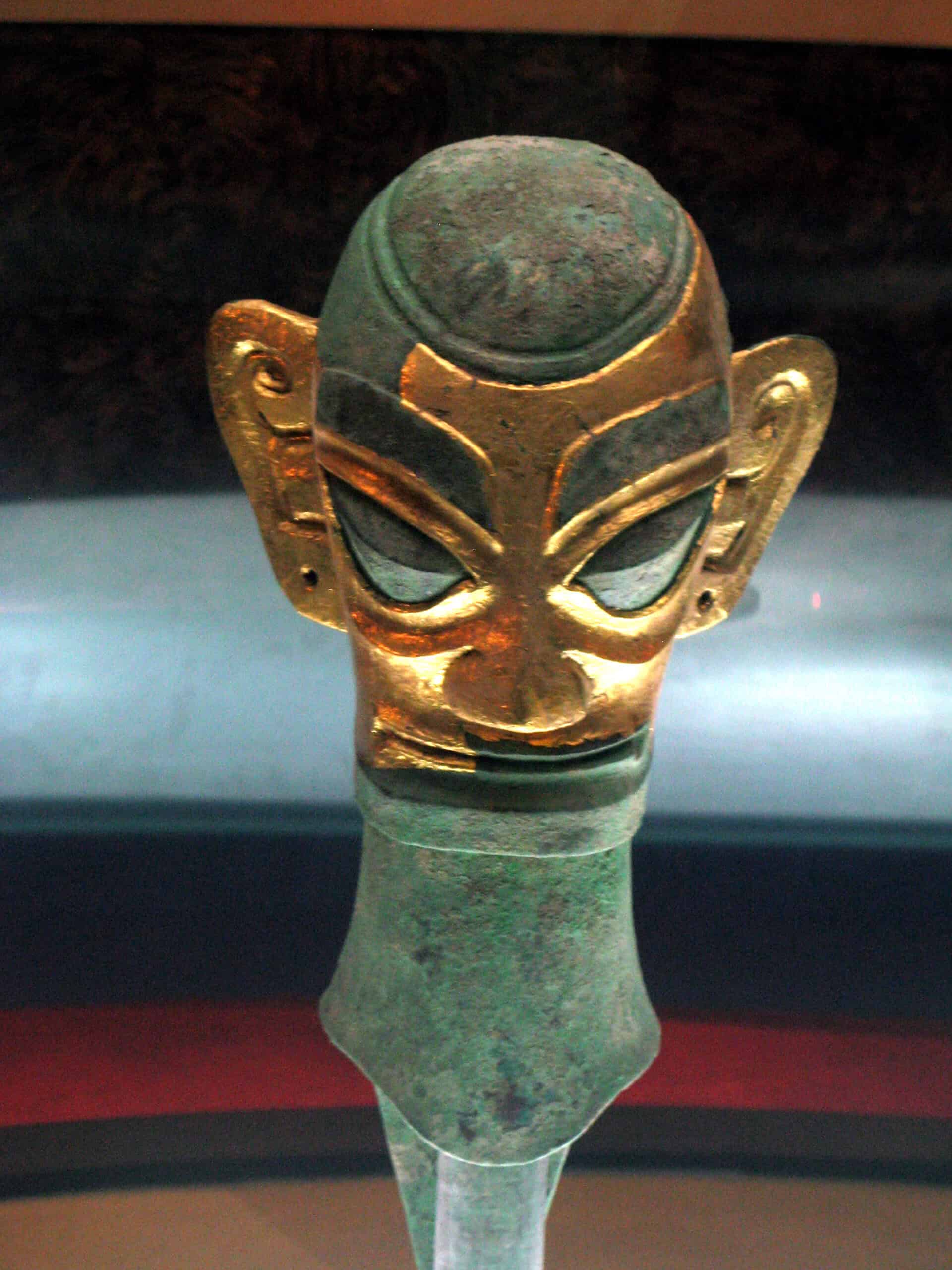
The Sanxingdui Culture represents one of China’s most baffling archaeological mysteries. This ancient civilization left behind thousands of deliberately destroyed artifacts in what appears to be massive ritual sacrifices. Bronze masks with bulging eyes, snake-bodied statues, and sacred trees were smashed, burned, and buried in elaborate ceremonies. The strange discoveries have sparked wild theories about alien visitors and supernatural powers.
In 1929, farmer Yan Daochang was digging a well near Chengdu when he struck something hard. What he found would change archaeology forever. Jade artifacts emerged from the earth in Moon Bay. But this was just the beginning of a mystery that continues to baffle experts today.
The site spans over 3,000 years of history. Yet the most puzzling finds come from sacrificial pits filled with broken treasures. Every precious object was deliberately destroyed before burial. Why would an advanced civilization smash their most sacred items?
The Sanxingdui Culture’s Ritual of Destruction
The most haunting aspect of the Sanxingdui Culture isn’t what archaeologists found. It’s how they found it. Nearly every artifact was ritually broken, burned, and carefully layered before burial. This deliberate destruction is the central mystery that haunts researchers.
Bronze masks with protruding eyes were smashed beyond recognition. Sacred trees made of gold and bronze were broken into pieces. Ivory tusks were snapped in half. Then everything was burned in massive fires before being buried in precise layers.
Archaeologist Tang Fei noted the “increasingly obvious sacrificial characteristics” of the pits. But what kind of sacrifice requires destroying your most precious objects? The violence of the destruction suggests something more than simple burial rites.
Recent excavations revealed over 17,000 artifacts from six newly discovered pits. All showed the same pattern of deliberate destruction. The Sanxingdui site continues to yield broken treasures that tell a story of systematic ritual violence.
Strange Creatures and Sanxingdui Culture Mysteries
For more strange history, see: Electronic Harassment: The Chilling Case of James Walbert and Modern Mind Control Fears
The artifacts themselves are unlike anything found elsewhere in ancient China. Bronze masks feature bulging eyes that seem to stare into another world. Some have pupils that extend outward on stalks. Others show serene faces with mysterious smiles.
A stunning discovery emerged in recent years. A bronze statue with a snake’s body and crowned head defied all expectations. The creature consists of three distinct sections. Its serpentine form suggests connections to dragon mythology or something more otherworldly.
Another bizarre find combined tiger and dragon features. This hybrid creature challenges everything archaeologists thought they knew about ancient Chinese art. The artistic style doesn’t match any known civilization from that period.
The bronze sacred trees are equally mystifying. These intricate sculptures show birds perched on branches heavy with fruit. Some trees reach over eight feet tall. Their purpose remains unknown, but their destruction was clearly significant to the ancient people.
Alien Theories Surrounding Sanxingdui Culture
The unusual artifacts sparked wild theories about extraterrestrial visitors. The bulging eyes on bronze masks looked alien to some observers. The advanced bronze-casting techniques seemed too sophisticated for the time period. Conspiracy theories flourished in China and beyond.
Chinese archaeologist Lei Yu firmly rejected these claims. “Some artistically exaggerated goddess statues cannot be said to be ‘aliens,'” he stated. The sketchy historical record left room for speculation, but science tells a different story.
The strange appearance of the masks reflects artistic exaggeration, not alien features. Ancient Chinese artists often emphasized certain facial features for religious or cultural reasons. The protruding eyes might represent spiritual vision or divine power.
Modern analysis reveals sophisticated but entirely human techniques. The bronze-casting methods show incredible skill and knowledge. But they fall within the capabilities of ancient Chinese craftsmen. Archaeological evidence supports human origins for all discoveries.
Modern Excavations and Hazmat Suits
Today’s archaeologists work under extraordinary conditions at the site. Xu Feihong begins each shift by entering a giant air-conditioned glass dome. He pulls on a full hazmat suit, surgical gloves, and face mask. Then he’s lowered into the ancient pits on a wooden board.
The preservation requirements are extreme. Organic materials like silk and ivory require immediate stabilization. Temperature and humidity must be precisely controlled. One mistake could destroy artifacts that survived thousands of years.
The 2020 excavations used cutting-edge technology. Multiple institutions collaborated on the project. Advanced imaging revealed painted details invisible to the naked eye. Black paint appeared on eyebrows and hair. Red paint decorated bronze tree petals.
Recent discoveries extended China’s painted bronze timeline by nearly a thousand years. The color analysis unveiled a “color code” that ancient artists followed. This systematic approach to decoration suggests organized religious practices.
The Sanxingdui Culture remains one of archaeology’s greatest puzzles. The deliberate destruction of precious artifacts defies logical explanation. Were these offerings to angry gods? Preparations for the afterlife? Or something else entirely? The broken treasures keep their secrets, leaving us to wonder what drove an advanced civilization to destroy its most sacred creations. Each new discovery adds pieces to the puzzle, but the complete picture remains tantalizingly out of reach.
Related Posts
 Longyou Caves: China’s 2,000-Year-Old Underground Mystery That Defies Explanation
 Tarim Basin Mummies: Ancient Secrets and Bizarre Burial Rituals in China’s Desert
 Phaistos Disc: The Mysterious Clay Artifact That Defies All Attempts at Translation
 Llangaffo: The Welsh Village Where Ancient Rituals Meet Modern Earthquakes