
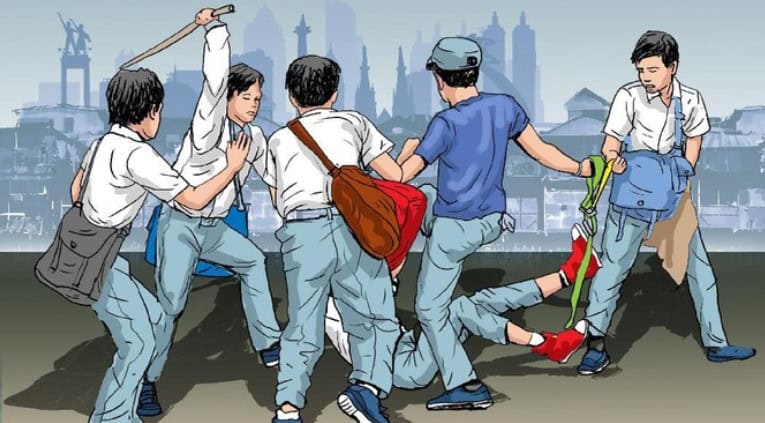
Tawuran represents one of Indonesia’s most disturbing urban phenomena – ritualistic mass street fighting between rival school gangs that has claimed hundreds of young lives in Jakarta. This deadly tradition transforms ordinary high school students into warriors engaged in brutal territorial battles that often end in death or permanent disfigurement.
The word itself carries an ominous meaning. Derived from Sundanese, “tawuran” originally meant “to pay for” or “to redeem,” as documented in Jonathan Rigg’s 1862 Dictionary of the Sunda Language. The term evolved to describe mob fighting among youth groups, retaining its dark connotations of retribution – literally “paying back” perceived slights between schools. What began as a linguistic curiosity became a blood-soaked reality on Jakarta’s streets.
The Dark Origins of Tawuran Gang Warfare
The first widely documented tawuran incident appeared in Kompas newspaper on June 29, 1968, reported as “Bentrokan Pelajar Berdarah” (Bloody Student Clashes) in central Jakarta. This marked the beginning of a phenomenon that would spiral into something far more sinister than typical teenage aggression.
Indonesian sociologist Wirumoto discovered disturbing patterns in these conflicts. They weren’t random outbursts of violence but carefully orchestrated events that followed examination periods, holidays, or graduations. The timing suggests something ritualistic – as if these young warriors needed to prove themselves through bloodshed during specific transitional moments in their academic lives.
Even more chilling is how the violence spreads. Multiple schools often join single campaigns, creating massive street battles involving hundreds of teenagers armed with makeshift weapons. The solidarity isn’t based on friendship or shared interests, but on something darker – a collective hunger for violence that binds these groups together in ways that normal social connections cannot explain.
Mysterious Tawuran Traditions and Supernatural Elements
Related article: Tommy Lee Walker Exonerated: The Haunting Legacy of Dallas County’s Greatest Injustice
Perhaps the most unsettling aspect of tawuran culture involves the mysterious transmission of fighting knowledge. Students at schools known for frequent battles possess an almost supernatural understanding of weaponry. They know how to transform ordinary belts into deadly weapons – a tradition carefully passed down from one generation to another like some dark inheritance.
Alumni don’t just remember their school days fondly; they actively pride themselves on their schools’ “guts” to attack other institutions. This suggests something beyond normal school spirit – a cult-like devotion to violence that transcends graduation. Former students become living legends, their battle scars serving as proof of their school’s warrior heritage.
French researcher Jerome Tadie uncovered even stranger patterns in his studies. Tawuran incidents follow strict temporal rhythms that seem almost supernatural in their precision. Violence peaks in June and August-September during recruitment periods, decreases October-February, then surges again March-April during exam periods. Daily patterns are equally mysterious: battles erupt at 06:00-07:00 (going to school), 12:00-14:00 (lunch), and 17:00-19:00 (going home).
These patterns suggest something beyond conscious planning. It’s as if the violence follows invisible currents that pull these young fighters into predetermined conflicts at specific times and places.
The Escalating Horror of Modern Tawuran Violence
The death toll tells a terrifying story of escalation. In 1999, 67 students died in tawuran conflicts. The numbers kept climbing: 297 deaths from 2000-2005, then 82 in 2011 alone. Between 2012 and 2017, another 130 students lost their lives to this urban warfare.
But death wasn’t enough. A 2013 Al Jazeera report documented the introduction of acid attacks into tawuran conflicts, resulting in victims whose faces were permanently destroyed. The psychological impact of seeing classmates with melted features added a new dimension of terror to these battles.
Recent incidents reveal even more disturbing trends. The October 13, 2023 fatal brawl in North Jakarta’s Pademangan District involved sharp weapons at the Bintang Mas Traffic Light area – a location that has become synonymous with student violence. In April 2024, mass arrests swept through Jakarta: 10 teenagers in East Jakarta, 38 in Depok, and 170 in Central Jakarta during pre-Ramadan operations.
Modern technology hasn’t reduced the violence – it’s made it more coordinated and terrifying. Gang leaders now use Instagram and Facebook to issue challenges and coordinate attacks. Social media serves as a digital battlefield where insults and threats build toward real-world violence.
Government Response and the Continuing Mystery
Despite decades of intervention, tawuran continues to baffle authorities. The Jakarta Metropolitan Police now coordinate with the Jakarta Provincial Government to revoke Jakarta Smart Cards (KJP) from students involved in brawls. They issue police record certificates that destroy future opportunities for these young fighters.
In 2023 alone, 3,547 cases of child violence were reported, with physical violence reaching 985 cases – a 27% increase from 2022. That same year, 163 Jakarta Smart Cards were revoked from elementary to high school students due to brawl involvement.
Police predict increased violence before religious holidays, deploying enhanced patrols in Central, East, and South Jakarta. They’ve identified factors including alcohol consumption, drug use, social media provocation, and socio-economic pressures. But these explanations feel inadequate when confronting the ritualistic nature of the violence.
The most recent mass arrest in February 2026 captured 51 suspects (31 minors, 20 adults) along with 56 sharp weapons. Yet these interventions barely scratch the surface of Indonesia’s youth violence epidemic.
What makes tawuran particularly mysterious is its persistence despite massive social changes. Economic development, educational reforms, and technological advancement have transformed Jakarta, but these street battles continue with the same intensity and ritualistic patterns observed decades ago.
The phenomenon reveals something darker about urban Indonesian society – a shadow world where young people find meaning through violence, where school pride transforms into murderous rage, and where ancient concepts of honor and retribution play out on modern streets. Tawuran isn’t just student fighting; it’s a window into the supernatural persistence of tribal warfare in the digital age, where teenagers become warriors in conflicts they barely understand but feel compelled to continue.
Related Posts
 2024 Manila Bay Oil Spill: The Mysterious Sinking That Sparked Smuggling Suspicions
 Gang Stalking: The Dark Web Communities Behind Modern Paranoia and Violence
 The Conjuring House Legal Battle and Mental Competency Controversy: When Spirits Allegedly Guide Real Estate Decisions
 El Callao Mine Disaster: Venezuela’s Cursed Gold Mine Claims Lives in Deadly 2025 Flood