
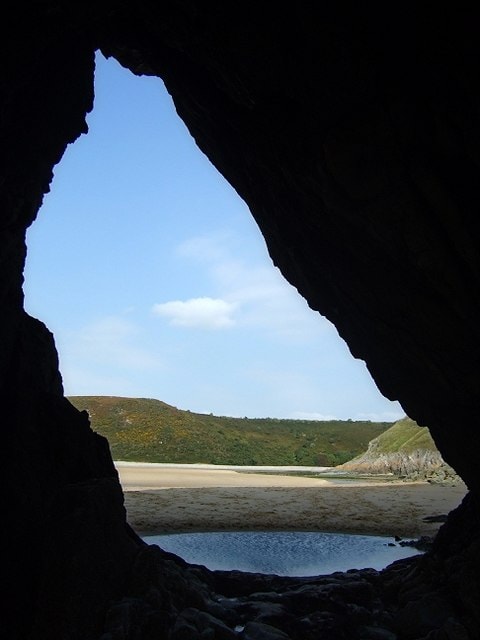
Burrows Cave is one of the strangest and most elaborate hoaxes in American archaeological history. Deep in the flatlands of Southern Illinois, a man claimed to have stumbled upon a hidden tomb packed with gold, mummies, diamonds, and artifacts from ancient civilizations. Romans. Phoenicians. Egyptians. All of them, supposedly buried beneath a cornfield near the Embarras River. The story gripped treasure hunters, fringe historians, and conspiracy theorists for years. But the cave was never found. The artifacts were fakes. And the man behind it all was a former prison guard with a very active imagination , and a very willing audience.
The Bizarre Discovery Claims Behind Burrows Cave
Russell E. Burrows was born in 1935. He was a Korean War veteran and former Illinois prison guard. He claimed to have studied archaeology at West Virginia University in the early 1950s. That claim was never verified.
In 1982, Burrows said he found something extraordinary near the Embarras River in Richland County, Illinois. The story changed depending on who was telling it. In one version, he was using a metal detector when it suddenly went wild. He fell into a narrow vertical pit. Inside, he found long stone corridors. Sealed portals. Statues. Mummies. Bronze weapons. Diamonds. Parchment scrolls.
In a second version, he discovered a 15-foot natural cave entrance covered in what he thought were Native American inscriptions. When he tried to remove them, the wall broke open. Behind it were stone steps lined with oil lamps and the charred remains of ancient torches.
Both stories end the same way. Burrows claimed the cave held an “impossible mix” of ancient peoples. Romans. Phoenicians. Hebrews. Egyptians. Sumerians. Even Black Africans. All represented in carved stone portraits and artifacts. Archaeologists and anthropologists considered the entire site a hoax almost immediately. Yet the legend grew anyway.
Burrows never revealed the exact location. He said he feared treasure hunters would loot the site. Conveniently, that meant no scientist could ever verify a single claim.
Forged Artifacts and the Burrows Cave Cottage Industry
For more strange history, see: Museum of Hoaxes: The Website That Exposes History’s Most Shocking Deceptions
The artifacts were the heart of the story. Burrows described life-sized gold statues. Gold coffins. Mummies wrapped in ancient cloth. Pagan idols. Suits of armor. Swords. Burial urns. Coins from the ancient world. Scrolls written in unknown languages.
But the items that really captured public attention were the carved stone tablets. Thousands of them. Each one supposedly depicting Old World figures , Romans, Greeks, Egyptians, Sumerians. Each one covered in mysterious writing no linguist could identify.
Here’s the problem. Those tablets were sold. Thousands of them. To private collectors across the country. No archaeologist was ever allowed to properly examine them. The few that were studied were quickly identified as modern forgeries. The carvings were crude. The stone showed no signs of genuine aging. The “ancient languages” matched no known script.
Even Barry Fell, a controversial Harvard professor who championed other fringe archaeological theories about ancient peoples in America, called the Burrows artifacts fake. When even the pseudoarchaeology crowd thinks you’ve gone too far, that says something.
The man most responsible for spreading the Burrows story was Frank Collin. Collin was a convicted Nazi who wrote under the pen name Frank Joseph. He met Burrows while serving time at the Pontiac Correctional Facility in Illinois , where Burrows worked as a prison guard. Collin later wrote books and articles about Burrows Cave, each version contradicting the last.
The Phoenician Ship Scandal and Burrows Cave’s Biggest Lie
By the early 1990s, the dominant theory around the cave shifted. Suddenly, the artifacts weren’t just from a random mix of ancient cultures. Now the story was that a Phoenician ship had sailed up the Mississippi River thousands of years ago. The crew died. The cave became their tomb.
Frank Joseph pushed this theory hard. He wrote about it in his book The Lost Treasure of King Juba: The Evidence of Africans in America before Columbus. He claimed a stone tablet from the cave depicted a Phoenician vessel.
To prove it, he placed the Burrows tablet image next to a genuine image of a known Phoenician ship. He cropped the tablet image carefully. Very carefully. The cropping hid the paddle end of a steering oar. That oar appeared at both ends of the ship on the tablet , which is not how Phoenician ships worked. Real Phoenician vessels had steering oars at the stern only. The tablet showed oars at both ends because the artist simply didn’t know what they were drawing.
Joseph’s cropping made this glaring error invisible to casual readers. It was deliberate. And it was eventually caught. The book itself survives in archive collections as a document of how fringe history can manipulate visual evidence.
Thomas Emerson, the Illinois State Archaeologist and former head of the Illinois Historic Preservation Agency, was blunt. He warned publicly that the claims made by Burrows Cave supporters were sensational and completely unsupported by evidence. No credible scientist ever backed the cave’s existence.
Why the Hoax Worked , and Why It Still Haunts Us
So why did so many people believe it? The answer is uncomfortable.
People want ancient mysteries. They want proof that history is stranger and older than textbooks say. The idea that Romans or Phoenicians sailed to Illinois thousands of years ago is thrilling. It rewrites everything. And Burrows understood that.
He fed the hunger perfectly. Gold statues. Mummies. Secret tombs. An impossible mix of ancient civilizations all buried under the American Midwest. It was too good not to believe.
The cave also appeared on television. America Unearthed covered it in Season 2, Episode 5. The History Channel’s Holy Grail in America touched on it too. Television gave the story legitimacy it never earned. Millions of viewers saw it presented alongside real archaeological discoveries.
The cave was never found. The artifacts were never verified. The location was never revealed. Burrows took his secret , if there ever was one , and guarded it behind a wall of paranoia and shifting stories. No one outside his immediate circle ever claimed to have set foot inside.
What remains is a cautionary tale. A prison guard with a good story and a willing audience built one of the most enduring archaeological frauds in American history. The tablets are still out there. Collectors still own them. Some still believe.
The mystery of what really happened near the Embarras River in 1982 may never be fully solved. And that ambiguity , that tiny crack of doubt , is exactly what keeps the legend alive.
Related Posts
 Blue Star Tattoo Legend: The LSD Scare That Terrified Parents for Decades
 Himalayan Fossil Hoax: The Greatest Paleontological Fraud That Fooled Science for Decades
 Bananadine: The Great Banana Peel Hoax That Fooled America in 1967
 Souvenir Hunting on the Battlefield of Waterloo: The Macabre Trade That Shocked Europe