The Gloucester Sea Serpent is one of America’s most chilling and well-documented cryptid encounters. Something enormous was spotted repeatedly off the coast of Gloucester, Massachusetts. Fishermen, sailors, and ordinary townspeople all saw it. They described a massive, serpentine beast unlike anything known to science. The sightings didn’t last just a season. They stretched across centuries, from 1638 all the way into the modern era. Whatever lurked in those cold New England waters left witnesses shaken and science scrambling for answers.
The Summer of Terror: Gloucester Sea Serpent Sightings of 1817
August 1817 was when things got truly terrifying. The waters off Cape Ann erupted with reports of a monstrous creature. It wasn’t one or two fishermen. Hundreds of witnesses came forward. The sheer number of accounts made this impossible to dismiss.
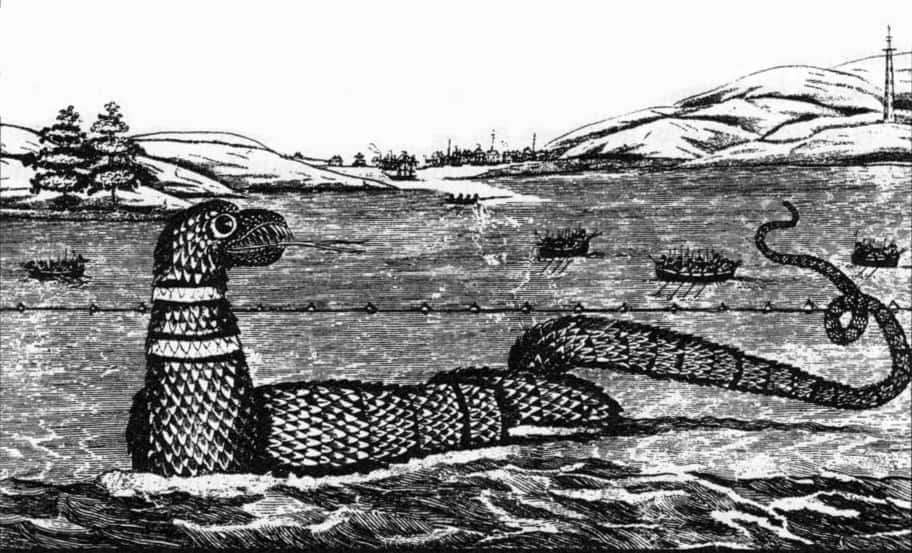
Witnesses described a creature stretching roughly 60 feet long. Its head resembled a turtle or a horse. Massive humps ran along its back as it moved through the water. It didn’t thrash wildly. It moved with unsettling, purposeful calm.
One of the most dramatic encounters involved the schooner Caravan. The crew spotted the beast swimming directly alongside their vessel. Panicked, they fired a cannon at it. The creature simply vanished beneath the surface. No blood. No wreckage. Nothing. Just dark water where a monster had been moments before.
Historical records of the Gloucester sightings show that the Linnaean Society of New England took the reports seriously enough to launch a formal investigation. That alone sets this cryptid apart. Scientists actually tried to document it. They collected sworn testimony from multiple credible witnesses. The resulting report remains one of the most unusual scientific documents in American history.
The sightings didn’t stop with summer. Reports continued into 1818 and 1819. Witnesses kept coming forward. The creature seemed to have made these waters its home.
What Did the Gloucester Sea Serpent Actually Look Like?
Related article: Alyoshenka: The Kyshtym Dwarf That Vanished Without a Trace
Witness descriptions varied wildly. That’s either a sign of mass hysteria or evidence of a creature that was genuinely hard to categorize.
Some described a long, snake-like body. Others said it had a horse-shaped head. Several witnesses reported something truly disturbing: a sharp stinger or spear-like protrusion jutting from its head. That detail haunted investigators. It didn’t match any known marine animal.
Skeptic Joe Nickell later suggested the stinger description pointed toward a narwhal. A lost or disoriented narwhal could certainly cause a stir. But narwhals don’t stretch 60 feet. They don’t have humped backs. And they don’t make entire crews fire cannons in terror.
Bernard Heuvelmans, the father of cryptozoology, catalogued the Gloucester sightings extensively in his landmark book In the Wake of the Sea-Serpents. He took the accounts seriously. He believed something genuinely unknown was operating in these waters.
Other theories floated over the years included giant eels, misidentified oarfish, and even a surviving prehistoric creature. None of them fully explained everything witnesses reported.
In 2023, researcher Karl Brandt offered a startling new theory. He suggested that harpooned sperm whales, dragging overturned rowboats behind them, could create bizarre surface phenomena. The boats would collect floating debris. The whole mass could stretch for hundreds of yards. It might even appear to move on its own. It’s creative. But it still doesn’t explain the humps, the head, or the stinger.
The Gloucester Sea Serpent and the Science That Tried to Catch It
Here’s where the story gets stranger. After the 1817 sightings, a baby serpent was reportedly found on a nearby beach. Locals were convinced it was the offspring of the sea monster. The Linnaean Society examined it eagerly.
They named it Scoliophis atlanticus. They published formal scientific findings. They were certain they had proof.
They were wrong. The creature turned out to be a deformed common black snake. A terrestrial snake. With a lumpy spine. The embarrassment was severe. Scientists backed away fast.
Academic research from 1990 in American Quarterly examined how this scientific misidentification shaped public perception of the sightings. The botched baby serpent discovery gave skeptics powerful ammunition. It made it easier to dismiss every other witness account. But the eyewitness testimonies from credible adults remained. Those didn’t go away just because one snake had a crooked spine.
The story even inspired a playwright. Charleston’s William Crafts wrote a satirical play in 1819 titled The Sea Serpent; or, Gloucester Hoax. He mocked the whole affair. But satire doesn’t explain away hundreds of independent witnesses describing the same creature.
A Legend That Refuses to Die
The earliest recorded sighting of something monstrous off Cape Ann dates back to 1638. John Josselyn documented it. The Indigenous people of the region had their own traditions about the creature long before European settlers arrived. They warned the newcomers. The newcomers didn’t listen.
Sightings continued sporadically through the 19th century. The New York Times even ran a report in 1886. The creature kept appearing. It kept vanishing. It left no body, no bones, no definitive proof.
What makes this case so compelling is the sheer volume of witnesses. We’re not talking about one frightened fisherman. Possibly thousands of people saw something. They came from different backgrounds. They had no reason to coordinate their stories.
Local businesses, strangely, never fully capitalized on the legend. Folklore expert Jeff Belanger noted that Gloucester never leaned into its monster the way other towns embraced their cryptids. There’s no sea serpent theme park. No monster festival. Just old accounts, cold water, and unanswered questions.
Occasional sightings still trickle in today. Whatever people saw in 1817 hasn’t been definitively explained. The waters off Cape Ann remain deep and dark. Something may still be out there, moving just beneath the surface, waiting to surface again when no one expects it.