
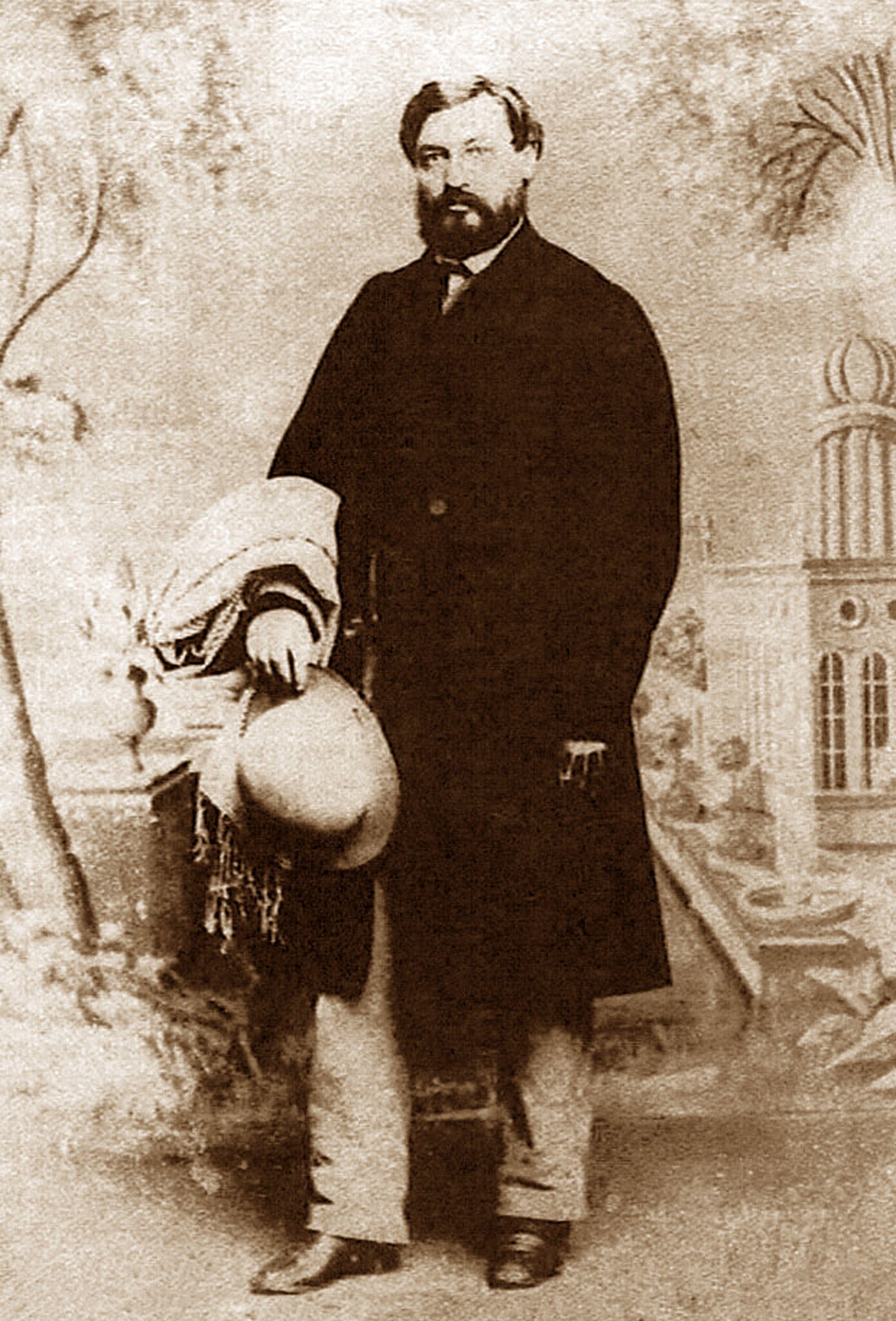
Moses Wilhelm Shapira was one of the most fascinating and tragic figures of the 19th century. He was a Jerusalem antiquities dealer who sold fake biblical relics to some of Europe’s greatest museums. He converted from Judaism to Christianity. He built a fortune on forgeries. And then, in a Rotterdam hotel room in 1884, he put a gun to his head and ended it all. His story reads like something out of a Gothic novel , a man who built his entire life on deception, only to be destroyed by the one discovery that might actually have been real.
What drove a Polish-Jewish immigrant to become the most notorious forger in Victorian archaeology? And was his final, most famous discovery , the so-called Shapira Scroll , truly a fake? Or did the world’s experts get it catastrophically wrong?
Moses Wilhelm Shapira and the Road to Jerusalem
Moses Wilhelm Shapira was born in 1830 in Kamenets-Podolski, in what is now Ukraine. His father left for Ottoman Palestine without him. In 1856, at age 25, Moses followed. The journey itself was already strange. His grandfather, who traveled with him, died along the way. And while passing through Bucharest, Moses did something remarkable. He converted to Christianity and applied for Prussian citizenship. He added “Wilhelm” to his name. He reinvented himself completely before he’d even arrived in the Holy Land.
Once in Jerusalem, he joined a community of Protestant missionaries and converts at Christ Church. He married a German deaconess nurse named Rosette Jöckel. He opened a shop in the Street of the Christians in 1869. At first, he sold religious souvenirs to pilgrims. Simple stuff. Pottery. Trinkets. But Shapira had bigger ambitions , and fewer scruples than most.
He had a talent for spotting what wealthy European collectors desperately wanted. They wanted proof. Physical, tangible proof of the Bible’s stories. And Shapira was more than willing to provide it , real or not.
He even tried to sell a fake “coffin of Samson” in London. It was exposed when a scholar named Adolf Neubauer noticed the inscription had misspelled “Samson” as “Sampson.” It was a clumsy mistake. But Shapira wasn’t done yet. Not by a long shot.
The Moses Wilhelm Shapira Forgery Empire
This event shares similarities with: Mary Toft: The Woman Who Fooled Doctors Into Believing She Gave Birth to Rabbits
The real money came after the discovery of the Mesha Stele, also known as the Moabite Stone. This ancient inscription caused a sensation across Europe. Museums scrambled to acquire Moabite artifacts. Shapira saw his opportunity.
He partnered with a Christian Arab dragoman named Salim al-Kari. Salim had actually helped copy the original Mesha Stele inscription for French scholars. He knew the ancient Moabite script better than almost anyone. Together, they organized a forgery operation of breathtaking scale.
Arab craftsmen produced hundreds of clay figurines, vessels, and erotic pieces. Salim covered them with inscriptions based on the Mesha Stele’s signs. The inscriptions didn’t actually translate to anything meaningful. But European experts didn’t know that yet. There was almost nothing to compare them against.
Shapira went further. He organized actual expeditions to Moab. He had Salim’s Bedouin contacts bury fresh forgeries in the ground. Then he brought potential buyers to “discover” them. It was theater. Elaborate, profitable theater.
In 1873, Berlin’s Altes Museum bought 1,700 of these fake artifacts for 22,000 thalers. A not-yet-famous British lieutenant named Horatio Kitchener bought eight pieces for the Palestine Exploration Fund. The forgeries were everywhere. Scholars even coined a new term , “Moabitica” , for this entirely fake category of ancient artifacts.
Shapira used the money to move his family into an elegant villa north of Jaffa Road. Life was good. But the deception couldn’t last forever.
The Moses Wilhelm Shapira Scroll Scandal
In 1883, Shapira arrived in London with something extraordinary. He claimed Bedouin traders had found ancient manuscript strips in a cave near the Dead Sea. The strips appeared to contain an early version of the biblical book of Deuteronomy , older than anything previously known. He wanted one million pounds for them.
The British Museum put the strips on display. Crowds lined up to see them. Prime Minister William Gladstone himself came to examine them. The world held its breath. Could these be the oldest biblical manuscripts ever found?
Then came the crushing blow. Charles Clermont-Ganneau , the same French scholar who had exposed Shapira’s Moabite forgeries , examined the strips. He declared them fake. Cut from the margins of a later scroll. Doctored. Worthless.
The press turned savage. Shapira became a laughingstock overnight. He fled London in disgrace. He traveled through Europe , Rotterdam, Amsterdam , trying to escape the humiliation. On March 9, 1884, he checked into the Hotel Willemsbrug in Rotterdam. He shot himself dead. He was 53 years old.
His manuscript strips were auctioned off for a few pounds. They eventually disappeared entirely. No one knows where they are today. Contemporary newspaper accounts from 1883 capture the feverish excitement , and the sudden, brutal reversal , that destroyed him.
Was the Scroll Actually Real?
Here’s where the story gets truly unsettling. In 1947, Bedouin shepherds discovered the Dead Sea Scrolls in caves near Qumran. Ancient manuscripts. Hidden in the desert. Exactly where Shapira said his strips had come from.
Suddenly, scholars started asking uncomfortable questions. What if Shapira’s scroll wasn’t a forgery? What if it was genuine , and the Victorian experts got it catastrophically wrong?
Some modern researchers believe the dismissal was too hasty. Clermont-Ganneau spent only 20 minutes examining the strips. The techniques used to detect forgeries in 1883 were primitive. The strips were never subjected to modern scientific testing. Because they vanished.
A researcher named Idan Dershowitz published a major study in 2021 arguing that the Shapira Scroll may actually be authentic. He suggests it could represent an ancient, alternative version of Deuteronomy , predating even the Dead Sea Scrolls. The implications are staggering. It would mean one of history’s greatest forgery scandals was actually one of history’s greatest archaeological discoveries. And it was thrown away.
The man who found it died alone in a Rotterdam hotel room, written off as a con artist. His daughter, the novelist Myriam Harry, spent years trying to restore his reputation.
The strips are still missing. Somewhere out there, they may still exist , in a private collection, a forgotten archive, a dusty drawer. And if they do, they might rewrite everything we know about the Bible’s oldest texts.
Moses Wilhelm Shapira died in disgrace. But history may not have delivered its final verdict yet.
Related Posts
 Museum of Hoaxes: The Website That Exposes History’s Most Shocking Deceptions
 Humbug: The Dark and Mysterious History of History’s Greatest Word for Deception
 Mummy Forgeries: The Shocking Fakes That Fooled Museums and Historians for Decades
 The Boiling Frog: The Creepy 19th-Century Experiment That Became History’s Most Disturbing Warning