
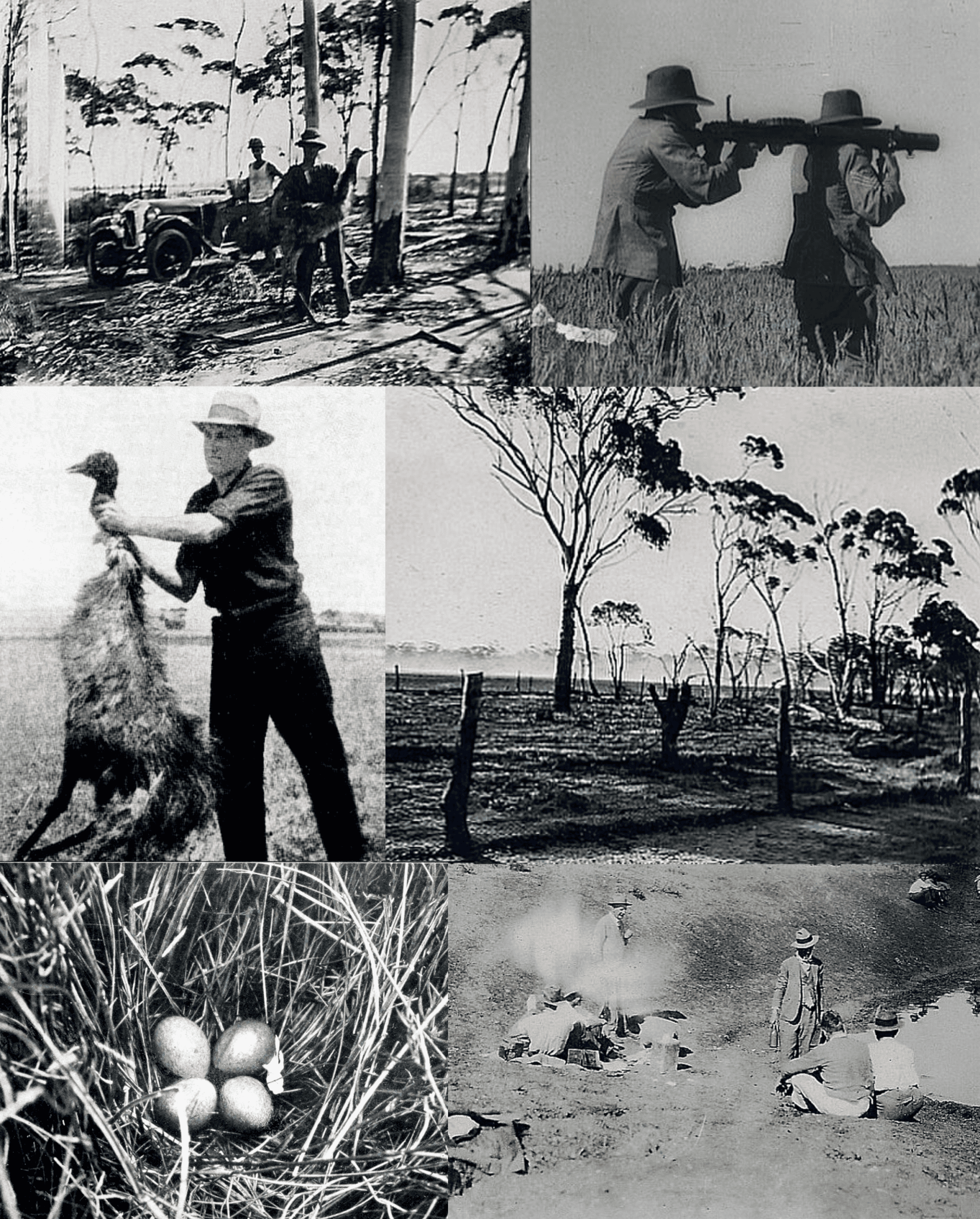
The Great Emu War is one of history’s most bizarre military disasters. It sounds like a joke. The Australian Army, armed with machine guns, deployed against a mob of giant flightless birds. And the birds won. But underneath the absurdity lies something genuinely unsettling. These weren’t just stubborn animals. They were eerily intelligent, impossibly hard to kill, and they seemed to absorb bullets like something out of a nightmare. Soldiers described them with genuine disbelief. Officers filed reports that read more like horror dispatches than wildlife management logs. What happened in the dusty Campion district of Western Australia in 1932 was strange enough to make headlines around the world , and strange enough to still haunt military history nearly a century later.
The Great Emu War Begins: Australia’s Most Humiliating Campaign
The setup sounds desperate. After World War I, the Australian government gave discharged veterans parcels of land in Western Australia. These men had survived trenches and mustard gas. Now they were trying to survive wheat farming in marginal, unforgiving soil. Then the Great Depression hit in 1929. Crop prices collapsed. Promised government subsidies never arrived. Farmers were already on the edge.
Then came the emus.
Around 20,000 of them descended on the Campion district. They weren’t wandering through. They were consuming crops, smashing fences, and leaving gaps wide enough for rabbits to pour through and cause even more damage. The farmers were furious. They’d fought in one war already. They wanted to fight another.
A deputation of ex-soldiers marched to the Minister of Defence, Sir George Pearce. They knew exactly what they wanted: machine guns. Pearce agreed. The Royal Australian Artillery deployed Major Gwynydd Purves Wynne-Aubrey Meredith, two Lewis guns, and 10,000 rounds of ammunition. A Fox Movietone cinematographer tagged along. The government wanted this to look good on film.
It would not look good on film.
The campaign was supposed to begin in October 1932. Rainfall delayed it. The emus, seemingly unbothered, continued eating everything in sight.
The Great Emu War’s Strangest Mystery: Why Couldn’t They Die?
Another fascinating historical case is: Folkton Drums: The Mysterious Neolithic Objects That May Have Measured Ancient Britain
When the shooting finally started on November 2, 1932, something deeply weird became apparent almost immediately. The emus wouldn’t die properly.
Major Meredith expected easy targets. He got something else entirely. The emus scattered into small, fast-moving groups the moment firing began. They didn’t panic and cluster together like most animals do. They split apart with almost tactical precision. Soldiers couldn’t get clean bursts on large groups. The birds kept moving, kept separating, kept surviving.
But the truly unnerving part was what happened when bullets did connect. Individual emus took round after round and kept running. Major Meredith himself compared them to Zulu warriors. He reportedly said each emu seemed to have a “built-in bullet-proof vest.” An ornithologist might explain this as dense muscle mass and high pain tolerance. But soldiers standing in the dust watching a bird absorb machine gun fire and run away probably weren’t thinking about ornithology.
The first major attempt at Campion was a near-total failure. The guns jammed. The emus scattered. Hundreds of rounds were fired. The confirmed kill count was devastatingly low relative to the ammunition spent.
A second attempt followed. It went slightly better, but only slightly. The military eventually claimed around 986 confirmed kills. But with 20,000 emus in the region, that was barely a dent. The emus didn’t retreat. They regrouped. They kept eating.
The Great Emu War’s Aftermath: A Nation Laughs, Then Panics
The media reaction was swift and merciless. Newspapers across Australia mocked the campaign openly. The story spread internationally. Here was a modern army, veterans of actual warfare, being humiliated by birds. Parliament wasn’t kinder. Senator James Dunn took to the floor and mockingly dubbed Sir George Pearce the “Minister of the Emu War.” The name stuck.
The National Museum of Australia notes that the campaign became a defining moment of national embarrassment. The military withdrew in December 1932. The operation officially ran from November 2 to December 10 , just over a month. But the damage to the army’s reputation lasted far longer.
Farmers immediately requested more military help. The government refused. Twice more in the following years, farmers asked again. Both times, the government said no. The political cost was simply too high.
Instead, pest-exclusion fences went up. Bounty systems were introduced. By 1948, the government paid out bounties on over 284,000 emus in a single year. That approach worked far better than machine guns ever did.
But here’s what nobody could fully explain: how did the emus know to scatter? How did they coordinate their dispersal so effectively? Emus have relatively small brains. They aren’t considered particularly intelligent animals. And yet their behavior during The Great Emu War was almost tactically sound. They avoided open ground. They split into groups too small to target efficiently. They kept moving. Military observers were genuinely baffled.
Australia’s Feathered Conquerors: What the Birds Left Behind
The legacy of this strange episode runs deep. The emus didn’t just win the battle. They changed Australian policy. They exposed the limits of brute military force against nature. And they left behind a question that still doesn’t have a clean answer.
How do you fight something that doesn’t know it’s supposed to lose?
The farmers suffered for years afterward. Their crops continued to take damage. Their fences kept getting broken. Some abandoned their land entirely. The veterans who had survived one of history’s bloodiest wars found themselves beaten by birds in their own fields.
There’s something genuinely eerie about that image. Men who had faced machine gun fire in the trenches of Europe, standing in the Australian dust, watching emus absorb their bullets and walk away. The cinematographer from Fox Movietone captured some of it on film. The footage exists. It’s as strange as you’d imagine.
The emus are still out there, of course. Their population was never significantly reduced. They still migrate. They still break fences. They still eat crops. Australia learned to live with them rather than fight them , because fighting them, as The Great Emu War proved beyond any doubt, simply doesn’t work.
Some battles can’t be won. And sometimes the most unsettling thing isn’t a ghost or a monster. Sometimes it’s a six-foot bird that looks you in the eye, shrugs off your bullets, and walks away.
Related Posts
 The Great Emu War: When Australia’s Military Lost to Flightless Birds
 Drake’s Plate of Brass: The 40-Year Hoax That Fooled America’s Top Historians
 Biblical Conspiracy Theory: The Hidden Truth About Sacred Texts and Secret Societies
 2009 Aftonbladet Israel Controversy: The Organ Harvesting Allegations That Shook Diplomacy