
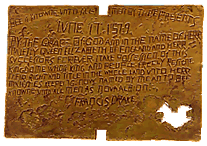
Drake’s Plate of Brass is one of the most audacious historical hoaxes ever pulled off on American soil. For four decades, it fooled professors, scientists, and institutions. It started as a prank among drinking buddies. It ended with one of California’s most respected historians completely humiliated. And the strangest part? The people who made it tried to confess , and nobody listened. This is the story of a fake artifact that took on a life of its own. It became more real than the men who created it ever intended. The deception stretched from a shipyard in San Francisco to the halls of the University of California. Along the way, it exposed just how badly people want to believe in something , even when the evidence screams otherwise.
The Legend Behind Drake’s Plate of Brass
In 1579, the English privateer Sir Francis Drake anchored somewhere along the Northern California coast. His chaplain, Francis Fletcher, recorded the moment in detail. Drake supposedly left behind a brass plate. It claimed the land for Queen Elizabeth I. It bore Drake’s name, the date, and a sixpence coin pressed into a hole.
That description sat in historical records for centuries. It became a kind of treasure hunt prompt. Historians obsessed over it. If someone could find that plate, it would be one of the greatest archaeological discoveries in American history.
Sir Francis Drake was already a legendary figure , pirate, explorer, and hero to the English Crown. The idea that physical proof of his California landing might still exist somewhere was irresistible. That irresistibility is exactly what the pranksters exploited.
One man in particular became obsessed. Herbert Eugene Bolton was a distinguished professor of California history. He was also director of the Bancroft Library at UC Berkeley. Bolton spent years urging his students to search for the plate. He told them to contact him immediately if they ever found anything matching Fletcher’s description. He practically wrote the instructions for his own humiliation.
The stage was set. All the conspirators needed was a piece of brass and a cold chisel.
How Drake’s Plate of Brass Was Built to Deceive
This event shares similarities with: Buytigers.com: The Internet Hoax That Fooled PETA and Exposed the Dark Side of Exotic Animal Trade
The hoax was born inside a rowdy fraternal organization called E Clampus Vitus , or ECV. This group had roots in the 1849 California Gold Rush. It was revived in the 1930s as a brotherhood of historians and Western lore enthusiasts. Their motto involved protecting widows and orphans, especially the widows. Pranks were a beloved tradition.
George Ezra Dane, an ECV leader, hatched the scheme. The target was Bolton , his fellow Clamper and colleague. The plan was simple. Create a fake brass plate. Plant it somewhere Bolton might find it. Watch him lose his mind with excitement.
George Haviland Barron designed the plate. He bought the brass from a nearby San Francisco shipyard. A worker there cut it with a modern guillotine shear , a fact that would later doom the hoax. George Clark, an inventor and art critic, hammered the letters into the surface using a basic cold chisel. He even added a hidden joke. The initials “C.G.” before Drake’s name stood for “Captain General” to historians. To Clark, they were his own secret signature.
As a final flourish, two other Clampers painted “ECV” on the back of the plate in paint only visible under ultraviolet light. It was a wink to fellow members. A confession hiding in plain sight.
The plate’s text matched Fletcher’s historical account almost perfectly. It read like something from the 16th century. The spelling was deliberately archaic. There was a hole cut for a sixpence coin. Everything looked right.
California historical records from the period show just how convincing the forgery appeared to contemporary eyes. The conspirators had done their homework.
Drake’s Plate of Brass Fools the Experts
The plate was likely planted in Marin County in 1933. But here’s where things went sideways. The intended victim , Bolton , didn’t find it. A random man named Beryle Shinn stumbled across it while picnicking. He thought it was junk. He tossed it in his car. He forgot about it for months.
Eventually, Shinn showed the plate to a friend. Word spread. The plate made its way to Bolton himself in 1936. And Bolton didn’t laugh. He didn’t recognize it as a prank. He declared it authentic. He went public with one of the most exciting historical announcements of the decade.
The academic world erupted. An early metallurgical study declared the brass genuine. Newspapers ran breathless headlines. Bolton gave lectures. The plate was treated as a national treasure. The Bancroft Library acquired it for display.
The ECV pranksters panicked. They tried to tell people the truth. Nobody believed them. Why would anyone believe a bunch of rowdy fraternity members over a distinguished professor and a scientific study?
The hoax had escaped. It had a life of its own now.
For forty years, the plate sat in the library. Respected. Celebrated. Completely fake.
Then, in the late 1970s, scientists ran a proper battery of physical and chemical tests. The results were damning. The brass was modern. The tool marks were modern. The cutting method matched 20th-century industrial equipment. Drake’s Plate of Brass was a fraud , and the evidence was now impossible to ignore.
The Joke That Destroyed a Legacy
The full story didn’t emerge until 2003. A team of four researchers , Edward Von der Porten, Raymond Aker, Robert W. Allen, and James M. Spitze , spent a decade piecing together the complete narrative. They published their findings in the journal California History in 2002.
Their conclusion was both funny and tragic. A group of history-loving drunks had pulled off a prank so good it rewrote American history for forty years. They had tried to confess. They had been ignored. And the man they targeted had staked his entire reputation on the fake.
Herbert Bolton died in 1953. He never knew the truth. He went to his grave believing the plate was real. That’s the part that lingers. The man who spent his career chasing authentic history became the greatest victim of fake history.
The plate still exists. The Bancroft Library at UC Berkeley still holds it , though now as a cautionary exhibit rather than a proud relic. It sits there as a monument to human gullibility. And to the terrifying power of wanting something to be true.
The ECV pranksters thought they were playing a harmless joke. Instead, they created a ghost , a fake artifact that haunted American historical scholarship for nearly half a century. Some hoaxes fool people for a week. This one fooled them for a generation. And the men responsible? They tried to tell the truth and were laughed out of the room.
Sometimes the strangest part of a hoax isn’t the lie. It’s how desperately people cling to it.
Related Posts
 The Calaveras Skull: California’s Greatest Archaeological Hoax and the Miners Who Fooled Harvard
 The Calaveras Skull: California’s Greatest Archaeological Hoax and the Miners Who Fooled Science
 Calaveras Skull: The Archaeological Hoax That Fooled Harvard Scientists
 Scarith of Scornello: The Twisted Forgery That Fooled Renaissance Europe