
The Ramensky Family Hoax is one of the most audacious cons in Soviet history. For over two decades, a single retired Communist Party activist rewrote Russian history , and almost nobody noticed. He forged documents. He invented ancestors. He fabricated connections to some of Russia’s most sacred cultural icons. And he did it all from his sickbed, playing the role of a dying old man to perfection. This is the story of Antonin Ramensky , a master manipulator who made fools of experts, journalists, and even foreign heads of state.
The Ramensky Family Hoax Begins: A Dying Man with a Dangerous Imagination
Antonin Ramensky was born in 1913. He came from a respectable family of country teachers in Russia. His great-uncle, Alexei Ramensky, had actually been a high-ranking education official in Imperial Russia. That part was true. But Antonin had a gift for taking small truths and spinning them into elaborate lies.
The key detail he exploited was this: in the early 1880s, his great-uncle briefly taught at a school in Simbirsk. That school also happened to educate a young boy named Vladimir Lenin. That connection , thin as a thread , became the foundation for everything that followed.
In 1961, Ramensky presented what he claimed were Lenin’s personal autographs to the 22nd Congress of the Communist Party of the Soviet Union. The forgeries were crude. But the Party officials endorsed them anyway. Soviet ideology had a way of overriding critical thinking. And just like that, Ramensky became famous.
He carefully crafted his public image. He presented himself as a bedridden invalid. Sometimes he appeared to be near death. Journalists from central and regional press outlets visited him regularly. They found a frail, patriotic old man with extraordinary stories. Nobody suspected they were being played.
You can read more about Soviet-era document forgery and historical manipulation at Wikipedia’s overview of historical revisionism, which provides useful context for how ideological systems enable such deceptions.
The Ramensky Family Hoax Grows: Pushkin, Dynasties, and Outright Lies
This event shares similarities with: Piltdown Man: The 41-Year Hoax That Fooled the Scientific World
Once Ramensky tasted success, he couldn’t stop. The lies snowballed fast.
He invented an entire “teachers’ dynasty” stretching back centuries. The Ramensky family, he claimed, had founded the first school in Mologino, in Tver Oblast. This fit perfectly with Soviet ideas about “labour dynasties” , families who dedicated generations to a single noble profession. It was ideologically irresistible.
Then he went even further. He forged autographs and drawings by Alexander Pushkin himself. Pushkin is essentially a god in Russian culture. Forging his work was extraordinarily bold. Ramensky claimed that Pushkin visited Mologino in 1829. He supposedly gave a book , a Russian translation of Walter Scott’s Ivanhoe , to one of Ramensky’s ancestors. The book was decorated with handwritten verse and drawings, all allegedly by Pushkin.
Here’s the truly unsettling part: leading Pushkin scholars accepted the forgeries as genuine. These were supposed experts. They published papers about these “new autographs.” The forgeries entered the academic record.
Ramensky didn’t stop at two centuries of invented history. He eventually pushed the dynasty back to the fifteenth century. His fictional ancestors began rubbing shoulders with dozens of famous historical figures , writers, artists, revolutionaries. Every major topic in Soviet propaganda somehow connected to the Ramensky family tree.
He rarely told the same backstory twice. His explanations were often outlandish. But in the Soviet context, ideological alignment mattered more than factual consistency.
The Ramensky Family Hoax Goes International
By 1968, the con had crossed borders. A prominent Soviet educator named Simon Soloveychik wrote a glowing article called “The House of Ramenskys.” It was published in Soviet Life magazine , the English-language propaganda publication aimed at Western readers. The hoax was now being exported abroad.
Ramensky also invented Bulgarian connections for his family. He claimed his surname had Bulgarian origins. Bulgarian journalists picked up the story enthusiastically. They promoted his fabrications without question.
The result was staggering. Ramensky exchanged gifts with Todor Zhivkov , the leader of Bulgaria. A retired Soviet pensioner, pretending to be bedridden, had maneuvered himself into correspondence with a foreign head of state. It’s the kind of story that sounds impossible. But it happened.
Ramensky died in 1985. He never faced exposure during his lifetime. The hoax he built survived him , at least briefly.
Shortly after his death, the most ambitious version of the family legend was published in Novy Mir, one of the Soviet Union’s most prestigious literary magazines. But this version was too ambitious. It was stuffed with anachronisms and absurd claims. Experts finally pushed back. By 1986, the hoax was officially debunked.
For a deeper look at how propaganda shaped Soviet cultural life, the digitized archives at Archive.org preserve issues of Soviet Life magazine from that era , the very publication that helped spread Ramensky’s lies internationally.
The Forgeries That Refused to Die
Here’s what makes this story truly strange. Debunking the hoax didn’t erase it.
Ramensky’s forged Pushkin autographs are still on display at the Alexander Pushkin Museum in Moscow. They sit there today, labeled as genuine artifacts. The museum hasn’t removed them.
In 1986 , the same year the hoax was exposed , a statue was unveiled in Tver Oblast. It depicts one of Ramensky’s invented ancestors, a man who never existed. The statue stands in front of a school. Children walk past it every day.
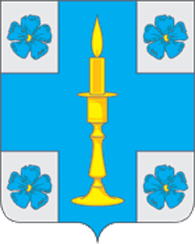
By the 2000s, the fictional Ramensky dynasty had worked its way into local heraldry. The made-up family became part of the official symbolic identity of a real place.
Regional media still quotes Ramensky’s fabrications as fact. The lie has become local legend. And local legend, once embedded in statues and coat of arms, is nearly impossible to dislodge.
This is the most chilling aspect of the entire affair. The truth came out. The forger was exposed. But the fiction proved more durable than the facts. A man who spent his life pretending to be dying managed to achieve a kind of immortality , not for himself, but for the fake family he invented.
The Ramensky Family Hoax stands as a masterclass in manipulation. It exploited ideology, emotion, and institutional laziness in equal measure. Ramensky understood that people believe what they want to believe. Give them a story that confirms their values, and they won’t look too closely at the evidence. That lesson feels uncomfortably relevant today. The legacy of Alexander Pushkin in Russian culture made his forged autographs almost impossible to question , because questioning them felt like an act of cultural heresy. And that, perhaps, was Ramensky’s darkest genius of all.
Related Posts
 Russian Sleep Experiment: The Terrifying Creepypasta That Fooled the World
 The Book of Veles: Ancient Sacred Text or Elaborate Slavic Forgery?
 School Shooting Hoax Conspiracy Theories: When False Flags Meet Real Terror
 Ursal: The Fake Socialist Conspiracy That Became Brazil’s Most Viral Political Hoax