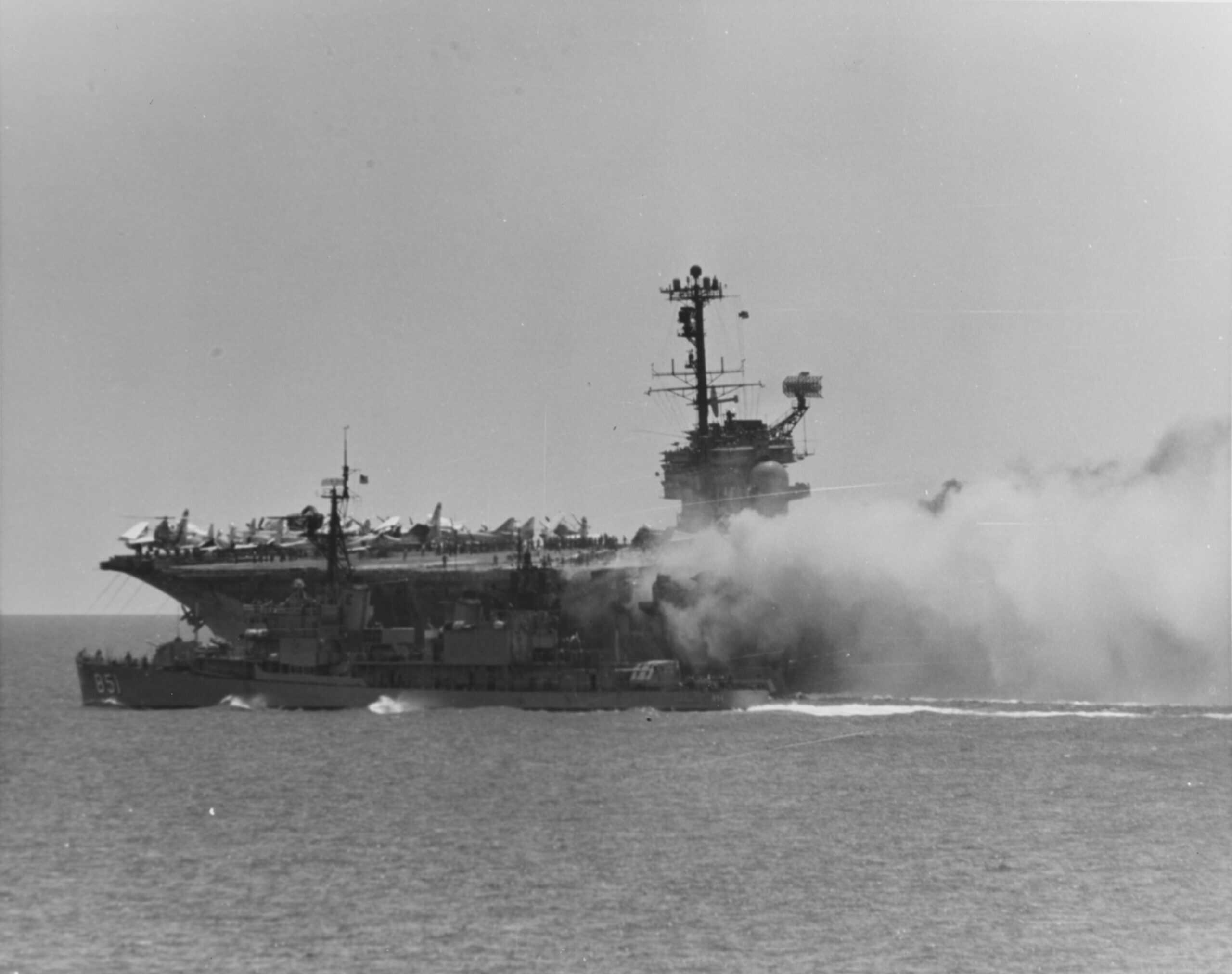
The 1967 USS Forrestal Fire remains one of the most catastrophic naval disasters in American history. It happened fast. Terrifyingly fast. One stray rocket fired by accident, and within seconds, a massive aircraft carrier became a floating inferno. The men aboard had no warning. They had no time. What followed was thirteen hours of chaos, heroism, and death that the Navy could never forget , and that survivors could never fully escape.
How the 1967 USS Forrestal Fire Started
It was July 29, 1967. The USS Forrestal sat in the Gulf of Tonkin, just off the coast of North Vietnam. The ship was four days into combat operations. Flight crews were preparing aircraft for the morning strike mission. The flight deck buzzed with activity , jets armed, fueled, and ready.
Then something went horribly wrong.
An electrical anomaly caused a Zuni rocket to fire accidentally from an F-4 Phantom. The rocket streaked across the crowded flight deck. It slammed directly into an A-4 Skyhawk loaded with fuel and bombs. The external fuel tank ruptured instantly. Jet fuel , hundreds of gallons of it , sprayed across the deck and ignited.
The fire spread in seconds.
What made it worse was the ordnance. The Navy had been running low on modern bombs during the Vietnam air campaign. They had resorted to using old World War II surplus bombs. These aging weapons were unstable. They weren’t designed for the heat of a jet fuel fire. Within 90 seconds, the first bomb cooked off. Then another. Then another.
According to historical records, the chain of explosions tore massive holes in the flight deck. Sailors standing near the aircraft were killed instantly. Others were blown into the sea. Some simply vanished.
The 1967 USS Forrestal Fire’s Eerie Human Stories
This event shares similarities with: USS Craven (TB-10): The Cursed Torpedo Boat That Met a Fiery End
The strange details from that day haunt historians and survivors alike.
Lieutenant Commander John McCain was sitting in his cockpit when the Zuni rocket fired. He scrambled out of his jet just moments before a bomb exploded directly beneath it. He ran through fire and shrapnel to escape. The future U.S. Senator later described the scene as pure chaos , men on fire, explosions everywhere, the deck shaking beneath his feet.
Chief Gerald Farrier ran toward the fire, not away from it. He was the commander of Damage Control Team 8. He carried a dry chemical extinguisher and tried to knock down the flames before the bombs cooked off. He knew the bombs were about to blow. He stayed anyway. He was killed when the first bomb exploded.
Farrier’s death became legendary. A firefighting school in Norfolk, Virginia was later named in his honor. His act of deliberate self-sacrifice , standing in front of a bomb he knew would kill him , is the kind of moment that doesn’t fit neatly into any official report.
Survivors described the flight deck as an apocalyptic scene. Men were on fire. Planes were exploding. Ammunition cooked off in all directions. Sailors dove overboard to escape. Some drowned. Others were rescued by escort ships. The smoke plume was visible for miles. A photograph taken from the USS Oriskany captured the enormous black column rising from the burning carrier.
The Haunting Aftermath of the 1967 USS Forrestal Fire
The final death toll was 134 sailors killed. Another 161 were injured. The ship lost 21 aircraft completely destroyed and 40 more damaged. Seven F-4B Phantoms, eleven A-4E Skyhawks, and three RA-5C Vigilantes were gone. Repair costs reached $72 million , not counting the aircraft.
The Forrestal limped to Subic Bay in the Philippines for emergency repairs. Then she crossed the Pacific to the shipyard in Norfolk. She sat in dry dock for five months.
Captain John K. Beling, the ship’s commanding officer, faced an investigation. The Navy ultimately absolved him of responsibility. No crew members were charged. The official conclusion pointed to the accidental Zuni rocket discharge, the unstable surplus ordnance, and inadequate firefighting procedures.
But the questions lingered. Why were those old, unstable bombs allowed on the flight deck? Why weren’t better safety protocols in place? The Navy had no good answers. What they did have was a determination to change.
Naval historical records show the disaster triggered sweeping reforms. The Navy completely overhauled its firefighting training. It modified weapon-handling procedures across the fleet. It installed deck wash-down systems on every carrier. These changes almost certainly saved lives in future incidents.
The Curse That Followed the Forrestal
The Forrestal’s story doesn’t end with the fire. The ship seemed to carry a dark shadow for the rest of her life.
Sailors who served aboard her in later years reported strange things. Unexplained sounds deep in the ship. Cold spots in compartments near where men had died. Some crew members claimed to hear voices or footsteps in empty corridors. Whether these reports reflect genuine paranormal activity or the psychological weight of serving on a ship where 134 men burned to death , that’s a question no one can answer cleanly.
The Forrestal was decommissioned in 1993. She sat in various ports for years, unwanted and deteriorating. Efforts to preserve her as a museum ship failed. In 2014, she was sold for one cent to a ship recycling company and scrapped. Even her end felt strange , a ship that had once been the pride of the Navy, the first purpose-built supercarrier America ever made, sold for a single penny.
The name “Forrestal” itself carries an eerie history. The ship was named after James Forrestal, the first U.S. Secretary of Defense. He died in 1949 under mysterious circumstances , an apparent suicide that some historians still debate. Newspapers from the time reported his death with shock and confusion. A ship named after a man who died under dark circumstances, later the site of one of the Navy’s worst peacetime disasters , it’s the kind of pattern that’s hard to ignore.
The 1967 USS Forrestal Fire changed how the Navy operates at sea. It forced hard lessons about safety, ordnance handling, and firefighting. But it also left behind something harder to measure , the weight of 134 lives lost in thirteen minutes of hell, on a ship that never quite shed its reputation for tragedy.