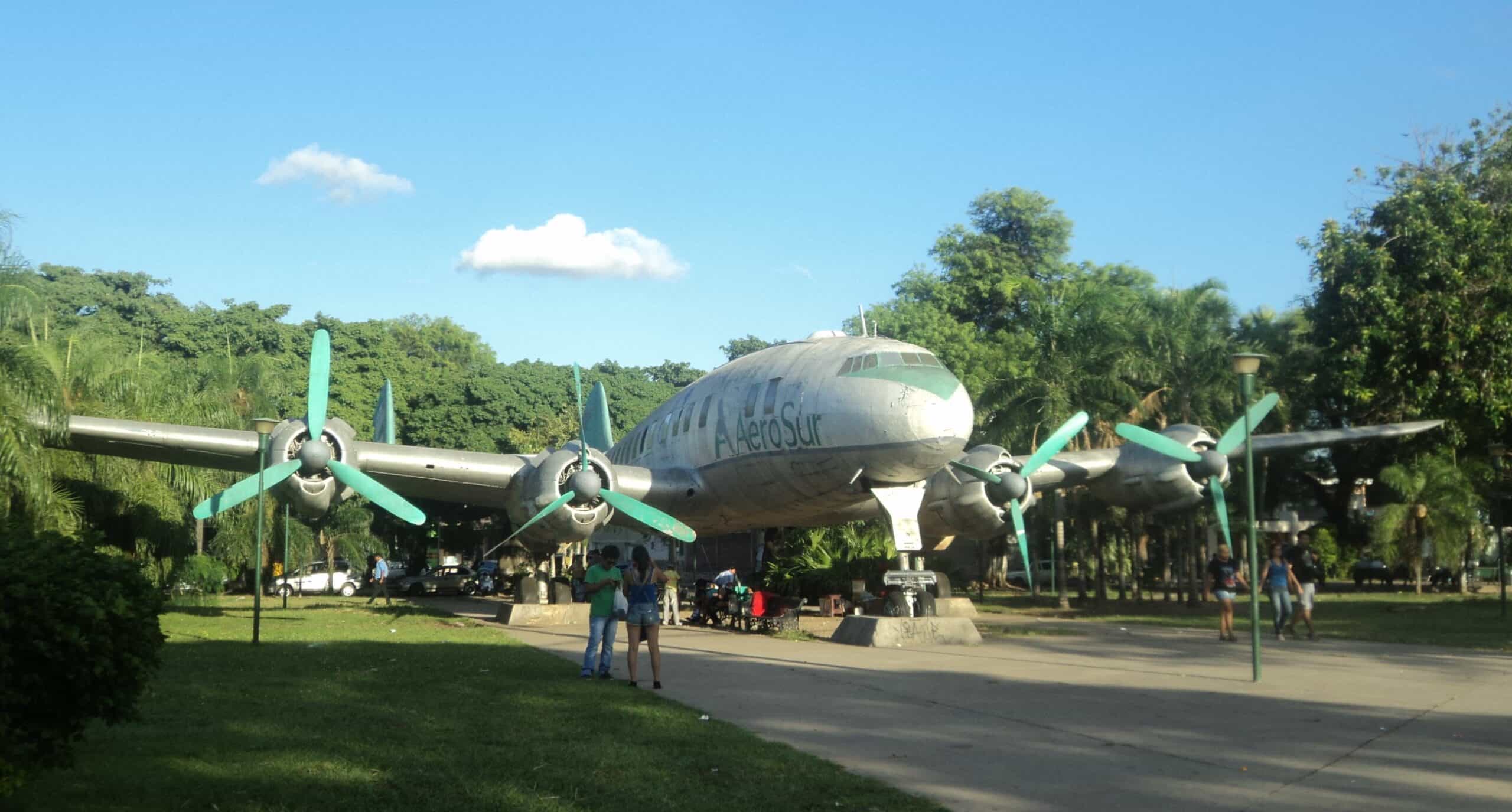
The Avion Pirata sits frozen in time in Santa Cruz, Bolivia, like a metallic specter from another era. This Lockheed Constellation became legendary not just for its mysterious cargo runs, but for the deadly chase that ended with blood in the sky. Local residents still whisper about the phantom flights that appeared without warning in the dead of night. The aircraft’s story reads like something from a supernatural thriller – complete with smuggled treasure, military pursuits, and a pilot’s tragic death that some say still haunts the skies above Bolivia.
Before its final, fatal flight, the Constellation had been conducting eerie nocturnal operations. Witnesses reported seeing the massive aircraft materialize out of darkness at El Trompillo Airport. No flight plans were filed. No official records existed. The plane would simply appear, unload its mysterious cargo, and vanish back into the night like a ghost ship of the airways. Locals began calling these phantom visits the work of the “airplane ghost” – a vessel that seemed to exist between worlds.
The cargo manifest read like a smuggler’s dream: cigarettes, whiskey, television sets, textiles, and contraband worth over a million dollars. But what truly chilled witnesses was the aircraft’s supernatural ability to evade detection. Night after night, it would slip through Bolivian airspace undetected, landing and departing without a trace. Some residents claimed they could hear the engines approaching long before the plane became visible, as if the sound itself was haunting the darkness.
The Avion Pirata’s Final Flight of Terror
On July 29, 1961, the phantom became flesh and blood reality. The Avion Pirata landed at El Trompillo Airport in broad daylight, breaking its pattern of nocturnal secrecy. Something had changed. The crew seemed nervous, agitated. They claimed to be conducting a “practice flight” – a lie that would soon turn deadly. When the aircraft departed on July 30th, it triggered a chain of events that would end in tragedy and create one of Bolivia’s most enduring mysteries.
The Bolivian Air Force scrambled P-51 Mustang fighters to intercept the rogue aircraft. What followed was a deadly aerial chase that played out like a scene from a war movie. The P-51 pilots repeatedly ordered the Constellation to land at Cochabamba, but the crew ignored every command. Desperation filled the radio waves as the chase intensified. The fighters opened fire, their bullets ripping through the night air toward the fleeing aircraft.
Captain Alberto Peredo Céspedes was pursuing the mysterious plane when disaster struck. In a final, desperate maneuver, the Constellation crew dove sharply, trying to shake their pursuers. The sudden movement caused Peredo’s P-51 to crash fatally. The captain died instantly, his aircraft becoming a twisted monument to the Avion Pirata’s deadly legacy. Some locals claim his spirit still patrols the skies, forever chasing the phantom plane that caused his death.
Supernatural Encounters with the Avion Pirata Crew
For more strange history, see: Charlie Charlie challenge
The five crew members arrested that day seemed to possess an almost supernatural ability to escape justice. Pilots William Roy Robinson and William Friedman, along with their companions, were charged with homicide, piracy, and contraband violations. But the legal system couldn’t contain them any more than the sky had. After being imprisoned at Panóptico de La Paz jail, three received provisional freedom while two were hospitalized under mysterious circumstances.
Then, like ghosts fading at dawn, they vanished. In November 1961, authorities announced that the entire crew had escaped Bolivia. They had simply disappeared, leaving behind only questions and a growing legend. The men were tried in absentia, with prosecutors seeking ten-year sentences for each. But the phantom crew never returned to face their earthly judgment.
Years later, investigators discovered that only pilot William Roy Robinson had died – in 2010 at age 90, buried in San Mateo, Florida. The other four crew members remained at large, their fates as mysterious as the flights they had conducted. Some theorists suggest they were protected by supernatural forces, while others believe they possessed insider knowledge that made them too dangerous to capture.
The crew’s escape added another layer to the Lockheed Constellation’s growing mystique. How had five men simply vanished from Bolivian custody? The official explanation involved American diplomatic intervention, but locals preferred more supernatural theories. They whispered that the crew had been spirited away by the same mysterious forces that had protected their phantom flights.
The Cursed Legacy of Bolivia’s Avion Pirata
The aircraft itself seemed cursed from the moment it touched Bolivian soil. Originally assigned to the Bolivian Air Force as compensation for the lost P-51, bureaucratic interference prevented this transfer. Instead, the plane became property of the Military Aviation College, beginning a series of ownership changes that would span decades. Each transition brought new problems, as if the aircraft carried a supernatural burden that no institution could bear.
In 1979, the Avion Pirata was moved to Boris Banzer Prada Park, where it was supposed to become a tourist attraction. Instead, it became a magnet for strange occurrences and social problems. The aircraft’s interior was invaded by drug addicts and criminals who used it as an impromptu shelter. Neighbors complained of eerie sounds emanating from the plane at night – sounds that some described as ghostly echoes of its smuggling days.
Local historian Ramiro Molina Alanes spent years researching the aircraft’s true story, separating fact from the growing mythology. His investigations revealed that much of what people believed about the plane was speculation and urban legend. Yet even his careful research couldn’t explain all the mysteries surrounding the aircraft. Why had it chosen Bolivia for its final flight? What forces had protected its crew during their escape?
The plane’s transformation from aircraft to urban legend reflects deeper questions about memory and mystery. Historical newspaper accounts from the period show how quickly fact blended with fiction in public consciousness. The Avion Pirata became whatever people needed it to be – symbol of defiance, reminder of corruption, or supernatural harbinger of change.
Modern Hauntings and Restoration Efforts
Recent restoration efforts have stirred up new supernatural activity around the aircraft. In 2022, 18-year-old Tomislav Viruez initiated a project to revitalize the Avion Pirata as a cultural landmark. But workers reported strange occurrences during renovation attempts. Tools would disappear overnight. Equipment would malfunction without explanation. Some claimed to hear voices speaking in English from inside the empty fuselage.
The municipal government has repeatedly tried to transform the aircraft into a proper tourist attraction, but each effort faces mysterious obstacles. Paint jobs fade unnaturally quickly. Security systems fail without cause. Visitors report feeling watched while exploring the plane’s exterior. These incidents have only added to the aircraft’s reputation as a cursed object that resists all attempts at domestication.
Local officials now speak carefully about the restoration project, avoiding direct references to the supernatural elements that seem to plague their efforts. Yet the problems persist, as if the Avion Pirata itself is fighting against being transformed from mystery into mere historical artifact. The plane appears determined to maintain its ghostly status, forever suspended between past and present.
The aircraft’s current condition reflects this supernatural resistance. Despite multiple restoration attempts, it continues to deteriorate in ways that defy normal explanations. Metal corrodes in patterns that spell out phantom words. Windows fog with moisture that forms ghostly faces. The Avion Pirata seems to be slowly dissolving back into the realm of legend from which it emerged.
Today, the Avion Pirata remains one of Bolivia’s most enduring mysteries – a physical monument to questions that may never be answered. Its presence in Boris Banzer Prada Park serves as a constant reminder that some secrets are too powerful to remain buried. The phantom flights may have ended in 1961, but the legend continues to soar through Bolivian consciousness, forever chased by the ghost of Captain Peredo and forever carrying its cargo of unanswered questions into the infinite mystery of the night sky.