
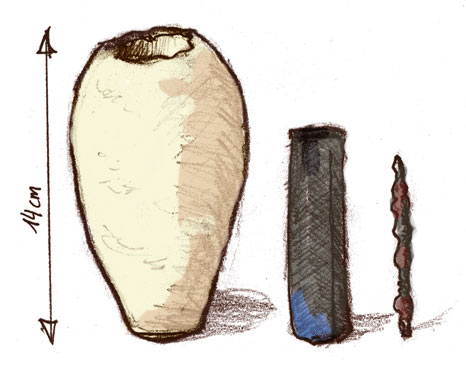
The Baghdad Battery is one of archaeology’s most unsettling puzzles. Dug up from the Iraqi desert in 1936, this strange little clay pot holds secrets that scientists still can’t fully explain. Was it a primitive electric cell? A container for dark magic? Or something else entirely? Whatever it was, it has haunted researchers for nearly a century , and its current location is completely unknown.
What Is the Baghdad Battery and Why Does It Matter?
The Baghdad Battery was unearthed near Khujut Rabu, Iraq, close to the ancient city of Ctesiphon. That city served as the capital of both the Parthian and Sasanian empires. The artifact itself looks simple enough. It’s a yellow clay pot, roughly 15 centimeters tall, with its neck removed. Inside sits a copper cylinder. Inside that cylinder? An iron rod. The whole thing is sealed together with bitumen , ancient asphalt.
Wilhelm König made the discovery famous. He was the director of the laboratory at the National Museum of Iraq at the time. His claim was explosive. He suggested the device could function as a galvanic cell , basically, a primitive battery. Fill it with an acidic liquid like vinegar or grape juice, and you’d generate a small electrical current.
That idea lit up the scientific world. Replicas were built. Tests were run. And yes , they produced electricity. Researchers generated between 0.8 and 2 volts using similar constructions. That’s not much. But it’s real.
Wikipedia’s overview of the Baghdad Battery documents these experiments in detail, including multiple attempts to replicate the electrical output.
König believed the device might have been used for electroplating , coating metal objects with a thin layer of gold or silver using electric current. It was a stunning idea. No electroplated artifacts from this period have ever been confirmed. But the theory refuses to die.
The Baghdad Battery’s Dark Alternative: Magic and Curses
For more strange history, see: Shapira Scroll: The Mysterious Biblical Manuscript That Drove a Man to Suicide
Here’s where things get genuinely creepy. Not everyone thinks this artifact was about electricity. Some researchers believe these vessels had a far darker purpose.
Similar clay jars were found at Seleucia in 1930. Four were excavated under archaeologist Leroy Waterman from the University of Michigan. Three were lying on their sides, pinned down by iron and bronze rods driven into the ground. Each contained a sealed bronze cylinder packed with plant matter , decomposed fibers, papyrus rolls, strange organic material.
Think about that image. Vessels pinned to the earth. Sealed tight. Filled with rotting organic matter. This isn’t a description of a power plant. It sounds like something ritual. Something meant to trap or contain.
Archaeologists have suggested these jars may have held magic spells. Written curses. Protective charms. The practice of burying written spells in sealed containers was common in the ancient world. Curse tablets have been found across the Roman and Parthian worlds , inscribed on lead, rolled up, and buried to invoke supernatural harm on enemies.
The British Museum’s collection of ancient curse tablets shows just how widespread this practice was across the ancient Near East. St. John Simpson of the British Museum’s Near Eastern department noted that the original excavation records for the Baghdad Battery were poorly kept. The dating evidence is weak. The pottery style actually points to the Sasanian period, not the earlier Parthian era.
So we don’t even know for certain when this thing was made.
The Baghdad Battery Goes Missing After the Iraq War
The story gets even stranger in 2003. When the United States-led invasion of Iraq began, the National Museum of Iraq in Baghdad was looted. Thousands of artifacts vanished. And the Baghdad Battery? Gone. Its current whereabouts are completely unknown.
An artifact already shrouded in mystery simply disappeared from history. No one knows if it was stolen, destroyed, or hidden away somewhere. The loss was catastrophic for researchers who wanted to conduct modern analysis on the original object.
Modern technology could tell us so much. Neutron activation analysis could identify trace elements in the copper. Advanced imaging could reveal internal structures we’ve never seen. But without the original artifact, we’re left working from old descriptions and replicas.
The disappearance adds another layer of unease to an already strange story. An object that may have generated electricity , or trapped ancient curses , vanished during one of the most chaotic moments in modern Middle Eastern history.
Ten similar vessels had been found in the region before the famous discovery. Some had iron nails. Some had lead plates. Some had bronze wrappers around decomposed organic material. None of them have been satisfactorily explained. The pattern is consistent enough to suggest a deliberate practice. But what practice? Nobody agrees.
Ancient Electricity or Ancient Deception?
The mainstream archaeological community is skeptical. Most archaeologists flatly reject the battery theory. No electroplated objects from the Parthian or Sasanian periods have ever been confirmed. The technology to use electricity for plating would require more than just a small clay pot. You’d need wires, knowledge of conductivity, and a systematic approach that leaves traces in the historical record.
None of those traces exist.
But the mystery persists because the replicas work. You can build one of these things today, fill it with lemon juice, and measure a current. That’s not nothing. It means the design is capable of generating electricity , whether or not ancient people knew that.
Historical science archives continue to document debates about ancient technological knowledge and what civilizations may have understood about natural phenomena long before modern science formalized those concepts.
Some theorists go further , much further. They invoke lost civilizations, suppressed history, and ancient knowledge deliberately erased. These ideas aren’t supported by evidence. But they’re hard to kill entirely when the artifact itself remains so stubbornly unexplained.
The truth is we simply don’t know what the Baghdad Battery was for. It might be the world’s oldest electrochemical cell. It might be a jar full of cursed papyrus meant to destroy an enemy. It might be something else entirely , something we haven’t even imagined yet.
What we do know is this: a 2,000-year-old clay pot from the Iraqi desert has outlasted empires, survived wars, and stumped generations of scientists. And now it’s gone , lost somewhere in the chaos of modern history, still keeping its secrets.
Related Posts
 Tarim Basin Mummies: Ancient Secrets and Bizarre Burial Rituals in China’s Desert
 Derinkuyu Underground City: Turkey’s Mysterious 18-Level Subterranean Labyrinth
 The Antikythera Mechanism: Ancient Greece’s Impossible Computer from the Deep
 Anita Anomalous Events: The Signals From Antarctica That Shouldn’t Exist