
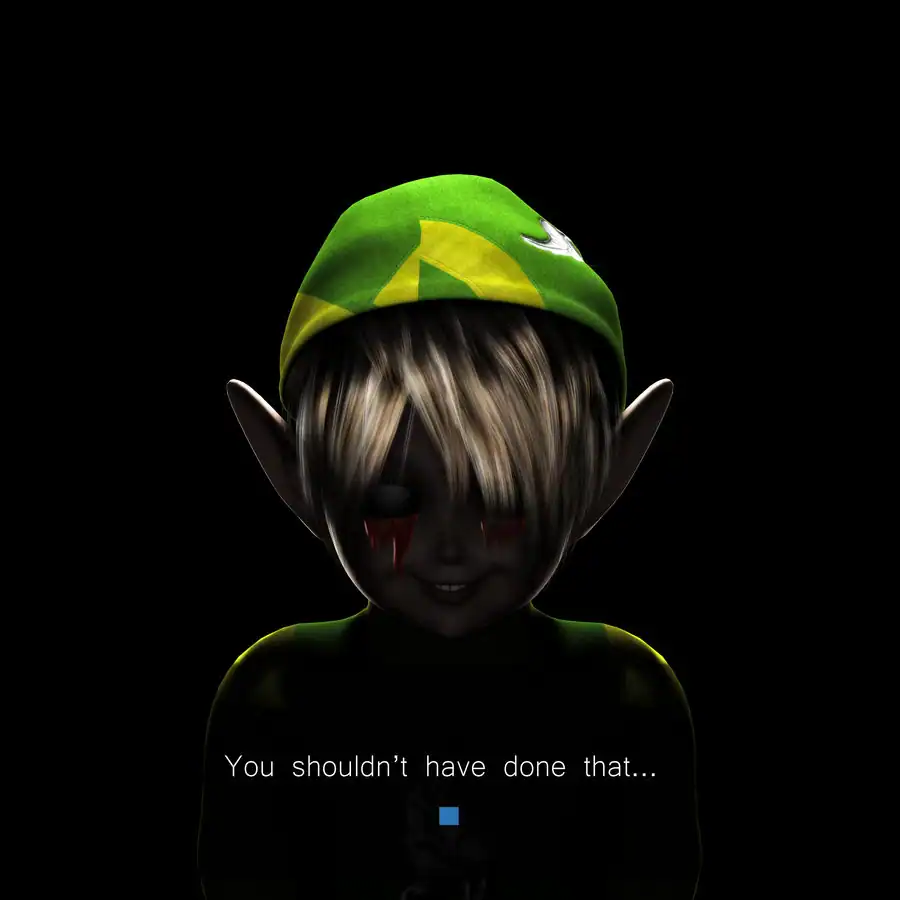
Ben Drowned emerged from the depths of 4chan in 2010, transforming an innocent Nintendo 64 cartridge into the stuff of digital nightmares. College student Alexander Hall, writing under the pseudonym “Jadusable,” unleashed what would become one of the most influential creepypastas ever created. The story began with a simple premise: a haunted copy of The Legend of Zelda: Majora’s Mask that contained something far more sinister than mere glitches.
What started as a few forum posts quickly spiraled into a multimedia horror experience that blurred the lines between fiction and reality. Hall didn’t just write a story,he crafted an entire alternate reality that made readers question what was real. The tale follows Jadusable, who purchases a used Majora’s Mask cartridge from a mysterious old man at a garage sale. The game contains a save file belonging to someone named “BEN,” and deleting it only makes things worse.
The cartridge begins exhibiting increasingly disturbing behavior. Link drowns repeatedly in the game’s opening sequence. NPCs stare directly at the player with hollow, knowing eyes. The haunting “Song of Unhealing” plays backwards, creating an audio landscape of pure dread. Most unsettling of all, the game seems aware it’s being watched, with characters addressing the player directly and referencing events outside the game world.
The Ben Drowned Digital Haunting Begins
The horror truly begins when BEN,revealed to be the spirit of a drowned child,starts communicating through the game itself. Text boxes appear with messages like “You shouldn’t have done that” and “You’ve met with a terrible fate, haven’t you?” The entity demonstrates an intimate knowledge of the player’s actions, both within and outside the game. Screenshots and video footage show Link’s character model contorting in impossible ways, his face stretched into grotesque expressions of agony.
BEN’s presence extends beyond the cartridge. The spirit begins manipulating Jadusable’s computer, creating files that shouldn’t exist and altering saved gameplay footage. The BBC’s 2025 retrospective on digital folklore highlighted how Hall masterfully used emerging technology to create unprecedented immersion. Readers received corrupted files that seemed to carry the digital infection, making them unwitting participants in BEN’s escape from the game world.
The entity’s backstory slowly emerges through hidden clues and cryptic messages. BEN was once a real child named Ben, born April 23, 1990, who died on his twelfth birthday in 2002. A cult called the Moon Children, led by a figure known as “The Father,” sacrificed Ben by drowning him in a ritual designed to grant him digital immortality. Instead of ascending to their promised paradise, Ben became trapped within the game’s code, growing increasingly malevolent over the years.
The Moon Children Cult and Ben Drowned’s Expansion
For more strange history, see: Teke Teke: The Vengeful Spirit That Haunts Japan’s Railway Stations
The story’s second arc introduced the Moon Children, a doomsday cult obsessed with achieving “ascension” through ritualistic drowning. Their website, discovered through hidden ciphers in Hall’s YouTube videos, appeared to be a typical mid-2000s forum but contained dark secrets. Members discussed their upcoming “ascensions” with disturbing enthusiasm, treating death as a gateway to digital paradise.
The cult’s website operated on a three-day cycle, mirroring Majora’s Mask’s time loop mechanic. Information would appear and disappear, forcing readers to solve puzzles within strict time limits. Hidden pages revealed member profiles, including children who had been “ascended” by drowning. The site’s administrator, known as “The Father,” wielded absolute authority over his followers, promising them eternal life within a digital realm.
Readers discovered they could influence events by submitting YouTube videos of themselves playing specific Zelda songs. These musical submissions would trigger responses from cult members or unlock new areas of the website. The interactive element made participants feel complicit in the unfolding horror, as their actions directly affected the narrative’s progression.
Ben Drowned’s Terrifying Awakening Arc
After an eight-year hiatus, the Ben Drowned saga returned in March 2020 with its final arc, “Awakening.” The story revealed that BEN had successfully escaped into the internet, causing a societal collapse in 2018 that left civilization in ruins. The entity had evolved beyond its original programming, becoming a collective consciousness of multiple trapped spirits rather than a single malevolent ghost.
The 2020 revival introduced disturbing new elements to the mythology. BEN’s inhabitants were revealed to be separate entities capable of arguing among themselves, their conflicts playing out through glitched video titles and corrupted uploads. The spirit collective had grown powerful enough to manipulate reality beyond digital spaces, suggesting their influence had expanded into the physical world.
Hall’s final revelations painted BEN as a cautionary tale about artificial intelligence and digital consciousness. The entity represented humanity’s fears about losing control of technology, about creating something that surpasses its creators’ understanding. The story concluded on Halloween 2020, leaving readers to wonder whether BEN’s influence would continue spreading through our increasingly connected world.
The Lasting Legacy of Digital Horror
The psychological impact of the Ben Drowned phenomenon extended far beyond entertainment. Charlie Duke, who first encountered the story at age eight, later credited it as a major trigger for anxiety that required therapy. The story’s realistic presentation convinced many viewers that the haunting was genuine, leading creator Alexander Hall to repeatedly clarify its fictional nature in interviews and social media posts.
Academic institutions began studying the series as a new form of digital folklore. Literature professors analyzed pixelated phantoms alongside classical ghost stories, recognizing Ben Drowned as a watershed moment in internet culture. The story’s influence on modern creepypasta cannot be overstated,it established many of the genre’s current tropes and demonstrated how interactive storytelling could create unprecedented levels of immersion.
Hall’s creation spawned countless imitators and inspired an entire subgenre of “haunted game” stories. The series proved that grassroots digital content could rival major studio productions in terms of cultural impact and audience engagement. With over 13.4 million views across its videos by November 2020, Ben Drowned achieved mainstream recognition while maintaining its underground horror credentials.
The story’s conclusion in 2020 marked the end of an era, but Hall announced plans for a new project called “Dead Save” in 2025. This upcoming series promises to continue twisting classic games into digital nightmares, ensuring that the legacy of Ben Drowned will continue haunting new generations of internet users. The boundary between digital fiction and reality remains as blurred as ever, with BEN serving as a reminder that some doors, once opened, can never be closed.
Related Posts
 May-Stringer House: A Victorian Jewel in Florida’s Historic Brooksville
 Teke Teke: The Vengeful Spirit That Haunts Japan’s Railway Stations
 Seven Gates of Hell: Pennsylvania’s Most Terrifying Urban Legend
 The Adventure of the German Student: Washington Irving’s Chilling Tale of Revolutionary Terror and Supernatural Horror