
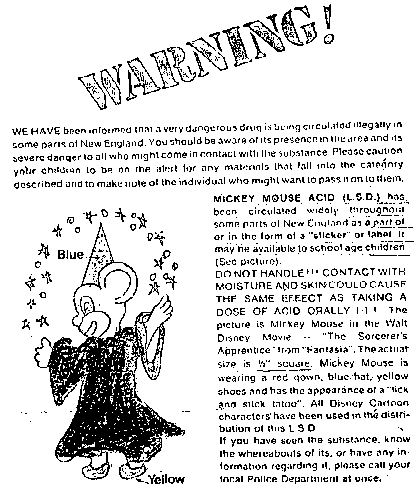
The Blue Star Tattoo Legend stands as one of America’s most persistent urban legends. This terrifying tale claimed that drug dealers were distributing temporary tattoos soaked in LSD to unsuspecting children. The story spread like wildfire through schools, parent groups, and communities across the globe. Despite decades of investigation, no documented case has ever been found.
The legend typically described colorful temporary tattoos featuring blue stars or popular cartoon characters. Parents received warnings claiming these innocent-looking transfers contained dangerous hallucinogenic drugs. The supposed goal was to get children addicted to LSD through skin contact or accidental ingestion. Fear gripped communities as the story spread through photocopied flyers and later through internet chains.
Origins of the Blue Star Tattoo Legend
The Blue Star Tattoo Legend likely emerged in the late 1970s during America’s growing war on drugs. Jack McCormick, a former FBI agent who became Ohio’s Bureau of Criminal Investigation superintendent, inadvertently became the “unwilling father” of this urban legend. When journalists pressed him for details about drug threats to children, his comments gave unintended credibility to circulating rumors.
The story gained momentum from a kernel of truth. LSD dealers did sometimes sell their product on decorated blotter paper featuring cartoon characters and colorful designs. However, these adult-targeted products bore no resemblance to children’s temporary tattoos. The leap from legitimate drug paraphernalia to supposed child-targeting schemes created the perfect storm for mass hysteria.
Early versions of the warning letters claimed endorsement from respected hospitals and government officials. The Danbury Hospital found itself flooded with calls every year since 1992, despite never employing anyone connected to the warnings. These false attributions gave the legend an air of official authority that fueled its spread.
How the Blue Star Tattoo Legend Spread Worldwide
Related article: Crystal Skull: The Victorian Hoax That Fooled Museums and Spawned Supernatural Legends
The legend’s propagation followed classic urban legend patterns. Concerned school officials distributed photocopied warnings to parents throughout the 1980s and 1990s. These flyers, often generations removed from their original source, contained increasingly dramatic language about the supposed threat to children.
As internet usage expanded, the Blue Star Tattoo Legend found new life in email chains and early social media posts. The story adapted to local contexts as it spread internationally. Hungarian versions featured different cartoon characters, while Swedish iterations described red pyramid designs instead of blue stars.
Law enforcement agencies worldwide found themselves repeatedly debunking the same false claims. The Metropolitan Police in the UK maintains a webpage stating clearly that no incidents involving LSD-laced tattoos have ever been recorded. Despite official denials, the legend persisted across multiple countries and cultures.
Scientific Debunking of the Blue Star Tattoo Legend Claims
Medical experts quickly identified fatal flaws in the Blue Star Tattoo Legend’s premise. LSD cannot penetrate intact skin in quantities sufficient to cause psychedelic effects. The drug requires direct ingestion or absorption through mucous membranes to produce its characteristic hallucinations.
Even if children licked the supposed tattoos before application, the amount of LSD that could be absorbed through such contact would be minimal. The legend’s claims about instant addiction also contradicted established medical knowledge. LSD does not create physical dependence like other controlled substances.
Drug enforcement agencies noted the economic impossibility of the scheme. LSD costs far more than temporary tattoos, making such distribution financially senseless for dealers. The extensive newspaper coverage from the 1980s and 1990s documented hundreds of investigations that found no evidence supporting the legend’s claims.
The Legend’s Lasting Cultural Impact
Despite thorough scientific debunking, the Blue Star Tattoo Legend continues to surface periodically. Modern versions often coincide with Halloween, when children’s interaction with strangers already heightens parental anxiety. The story has become a case study in how moral panics spread through institutional endorsement and media amplification.
Urban legend specialist Jan Harold Brunvand identified this as “the urban legend that has proved most difficult to debunk of all.” Its persistence demonstrates how fear for children’s safety can override logical analysis. The legend also reflects broader societal anxieties about drug culture and threats to childhood innocence.
Contemporary artists have drawn inspiration from the phenomenon. Patrick Turk created a series exploring how the Blue Star Tattoo Legend captured 1990s paranoia about hidden dangers in everyday objects. The story’s cultural footprint extends far beyond its original false premise, becoming a symbol of mass hysteria in the digital age.
The Blue Star Tattoo Legend serves as a powerful reminder of how quickly misinformation can spread when it taps into primal fears. Parents’ natural desire to protect their children created the perfect conditions for this unfounded scare to persist across decades and continents. While no child was ever harmed by LSD-laced tattoos, the legend itself caused real distress to countless families worldwide.
Related Posts
 Iron Maiden: The Medieval Torture Device That Never Existed
 Buytigers.com: The Internet Hoax That Fooled PETA and Exposed the Dark Side of Exotic Animal Trade
 Japanese Paleolithic Hoax: The Divine Hand That Fooled a Nation for Decades
 Biblical Conspiracy Theory: The Hidden Truth About Sacred Texts and Secret Societies